A fully developed, swirl-free velocity profile is the physiological requirement for accurate Venturi meter readings. In fluid mechanics educational pilot plants, a straight pipe run of 5 to 10 diameters upstream of the meter is essential to damp out disturbances from elbows, valves, or reducers and allow the flow to re-establish a predictable, axisymmetric velocity distribution before entering the convergent section. In a compact laboratory-scale unit where such lengths are physically impossible, flow straighteners—carefully positioned sets of vanes or honeycomb cells—can collapse the swirling eddies and dramatically reduce the required settling distance to as little as 2 to 3 diameters without sacrificing meaningful measurement accuracy.
If space is tight, you can’t simply shorten the pipe and hope for the best. The solution lies in actively breaking up large-scale vortices with a flow straightener, restoring the measurement integrity while preserving the unit’s compact footprint.
Why a Straight Pipe Run is Non‑Negotiable for Venturi Accuracy
The Physics of a Stable Velocity Profile
The pressure differential across a Venturi meter is not an absolute measure of flow rate; it is interpreted through Bernoulli’s principle and a discharge coefficient ( C_d ). That coefficient assumes a fully developed, axisymmetric velocity profile at the meter inlet—a profile where the fluid’s speed varies only with the radial distance from the pipe center and does not have any tangential (swirling) component. When the fluid enters the meter in this condition, the relationship between the measured pressure drop and the true volumetric flow rate is stable, predictable, and close to the theoretical ideal (with ( C_d ) typically 0.97–0.99).
How Upstream Disturbances Corrupt Your Measurement
Any upstream fitting—a bend, a partially open valve, or a tee—distorts the velocity field by introducing secondary flows, asymmetry, and large‑scale swirl. These residual anomalies do not decay quickly. A swirling core, for example, imparts a tangential velocity component that artificially lowers the throat pressure, making the meter register a higher flow rate than actually passes. Because the swirl pattern cannot be assumed to be the same under all flow conditions, the error becomes non‑reproducible, rendering careful calibration exercises—so central to an educational pilot plant—pointless.
The 5‑to‑10 Diameter Rule—and When It’s Not Enough
Classic installation guidelines call for a straight settling length of 5 to 10 pipe diameters upstream of a Venturi meter. This allows the natural viscous dissipation and pipe‑wall friction to restore a symmetric profile after a mild disturbance. However, the primary reference highlights a critical exception: if the upstream section contains two short‑radius elbows in perpendicular planes, the resulting compound vortex can persist for more than 30 diameters. In such a case, no amount of straight pipe in a benchtop trainer will ever return the flow to a swirl‑free state.
Solving Space Constraints in Laboratory‑Scale Units
The Role of Flow Straighteners
When the laboratory bench cannot accommodate the necessary settling length, the engineering answer is to actively destroy the swirl. A flow straightener—a rigid structure inserted into the pipe—does exactly that by shearing the large‑scale eddies into many small, rapidly decaying ones. The most common types are honeycomb arrays (hexagonal cells with high length‑to‑diameter ratio) and tube‑bundle straighteners, which offer a high cell density to break up tangential momentum.
How Vanes Break Up Swirling Vortices
A straightener works by dividing the flow cross‑section into numerous narrow channels. Each channel suppresses tangential velocity because the fluid’s rotational inertia is intercepted by the channel walls. The length of the individual cells (typically 5–10 times their own hydraulic diameter) is sufficient to eliminate swirl locally. As the fluid exits the straightener, the small‑scale eddies that remain dissipate within a few pipe diameters, allowing a stable profile to form rapidly. In compact educational units, placing a well‑designed honeycomb straightener 2–3 pipe diameters upstream of the Venturi can reduce the upstream straight‑pipe requirement to zero for all practical purposes, even after severe upstream disturbances.
Understanding the Trade‑offs
Pressure Drop Penalty
Flow straighteners are not transparent to the fluid; they add permanent pressure loss that reduces the overall system head. In a small‑scale plant running with a low‑power pump, every millimeter of additional head loss matters. Honeycomb straighteners typically introduce less loss than tube‑bundle designs, but the trade‑off between swirl suppression and pressure drop must be evaluated experimentally for your specific geometry.
Maintenance and Clogging Risks
In a teaching laboratory, the straightener becomes a collection point for debris, scale, or particles present in the working fluid. Even a partial blockage disturbs the velocity profile downstream, reintroducing the very problem it was meant to solve. Over time, surface roughening or deposits inside the Venturi and straightener can shift the discharge coefficient by 1–2%, making regular cleaning and recalibration a necessary part of the operational routine.
A hidden upside for education: the straightener’s presence gives students a tangible, inspectable component that makes the abstract concept of “swirl elimination” physically visible. It transforms a plumbing detail into a teachable moment.
Making the Right Choice for Your Educational Pilot Plant
Every kilometer of textbook theory demands a centimeter of bench space. You can design your apparatus to meet both physics and footprint limits by aligning the solution with your primary learning objective.
- If your primary focus is pristine measurement accuracy: Whenever possible, design the piping to incorporate a straight run of 10 diameters without a straightener, followed by a calibration run to determine the discharge coefficient across the Reynolds number range of interest.
- If your primary focus is maintaining a compact, benchtop footprint: Integrate a high‑cell‑density honeycomb straightener 2–3 diameters upstream of the Venturi, and accept the small pressure‑drop penalty in exchange for swirl‑free, repeatable measurements well within the 1‑2% accuracy band typical of educational devices.
- If your primary focus is teaching the consequence of flow disturbances: Build the unit with a removable straightener and quick‑connect upstream spools that include intentional disturbance elements (elbows, tees). Let students experimentally witness how the discharge coefficient drifts when the same meter is used without proper flow conditioning, reinforcing the lesson through direct observation.
- If your primary focus is long‑term reliability with minimal maintenance: Select a straightener geometry that is easy to remove for cleaning, use a transparent pipe section to visually inspect debris accumulation, and schedule semester‑based recalibration to track the inevitable wear‑induced shift in the Venturi coefficient.
In a laboratory‑scale fluid mechanics trainer, the ideal straight‑run length is never a fixed number—it is the shortest distance that, with or without a straightener, delivers the stable, swirl‑free profile that makes the Venturi meter a transparent window into the elegance of energy conservation.
Summary Table:
| Feature / Parameter | Standard Straight Pipe Run | Flow Straightener Solution |
|---|---|---|
| Required Upstream Length | 5 to 10 pipe diameters (up to 30+) | 2 to 3 pipe diameters |
| Primary Mechanism | Natural viscous dissipation of swirl | Active destruction of vortices via honeycomb/vanes |
| Pressure Drop Penalty | Minimal / None | Moderate (additional system head loss) |
| Maintenance Needs | Low | Regular cleaning/recalibration to avoid clogging |
| Best For | High accuracy with ample bench space | Compact, space-constrained laboratory units |
Optimize Your Fluid Mechanics Lab Design with LABPARK
Building a high-performing fluid mechanics lab requires balancing precise measurement accuracy with limited bench space. LABPARK designs and manufactures state-of-the-art Educational and Vocational Unit Operations Pilot Plants in chemical engineering, bioprocess & biotech, and environmental & water treatment.
Whether you represent a university, research institute, or enterprise, our systems integrate smart space-saving features—like optimized flow straighteners—to ensure accurate, repeatable learning outcomes without sacrificing floor space.
Contact LABPARK today to customize a pilot plant tailored to your curriculum and space requirements!
Related Products
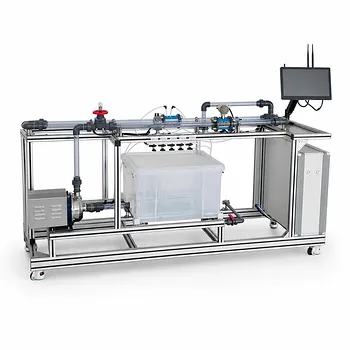
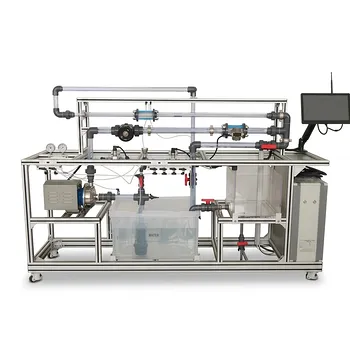
- Orifice and Venturi Flowmeter Calibration Educational Pilot Plant for Fluid Mechanics Laboratory
- Centrifugal Pump Performance and Orifice Flowmeter Calibration Educational Pilot Plant
- Cavitation Phenomenon Demonstration and Analysis Educational Unit Operations Pilot Plant
- Quantitative Dosing and Liquid Flow Control Educational Unit Operations Pilot Plant
People Also Ask
- What is the difference between static and stagnation pressure? Master Pilot Plant Flow Measurement
- How do pilot plants demonstrate siphon pressure variations? Visualizing Bernoulli's Energy Balance
- How do fluid mechanics training pilot plants facilitate the visualization and calculation of laminar and turbulent flows?
- How to update chemometric calibration models in pilot plants? Best practices for process engineers.
- Why are the laws of similitude critical in fluid flow pilot plants? Scale Up Safely