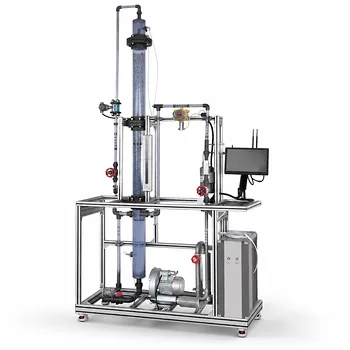
Liquid distributors are not just accessories; they are the primary determinants of a packed column's function. They are critical because they control the initial and ongoing uniformity of liquid-gas contact, which directly dictates mass transfer and separation efficiency. A column without proper initial distribution and intermediate redistribution will suffer from channeling and wall flow, collapsing its performance. The notorious column "scale-up effect"—where a larger industrial column fails to match the efficiency of its pilot-scale counterpart—is fundamentally a problem of achieving and maintaining that uniform distribution across a larger cross-section, not an inherent property of increased height or diameter.
The core insight: if perfect liquid-gas distribution is achieved and sustained through the entire bed, column efficiency is independent of tower height or diameter. The scale-up effect is, therefore, a distribution challenge in disguise. By mastering distributor and redistributor design, you directly solve the scale-up problem, turning a theoretical risk into a reproducible engineering outcome.
The Fundamental Role of Liquid Distribution in Packed Columns
Why Uniform Initial Distribution Is Non-Negotiable
Mass transfer in a packed column depends entirely on the intimate contact between gas and liquid phases. If the liquid is not spread uniformly over the top of the packing at the very start, some areas will be starved of liquid while others are flooded.
This maldistribution creates preferential gas paths, or channeling, which dramatically reduces the effective interfacial area. Consequently, the column’s separation power drops, and product purity or recovery suffers. Poor initial distribution discards the efficiency you paid for in the packing itself.
How Height Degrades Liquid Distribution
Even if the initial distribution is perfect, the liquid's flow pattern naturally deteriorates as it travels down the bed. The liquid phase tends to migrate toward the column wall, a phenomenon known as the wall effect.
This migration drains liquid away from the central packing regions, creating a core-starved, ring-rich distribution profile. The longer the uninterrupted packing bed, the more severe this maldistribution becomes.
The Hard Limits: When You Must Use a Redistributor
The degradation is not linear; it reaches a point where efficiency falls off a cliff. As a firm rule, you must segment the bed with a liquid redistributor when the packing height exceeds 9 meters or when a single bed would span more than 20 theoretical stages.
This isn't an optional preference. Ignoring these limits guarantees a column that operates well below its design capability, rendering the extra packing height functionally useless beyond the maldistribution threshold.
The Redistributor's Core Function: Resetting the System
A redistributor acts as a "reset" button for liquid flow. It mechanically collects all the liquid, critically including the portion that has migrated to the wall.
It then blends and re-dispenses this collected liquid evenly over the full cross-section of the packing layer directly below. This segmentation ensures each packed bed begins its job with a near-ideal distribution, restoring optimal mass transfer performance for that section.
The Scale-Up Effect: A Distribution Problem Disguised by Size
Debunking the Myth of an Inherent Height Penalty
The prevailing fear in scale-up is that a taller, wider column will be inherently less efficient per meter than a small pilot unit. Research proves this is not a fundamental law of physics but a consequence of distribution failure.
Research clearly states: if uniform liquid-gas distribution is maintained, column efficiency remains entirely independent of tower height and packing depth. The dramatic efficiency drops observed at scale are symptoms of untreated maldistribution, not inescapable thermodynamic penalties.
How Diameter Amplifies the Distribution Challenge
Scaling up the column's diameter exponentially increases the difficulty of liquid distribution. A simple central half-open pipe that works perfectly in a 150-mm pilot column cannot cover the cross-section of a 2-meter industrial tower.
At industrial diameters, you need multi-point distributors—orifice, weir, or trough-type designs—that provide dozens or hundreds of drip points. The scale-up effect is, therefore, the gap between the simple distribution method that sufficed in the lab and the complex engineered system required for a large-diameter column.
Bridging the Gap: Lessons from Educational and Pilot Plants
In vocational and research pilot plants, students and engineers can visually trace the impact of distribution on performance. These training systems are designed to demonstrate that controlling liquid flow geometry is the master variable for successful scale-up.
By systematically studying how wall flow develops and how redistributors correct it, a student learns not just to build a bigger column, but to design the distribution system that makes the bigger column work. This transforms a "scale-up effect" from a mysterious penalty into a solved engineering problem.
Understanding the Trade-offs in Distributor Selection
Initial Distribution Quality vs. Pressure Drop
Orifice-type distributors pass liquid through holes and gas through risers, achieving excellent distribution. However, if the gas riser area is too small, you introduce an excessive pressure drop that penalizes operating costs.
Trough-sieve distributors integrate liquid and gas pathways into a single compact unit, achieving low resistance and very high distribution quality. The trade-off is increased design complexity and cost.
Flow Range and Turndown Ratio
Weir-type distributors handle a wide range of liquid rates by allowing flow through notched channels, making them inherently flexible for varying throughput. However, their performance is notoriously sensitive to being perfectly horizontal; even a slight tilt causes gross maldistribution.
Pipe distributors fed under pressure offer a constant, even spray but suffer from low operating flexibility. They cannot handle significant turndown in liquid rate without compromising their spray pattern.
Robustness and Clogging Resistance
For clean, non-fouling systems, a simple nozzle or pipe distributor may be cost-effective. But for streams with suspended solids or fouling tendencies, these small-orifice devices are prone to clogging, which creates dead zones in the packing.
Trough-type distributors offer excellent anti-clogging performance and high operational flexibility. Their trade-off is that they are mechanically heavier, larger, and more expensive to fabricate and install.
The Liquid Holdup Balance
Liquid holdup is the volume of liquid retained in the packing during operation. A moderate, stable holdup is beneficial, ensuring good contact. But excessive holdup—often a result of poor liquid discharge at redistributors or flooding—restricts gas pathways and dramatically increases pressure drop.
The design must balance sufficient holdup for mass transfer against the hydrodynamic limit where the column loses capacity. A poor distribution system can artificially flood a column long before its true hydraulic limit is reached.
Making the Right Choice for Your Goal
Your specific objective determines the exact distribution strategy you should prioritize. Apply these targeted principles to your project:
- If your primary focus is scaling up a pilot column to industrial scale: Invest heavily in a high-performance, multi-point distributor and plan for redundant redistribution stages. The success of your scale-up depends on replicating the pilot plant's distribution quality over a much larger area, not on saving money on column internals.
- If your primary focus is achieving reliable, reproducible data in a training or research pilot plant: Use a trough-sieve or similar high-turndown distributor that can demonstrate clear, stable performance across diverse operating conditions. This ensures students observe true process dynamics, not artifacts of maldistribution, and learn principles they can directly map to industrial design.
- If your primary focus is troubleshooting a large, underperforming industrial column: Check the distributors and redistributors first. Inspect for out-of-level installation, clogged drip points, or a missing redistribution stage before examining the packing or revising the thermodynamic model. Fixing the distribution is the most common and impactful performance gain.
Mastering liquid distribution is not just a maintenance practice; it’s the strategic lever that turns a scaled-up column from a risky gamble into a predictable, high-performance unit.
Summary Table:
| Distributor Type | Key Advantages | Major Trade-offs & Limitations |
|---|---|---|
| Orifice-type | Excellent distribution quality | High pressure drop if gas risers are too small |
| Trough-sieve | Low gas resistance, high quality flow | High design complexity and fabrication cost |
| Weir-type | Wide flow range (high flexibility) | Extremely sensitive to leveling/tilt |
| Pipe/Spray | Simple, cost-effective for clean feeds | Low turndown flexibility; prone to clogging |
Master Mass Transfer with LABPARK Pilot Plants
Are you looking to eliminate column scale-up risks and demonstrate real-world chemical engineering principles in your lab?
LABPARK provides state-of-the-art Educational and Vocational Unit Operations Pilot Plants across chemical engineering, bioprocess & biotech, and environmental & water treatment. Designed specifically for universities, research institutes, and enterprises, our systems enable you to:
- Demonstrate Complex Physics: Visually and quantitatively analyze liquid distribution, wall flow, and pressure drop.
- Ensure Reliable Research: Gather highly reproducible process data using industrial-grade internals and controls.
- Bridge the Education Gap: Prepare students with hands-on training on the exact scale-up challenges faced in industry.
Take the risk out of your process engineering. Contact LABPARK today to find the perfect pilot plant for your institution!
Related Products
People Also Ask
- How Do Flow Regimes Transition in Packed Bed Pilot Plants? Key Scale-up Insights
- How does reactant concentration determine absorption column control? Gas-film vs. dual-film.
- How is the packing height of an absorption column calculated? Master HTU & NTU Concepts
- How does static vs. operating holdup affect pilot plant calibration? Avoid Critical Scale-Up Errors
- Why is counter-current flow selected for gas absorption? Maximize Pilot Plant Efficiency