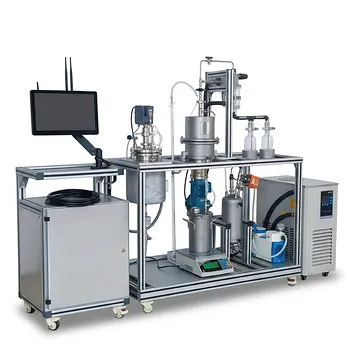
The right mixer is the difference between a lumpy slurry and a nano‑stable product. When configuring a pilot‑plant dispersion unit, the critical distinction between a high‑speed disperser and a rotor/stator homogenizer comes down to shear intensity, energy density, and the minimum particle size they can reliably achieve. High‑speed dispersers deliver moderate shear for delumping and coarse solid‑liquid dispersions, while rotor/stator homogenizers generate extreme, localized shear that creates stable dispersions below 10 µm.
A disperser excels at wet‑out and deagglomeration down to roughly 10–20 µm; a rotor/stator is the tool of choice when your formulation demands sub‑10‑µm stability and you can manage its intense energy input. For high‑viscosity or yield‑stress fluids, the most effective pilot‑plant strategy often combines a rotor/stator with a close‑clearance impeller to separate bulk circulation from high‑shear processing.
Dissecting the Core Differences
Tip Speed and the Shear‑Intensity Gap
High‑speed dispersers typically operate at blade tip speeds of 2 to 25 m/s. This creates a pumping vortex that circulates material past the saw‑tooth disc, where agglomerates are broken by mechanical impact and moderate shear. Rotor/stator homogenizers run at 5 to 50 m/s, but speed is only part of the story.
The real difference lies in the rotor/stator’s extremely narrow working gap. Fluid is forced through a perforated stator at high velocity, generating intense shear and elongational stresses that high‑speed dispersers cannot replicate.
Energy Dissipation Density
The rotor/stator concentrates 10³ to 10⁵ W/kg into a tiny clearance volume, creating a well‑defined, high‑energy zone. High‑speed dispersers scatter energy across the entire vessel, which is efficient for bulk motion but dilutes the peak stress on particles. This difference in local energy density is the reason rotor/stator units can break fine agglomerates and reduce droplet size far more effectively.
Particle Size and Stability Limits
If your pilot‑plant target is a stable dispersion with mean particle size below 10 µm, a rotor/stator is almost always required. The high shear and controlled flow through the stator gap can reliably achieve sub‑micron emulsions and fine suspensions. High‑speed dispersers are best suited for delumping, wetting powders into liquids, and producing coarse dispersions where 10–50 µm is acceptable.
Flow Pattern and Bulk Mixing
A disperser blade creates a classic doughnut vortex that mixes the entire batch, but it can leave stagnant zones in high‑viscosity fluids. A rotor/stator is a poor bulk mixer on its own—it acts as a high‑shear pump that must be paired with vessel agitation or a circulation loop to bring material to the head repeatedly. In a pilot‑plant, that often means mounting the rotor/stator in‑line with a recirculation loop or pairing it with an anchor‑type close‑clearance impeller.
Pilot Plant Integration Strategies
When to Choose a High‑Speed Disperser
Use a disperser as your primary tool when:
- The product’s quality metric allows a particle size ≥10–20 µm.
- You need a simple, robust system with minimal cleaning and maintenance.
- The operation is primarily powder wet‑out, pigment dispersion, or pre‑mix ahead of a milling step.
- Viscosity is low enough that a vortex forms easily, or you can adjust blade diameter and speed to match.
When a Rotor/Stator Becomes Non‑Negotiable
Select a rotor/stator homogenizer when:
- Your formulation demands a stable, sub‑10‑µm dispersion or emulsion.
- Energy‑density‑dependent processes like fine emulsification or cell disruption are involved.
- You need a reproducible scale‑down methodology; tip speed and power per unit volume are more directly translatable to production‑scale rotor/stator machines.
- The pilot plant must mimic an in‑line high‑shear mixer that will be used at full scale.
The Combined Approach for High‑Viscosity Fluids
High‑viscosity or yield‑stress products challenge both technologies. A disperser alone may stall or fail to create sufficient shear, while the rotor/stator may cavitate or starve because the fluid does not flow into the head. The proven solution is to pair a rotor/stator with a close‑clearance impeller (e.g., anchor or helical ribbon). The impeller ensures bulk circulation and feeds the rotor/stator, which then delivers the necessary localized high‑shear processing.
Understanding the Trade‑offs
Energy Density vs. Temperature Rise
Rotor/stator homogenizers dissipate enormous energy in a small volume, so controlling product temperature is essential. Pilot plants need jacketed vessels or in‑line heat exchangers to prevent overheating that can degrade heat‑sensitive materials. Dispersers typically generate less severe hot spots, but at high tip speeds they can still raise bulk temperature over time.
Complexity and Cleanability
A high‑speed disperser consists of a shaft, blade, and simple bearing assembly—easy to clean and maintain, with fewer crevices for product hold‑up. Rotor/stator units have a multi‑part stator, seals, and tight clearances that demand more rigorous cleaning protocols, especially when switching between formulations in a pilot plant.
Scalability Pitfalls
Scaling up a high‑speed disperser is notoriously empirical; maintaining the same power per volume or tip speed often gives inconsistent results because the bulk flow pattern changes. Rotor/stator scale‑up is more predictable when using constant tip speed and residence‑time distribution in the shear gap, but you must still account for differences in gap geometry and power density at larger scales.
Capital and Operating Cost
A disperser is generally lower in capital cost and energy consumption per batch. A rotor/stator system, especially with a recirculation loop and auxiliary impeller, adds cost and complexity. However, if your product cannot meet specifications without it, the higher cost is a necessity, not a choice.
How to Configure Your Pilot Plant for Dispersion Success
The best configuration matches the mixer to the dispersion’s true critical quality attribute: particle size, stability, and the fluid’s rheology. Use the following goal‑based guide to decide:
- If your primary focus is rapid powder wet‑out and coarse dispersion: Start with a high‑speed disperser; it delivers effective delumping without the complexity of a high‑shear in‑line device.
- If your primary focus is achieving a dispersion with a mean particle size below 10 µm: Commit to a rotor/stator homogenizer; its concentrated energy density is essential for fine, stable dispersions.
- If your primary focus is processing high‑viscosity or yield‑stress products: Configure the pilot plant with a rotor/stator combined with a close‑clearance anchor impeller to ensure material transport and shear exposure.
- If your primary focus is building a flexible pilot platform: Include both a disperser and a rotor/stator homogenizer; this lets you map the effectiveness of each technology and scale results to whichever is most suitable for full‑scale manufacturing.
A well‑matched mixer turns your pilot plant data into a reliable blueprint for production. Match the technology to the physics of your dispersion, not just to what is sitting in the equipment catalog.
Summary Table:
| Feature | High-Speed Disperser | Rotor/Stator Homogenizer |
|---|---|---|
| Tip Speed | 2 to 25 m/s | 5 to 50 m/s |
| Energy Density | Low to moderate (scattered) | High ($10^3$ to $10^5$ W/kg, localized) |
| Target Particle Size | $\ge 10\text{--}20\ \mu\text{m}$ (coarse) | $< 10\ \mu\text{m}$ (fine/sub-micron) |
| Primary Function | Powder wet-out & deagglomeration | Fine emulsification & high-shear mixing |
| Bulk Mixing | Excellent (creates vortex) | Poor (requires auxiliary impeller/pump) |
| Cleaning & Maintenance | Simple, low overhead | Complex due to tight tolerances & seals |
Configure the Perfect Pilot Plant with LABPARK
Choosing the right mixing technology is critical for accurate scale-up and reliable process data. LABPARK provides premium Educational and Vocational Unit Operations Pilot Plants in chemical engineering, bioprocess & biotech, and environmental & water treatment tailored for universities, research institutes, and enterprises.
Whether you need to configure a high-speed disperser, a rotor/stator homogenizer, or a multi-stage pilot system, our engineering team is ready to design a solution that meets your exact training and research requirements.
Contact LABPARK Today to Request a Quote and Technical Consultation
Related Products
People Also Ask
- How is the heat transfer area calculated for an evaporation unit operations pilot plant during experimental design? Guide
- How to select educational evaporator pilot plants for thermal & scaling solutions? Complete Guide
- What is the practical significance of Kb in pilot plant evaporation? Master process design.
- How do flash calculations relate to flash evaporation pilot plants? Bridge Theory and Practice
- Vacuum vs. Atmospheric Evaporation: Key Pilot Plant Trade-Offs to Evaluate