When deploying xanthine oxidase in a bioprocess, account for both its multi-center electron-transfer architecture and its broad but nonuniform substrate range. The enzyme is a homodimer of approximately 283 kDa, with each subunit containing one FAD center, one molybdenum center, and two iron-sulfur centers. These cofactors support rapid internal electron transfer while enabling oxidation of substrates ranging from purines to aliphatic and aromatic aldehydes.
The central design task is to match substrate chemistry and process conditions to the enzyme’s cofactor-dependent electron-transfer pathway. Broad specificity expands the range of possible conversions, but it does not mean that all substrates will be processed with comparable rate, selectivity, or operational stability.
What the Enzyme Structure Means for Process Design
Treat the enzyme as a multi-center redox catalyst
Each xanthine oxidase subunit contains four redox-active centers: molybdenum, FAD, and two Fe₂S₂ centers. The molybdenum center is associated with substrate oxidation, while the iron-sulfur centers and FAD participate in transferring the resulting electrons through the protein.
This architecture makes xanthine oxidase more complex than a single-cofactor oxidoreductase. Process performance depends on maintaining the functional state of the complete cofactor system rather than optimizing only substrate binding at the molybdenum site.
Consider the proximity of the redox centers
The redox centers are positioned within approximately 20 Å of one another. Their close arrangement supports efficient intramolecular electron transfer between the catalytic and electron-accepting sites.
For a bioprocess, this means that structural integrity is directly connected to catalytic throughput. Conditions that disrupt folding, subunit association, or cofactor retention can impair electron transfer even if the enzyme remains partially soluble.
Account for the homodimeric organization
Xanthine oxidase consists of two identical subunits, giving a total molecular weight of roughly 283,000. The dimeric structure affects how the enzyme behaves during immobilization, concentration, filtration, and formulation.
Large quaternary structures may also influence mass transfer and reactor residence-time requirements. These factors should be evaluated during scale-up rather than inferred solely from small-volume activity assays.
Which Substrates Can Be Converted
Purines are a primary substrate class
Xanthine oxidase can oxidize purines including xanthine and hypoxanthine, producing uric acid. These conversions are relevant to analytical, pharmaceutical, metabolic, and waste-treatment processes involving purine-containing streams.
Substrate identity remains important even within this class. Differences in molecular structure can affect binding orientation, catalytic rate, conversion level, and the likelihood of side reactions or downstream separation challenges.
Aldehydes broaden the application space
The enzyme also oxidizes aliphatic and aromatic aldehydes. Examples include acetaldehyde and benzaldehyde, which can be converted to their corresponding carboxylic acids.
This broad specificity creates opportunities for aldehyde upgrading and selective oxidation. It also requires careful feed characterization because a process stream containing multiple aldehydes may produce several products simultaneously.
Broad specificity does not imply uniform activity
“Broad specificity” describes the range of substrates that the enzyme can accept, not equal catalytic efficiency across that range. Xanthine, hypoxanthine, acetaldehyde, and benzaldehyde may differ substantially in affinity, turnover, solubility, and product formation.
Pilot-scale design should therefore use substrate-specific kinetic data. A conversion demonstrated with one representative substrate should not be treated as proof that the enzyme will perform equivalently with another.
How Cofactor Architecture Affects Unit Operations
Preserve the complete electron-transfer chain
The enzyme’s catalytic cycle depends on coordinated activity across the molybdenum, iron-sulfur, and FAD centers. Loss or damage to any one of these components can interrupt electron flow and lower overall activity.
Process development should monitor activity using a relevant substrate and, where practical, distinguish loss of catalytic function from simple protein loss. This is especially important after purification, immobilization, long-term storage, or repeated reactor operation.
Evaluate oxygen and electron-acceptor requirements
Xanthine oxidase transfers electrons internally from the molybdenum site through the iron-sulfur centers toward FAD. In an oxygen-based operation, oxygen availability and gas-liquid mass transfer can become limiting at larger scale.
The reactor must therefore be designed around the intended electron acceptor and substrate loading. Oxygen transfer, mixing, enzyme concentration, and substrate solubility should be evaluated together because improving one variable may expose a limitation in another.
Consider enzyme concentration and reactor configuration
The enzyme’s high molecular weight and multi-subunit structure can affect retention and transport in continuous systems. Membrane retention, immobilization, or packed-bed operation may improve enzyme reuse, but these approaches can also introduce diffusion barriers.
A soluble batch process may provide simpler mass transfer and easier characterization. A retained or immobilized configuration may offer better operational economics when enzyme recovery and reuse are more important than maximum initial reaction rate.
Understanding the Trade-offs
Broad substrate acceptance can reduce product specificity
A feed containing several compatible substrates may lead to parallel oxidation reactions. This can complicate product recovery and make selectivity dependent on substrate concentration, competing reactions, and residence time.
Selectivity should be measured under realistic feed conditions rather than in a single-substrate buffer system.
Large enzyme architecture can increase process sensitivity
The dimeric, multi-cofactor structure provides an efficient electron-transfer pathway, but it also creates more structural features that must remain intact. Denaturation, subunit dissociation, or cofactor damage may produce activity losses that are not obvious from total protein concentration.
Operational robustness should be tested across the actual pH, temperature, solvent exposure, ionic strength, oxygen-transfer conditions, and shear environment expected in the process.
Substrate and product handling may become limiting
Purines and aromatic aldehydes can differ considerably in solubility and physical behavior. A substrate that is kinetically suitable may still be difficult to feed at the concentration required for commercial productivity.
Likewise, product accumulation can alter solubility, downstream purification, or apparent reaction performance. Process design must evaluate both biochemical conversion and material handling.
Activity data may not transfer directly to scale
Small-scale assays often provide favorable mixing, oxygen availability, and substrate distribution. At pilot scale, mass-transfer gradients and local concentration differences can change the observed reaction rate.
Scale-up should therefore use productivity and volumetric oxygen-transfer data, not only the enzyme’s specific activity measured under idealized assay conditions.
Making the Right Choice for Your Goal
The appropriate deployment strategy depends on whether the process prioritizes substrate breadth, selectivity, reuse, or scale-up reliability.
- If your primary focus is purine conversion: Characterize xanthine and hypoxanthine separately, then design around their individual kinetics and uric-acid handling requirements.
- If your primary focus is aldehyde oxidation: Screen both aliphatic and aromatic aldehydes under process-relevant concentrations, because substrate class alone does not predict comparable performance.
- If your primary focus is high volumetric productivity: Evaluate oxygen transfer, mixing, substrate solubility, and enzyme concentration together with catalytic activity.
- If your primary focus is enzyme reuse: Compare soluble, immobilized, and retained-enzyme configurations while monitoring preservation of the dimeric structure and all redox cofactors.
- If your primary focus is product selectivity: Test realistic multisubstrate feeds and quantify competing conversions rather than relying on the enzyme’s broad specificity as a guarantee of selective oxidation.
Successful bioprocess deployment of xanthine oxidase requires treating its cofactor architecture, quaternary structure, substrate-specific kinetics, and reactor transport behavior as one integrated design problem.
Summary Table:
| Design factor | Key consideration | Process impact |
|---|---|---|
| Cofactor architecture | Mo, FAD, and two Fe-S centers must remain functional | Maintains electron transfer and catalytic activity |
| Quaternary structure | Homodimer of approximately 283 kDa | Influences immobilization, retention, filtration, and mass transfer |
| Substrate range | Oxidizes purines and aliphatic or aromatic aldehydes | Enables broad applications but requires substrate-specific testing |
| Electron acceptor | Oxygen availability and transfer may limit performance | Guides aeration, mixing, and reactor design |
| Reactor configuration | Soluble, immobilized, or retained enzyme options | Balances mass transfer, reuse, productivity, and operating cost |
| Scale-up requirements | Evaluate kinetics, solubility, mixing, and volumetric oxygen transfer | Improves reliability beyond small-scale activity assays |
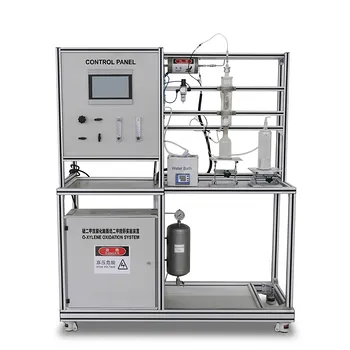
Planning a xanthine oxidase or other enzyme-based process? Contact LABPARK for Educational and Vocational Unit Operations Pilot Plants designed for chemical engineering, bioprocess and biotech, and environmental and water treatment applications. Our pilot-scale systems help universities, research institutes, and enterprises evaluate enzyme kinetics, oxygen transfer, substrate handling, reactor configuration, immobilization, enzyme reuse, and scale-up performance under realistic operating conditions. Work with LABPARK to turn laboratory results into reliable, measurable process data and select a pilot plant that matches your productivity, selectivity, and operational goals.
Related Products
People Also Ask
- Why Is the Peclet Number (Pe) Key in Tubular Reactors? Avoid Critical Modeling Errors
- Why determine reaction order & activation energy in pilot plants? Key to safe scale-up.
- What materials fit high-temp oxidation pilot plants? Key Hastelloy & Titanium Requirements
- Why is the reactor tube-to-catalyst particle diameter ratio (dt/dp) critical? Key to Accurate Kinetic Scale-Up
- Under what conditions can axial diffusion be neglected? Reactor Simulation Guide