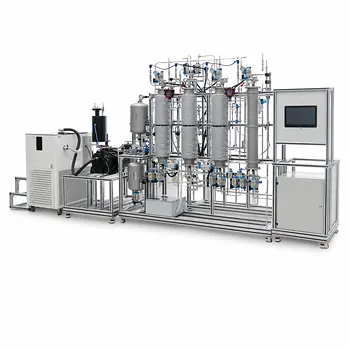
To get a safe, code-compliant pressure vessel into your pilot plant, you must provide six core specifications. These are the vessel’s function and process fluids, its operating and design temperatures and pressures, the material of construction, overall dimensions and nozzle orientations, the vessel head type, and the opening and connection types. These inputs directly feed the mechanical design calculations, making them the non-negotiable foundation of your project.
Defining a custom pressure vessel is not a data-dump exercise; it is a risk-management process. The six specifications are the precise language that translates your chemical process into a safe, ASME-compliant vessel that will not rupture, leak, or fail under its intended conditions.
Defining the Vessel’s Purpose and Contents
A vessel's function is the master variable that shapes everything from its internal configuration to its relief system.
Function Informs Configuration and Internals
A reactor, a distillation column, and a two-phase separator demand fundamentally different geometries.
- Vertical vessels are standard for fractionation columns with trays or packing and for scrubber separators.
- Horizontal vessels excel at two- or three-phase separation, where a large liquid surface area is needed.
Getting the function wrong means you will order a vessel that cannot physically do its job.
Process Fluids Dictate Material Compatibility
The chemicals, phases, and any corrosive species define the material selection path. Your specification must list all process fluids, including trace components that could cause stress corrosion cracking or pitting. A missing corrosive element can lead to a through-wall failure in months, which is catastrophic in a research facility.
Establishing the Thermal and Pressure Envelope
This is the single most critical safety boundary you will set. Under-specifying here is not an option.
Operating vs. Design Conditions: A Critical Safety Margin
- Operating pressure/temperature is where the vessel normally runs.
- Design pressure/temperature must incorporate a safe margin above maximum operating levels to cover process upsets, control failures, and transient spikes.
The design pressure must also consider the vessel’s classification threshold. A vessel with an inner diameter greater than 150 mm operating under a pressure differential above 0.5 bar must be designed as a code-stamped pressure vessel. Ignoring this can mean an unsafe, uncertified unit on your lab floor.
The Critical Role of Relief Scenarios
You must define the worst-case relief scenario to size the vessel and its overpressure protection.
- Think runaway reactions, blocked outlets, or rapid thermal expansion.
- This data determines whether you need a reclosable safety valve or a rupture disc for rapid pressure spikes in corrosive media.
The mechanical designer will use standards like API RP 520/521 to size the relief system for gas, liquid, or flashing two-phase flow. If you don’t provide the scenario, they can’t guarantee the vessel won’t rupture in an emergency.
Material Selection: The Foundation of Integrity
Selecting the right metal is a balance of chemistry, stress, and budget.
Balancing Cost, Strength, and Corrosion Resistance
- Carbon steel (e.g., A516) is cost-effective but has limited corrosion resistance and a lower ceiling for extreme conditions.
- Alloy steels (e.g., A387) include chromium and molybdenum to improve high-temperature strength and hardness, making them mandatory for specialized, high-performance pilot plant work.
The material must also withstand the hydrostatic test pressure, which is typically 1.3 times the design pressure, adjusted for the material’s allowable stress at test and design temperatures. You cannot pick a material without considering its stress values at both sets of conditions.
Code-Compliant Material Specifications
Every material you list must be traceable to an ASME specification. For piping connected to the vessel, ASME B31.3 governs, ensuring that the entire connected system—from the raw material inlet to the product outlet—can handle the process conditions safely.
Geometry, Nozzles, and Heads
These dimensions are not just for fit; they directly influence stress distribution and fabrication cost.
Overall Dimensions and Nozzle Orientation
Overall diameter and tangent-to-tangent length must be supplied, but so must the exact location and projection of every nozzle. A poorly placed nozzle can interfere with internals or create a dead-leg where corrosive fluid stagnates.
Opening and Connection Types
You must specify whether you need flanged, threaded, or welded connections. Flanged connections allow for cleaning and maintenance, while welded connections offer a leak-free guarantee but are permanent. This choice impacts the vessel's pressure rating and overall safety.
Head Type Impacts Stress Distribution
The choice between a 2:1 ellipsoidal, hemispherical, or torispherical head is a direct engineering decision.
- Hemispherical heads are strongest for high-pressure but expensive and deep.
- 2:1 ellipsoidal heads are a common, cost-effective balance.
- Torispherical heads are often used at lower pressures.
A mismatched head type for your pressure range will require unnecessary thickness or create stress hot-spots near the knuckle.
Understanding the Trade-offs and Pitfalls
Trust is built on transparency. Here are the most destructive mistakes researchers make when specifying vessels.
- Assuming “stainless steel” is a specification: It’s a family. 304L and 316L have vastly different chloride resistance. Vague material calls lead to failed vessels.
- Ignoring the design margin for temperature: A process running at 150°C with a design temperature of only 160°C leaves zero room for a control-loop overshoot.
- Forgetting the corrosion allowance: If you don’t specify a value (e.g., 3 mm), the vessel will be designed to net thickness, leaving no sacrificial metal for long-term corrosion.
- Chasing low-bid vendors: A quote that is 30% below the average often signals substandard fabrication that may not meet ASME code, putting personnel at direct risk.
- Skipping the relief scenario on multi-phase pilot plants: Sizing a relief valve for a single-phase liquid when a runaway reaction could produce a two-phase gas-liquid flow will undersize the relief system, creating a hidden overpressure hazard.
Making the Right Choice for Your Pilot Plant Goal
Turn your process knowledge into a precise specification sheet using these distinctions.
- If your primary focus is absolute safety and code compliance: Over-specify your design margins and insist on fully ASME Section VIII-stamped fabrication with complete material test reports.
- If your primary focus is handling highly corrosive media: Start with the fluid list and select an alloy steel or high-grade stainless while specifying an accelerated corrosion allowance.
- If your primary focus is multi-phase or highly transient operation: Define the worst-case two-phase relief scenario upfront; this single data point will drive the entire relief and vessel design and prevent catastrophic undersizing.
- If your primary focus is cost efficiency for a low-risk process: Standardize on a 2:1 ellipsoidal head, carbon steel (if chemistry allows), and flanged connections while rigorously verifying the vendor’s ASME credentials to avoid safety risks from low-quality work.
Clarity in the initial six specifications is the single factor that separates a safe, long-lasting pilot-plant asset from an expensive liability.
Summary Table:
| Specification | Key Considerations | Impact on Safety & Design |
|---|---|---|
| Function & Fluids | Process chemistry, phase separation, and corrosives | Dictates vertical/horizontal layout & material choice |
| Temp & Pressure | Operating vs. design margins, worst-case relief scenarios | Sizes overpressure protection & prevents rupture |
| Material of Construction | Carbon steel vs. alloy steels, ASME traceability | Ensures corrosion resistance & stress tolerance |
| Geometry & Nozzles | Diameter, tangent-to-tangent length, nozzle locations | Prevents stagnant zones & fits process internals |
| Vessel Head Type | Hemispherical vs. 2:1 ellipsoidal vs. torispherical | Optimizes stress distribution and cost |
| Connections | Flanged, threaded, or welded types | Balances leak-free requirements & maintenance access |
Secure Your Pilot Plant's Safety and Compliance
Designing custom pressure vessels requires rigorous attention to code compliance and process safety. LABPARK provides state-of-the-art Educational and Vocational Unit Operations Pilot Plants across chemical engineering, bioprocess & biotech, and environmental & water treatment.
Whether you are representing a university, research institute, or enterprise, our expert engineering team is ready to help you translate complex process parameters into high-performance, ASME-compliant systems.
Contact LABPARK today to design your custom pilot plant solution!
Related Products
- Chemical Pipeline Assembly and Fluid Transport Practical Training Unit Operations Pilot Plant
- Constant Pressure Filtration Educational Unit Operations Pilot Plant
- Educational Pressure Swing Adsorption Ethylene Capture Unit Operations Pilot Plant
People Also Ask
- Why distinguish Newtonian & non-Newtonian fluids in pilot plants? Prevent design errors.
- How is shaft work (We) used to determine pump specifications? Optimize pilot plant fluid transport design.
- Gear vs Centrifugal Pumps in Pilot Plants: How do operating characteristics and power requirements differ?
- What are the primary methods for regulating flow rate in pilot plants? VFD vs. Throttle
- How does Reynolds number affect viscous sublayer thickness? Optimize pilot-plant flow, friction, and scale-up