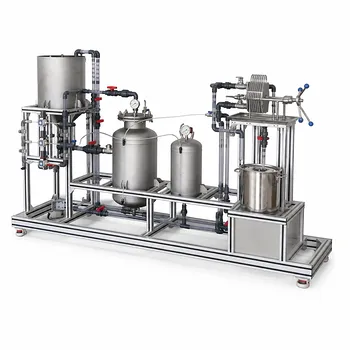
The key characteristics to analyze are the slurry’s specific cake resistance—which dictates filtration speed—and the resulting cake’s mechanical properties, including its compressibility, tendency to agglomerate or attrite, and susceptibility to cracking. In a pilot plant setting, these analyses move beyond textbook theory by forcing you to directly link the material’s physical behavior to a specific piece of equipment, whether that’s a pressure filter, a centrifuge, or an agitated filter dryer.
The primary goal of a chemical engineering pilot plant is not just to separate solids from liquids, but to understand how the intrinsic properties of the cake control equipment selection and process economics. Analyzing cake compressibility and specific resistance provides the quantitative basis for this decision, while observing secondary behaviors like cracking and agglomeration dictates the operational success and scalability of the chosen unit.
The Core Material Properties: Predicting Filtration Performance
Before you select a piece of equipment, you must define the material’s resistance to filtration and its structural integrity. These properties directly determine whether a simple pressure filter will suffice or if you need a more complex, contained system.
Specific Cake Resistance: The Speedometer for Filtration
Specific cake resistance (α) is the single most critical parameter for predicting filtration behavior. It is an intrinsic property that quantifies how easily fluid can pass through a bed of solids.
This value allows you to predict cycle times and select appropriate driving forces. In conventional equipment, the specific cake resistance values dictate the filtration speed:
- A range of 1 x 10⁷ to 1 x 10⁸ m/kg indicates fast filtering.
- A range of 1 x 10⁸ to 1 x 10⁹ m/kg indicates moderately fast filtering.
- A range of 1 x 10⁹ to 1 x 10¹⁰ m/kg indicates slow filtering.
- Values greater than 1 x 10¹⁰ m/kg indicate very slow filtering.
Cake Compressibility: The Pressure Paradox
Cake compressibility describes how the solid matrix deforms under applied pressure. While increasing the pressure drop across a filter seems like an obvious way to boost throughput, a highly compressible cake will react by collapsing into a dense, low-permeability barrier.
This is the classic filtration paradox. Applying higher pressure or spin speed can actually crush the interstitial spaces between particles, leading to a dramatic reduction in filtration rate. For a pilot plant, this teaches a vital lesson: you must find the optimal pressure, not the maximum pressure.
Agglomeration and Attrition: The Agitation Problem
The behavior of the cake under mechanical stress dictates whether you need an agitated or non-agitated process.
- Agglomeration: If the cake binds together into hard lumps under mixing, an agitated filter dryer might be necessary. The agitator can actively break these lumps during drying to maintain efficient heat transfer.
- Attrition: Conversely, if the crystalline cake is fragile and breaks down into fine particles when agitated, a non-agitated static bed is often superior. Agitation would generate fines, which can clog downstream filters or centrifuge screens.
Cake Cracking: The Washing Inefficiency
Many wet cakes tend to crack during the isolation or drying phase. A crack in a filter bed creates a low-resistance "channel."
Wash solvent will flow almost entirely through this crack, bypassing the bulk of the cake. This is called solvent channeling, and it leaves most of the cake unwashed and impure. In pilot-scale operations, observing this phenomenon highlights why maintaining a homogenous, saturated bed structure is essential for effective purification.
Operational Context: Linking the Cake to the Plant
The cake does not exist in a vacuum. Its properties must be mapped against the available equipment and the overarching safety protocol.
Filtration Centrifuge vs. Pressure Filter Selection
The target output and particle size determine the core piece of rotating equipment.
A filtration centrifuge, which uses a porous wall to retain solids, is selected when the goal is a clean, dry solid cake, typically with larger particles (often >150 μm). A sedimentation centrifuge separates phases based on density differences and is preferred when the primary target is the clarified liquid, especially for finer particles. Pilot plants equipped with both types allow students to study the direct trade-off in filtrate clarity and cake dryness based on particle size distribution.
Health, Safety, and Environmental (HSE) Integration
The toxicity and potency of the solid material override almost all other mechanical considerations.
For highly toxic or potent compounds, containment is king. An open Nutsche filter requires manual intervention to smooth cracks, which exposes the operator during personal protective equipment-intensive procedures. In such cases, a highly contained, mechanically sealed agitated filter dryer becomes mandatory. The pilot plant environment is therefore critical for establishing the safety baseline for a process.
Understanding the Trade-offs
No single piece of equipment perfectly solves every filtration problem. The pilot plant is where these conflicts become tangible.
Compressibility vs. Washing Efficiency
A thin, highly compressed cake resists cracking. However, a thicker, non-compressed cake often washes more uniformly but may retain more liquid. You must choose between a fast filtration cycle (favoring a thin, incompressible bed) and total purity requirements (favoring a stable, capable washing surface).
Containment vs. Capital Simplicity
An agitated filter dryer provides superior containment and in-situ processing, but it is mechanically complex and expensive. A simple Buchner funnel is transparent and educational. The pilot plant teaches that the decision is driven by the cake’s toxicity, not just its specific resistance.
Granule Integrity vs. Drying Speed
An agitated dryer prevents lump formation and accelerates heat transfer, solving an agglomeration problem. However, the continuous motion may attrite the particles, ruining the crystal size distribution you worked hard to produce in the upstream crystallizer.
Making the Right Choice for Your Pilot Plant Goal
Your analysis of the slurry and cake must be guided by what you are optimizing for in the educational or research workflow.
- If your primary focus is demonstrating fundamental transport phenomena: Prioritize the measurement of specific cake resistance. Use a standard pressure filter to show students the direct parabolic relationship between pressure drop and flow rate in a compressible cake.
- If your primary focus is maximizing product purity: Focus your analysis on the cake’s susceptibility to cracking. Select a filter that allows controlled, uniform compression to prevent solvent channeling during washing.
- If your primary focus is process safety with potent compounds: Judge the slurry by its toxicity. Select an agitated filter dryer to eliminate the manual breaking of crusts and the resulting solid exposure to the operator.
- If your primary focus is scale-up prediction: Observe the cake’s response to agitation. A material that attrites easily at a small scale dictates a decision for static, non-agitated drying equipment at the production scale.
Ultimately, the data you collect on cake compressibility and particle size resistance is the quantitative foundation for a safe and efficient isolation process.
Summary Table:
| Slurry/Cake Characteristic | Impact on Filtration & Processing | Equipment & Operational Significance |
|---|---|---|
| Specific Cake Resistance | Dictates filtration speed and cycle times | Determines the required driving force and pressure filter selection |
| Cake Compressibility | Pressure causes cake collapse, reducing flow rate | Requires finding optimal, not maximum, operating pressure |
| Agglomeration & Attrition | Lumping or particle breakdown under stress | Dictates use of agitated filter dryers vs. non-agitated static beds |
| Cake Cracking | Causes solvent channeling and poor washing | Highlights the need for uniform cake compression and stabilization |
Optimize Your Unit Operations Training with LABPARK
Are you looking to bridge the gap between textbook theory and practical chemical engineering? LABPARK designs and provides high-quality Educational and Vocational Unit Operations Pilot Plants in chemical engineering, bioprocess & biotech, and environmental & water treatment for universities, research institutes, and enterprises.
Whether you need to demonstrate complex filtration phenomena, cake washing, or advanced separation processes, our pilot plants deliver the hands-on experience your students and researchers need.
Contact LABPARK today to discuss your laboratory requirements and get a customized solution!
Related Products
People Also Ask
- How do educational unit operations pilot plants bridge theory and design? Bridge the Engineering Gap
- How do educational unit operations pilot plants address safety and waste management when scaling up?
- Why splitting a filtration batch doesn't always reduce cycle time? Pilot Plant Insights
- Why Demo Constant-Rate to Constant-Pressure Filtration on a Pilot Plant? Key Practical Insights
- How can researchers identify and resolve filter medium blinding? Optimize Your Pilot Plant Runs