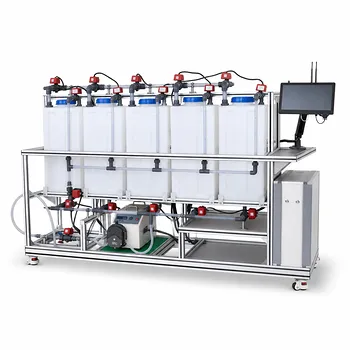
Electrodialysis (ED) achieves separation by forcing ions through selective membranes under a direct current electric field. In a unit operations pilot plant, this means you apply a voltage across a stack of alternating cation- and anion-exchange membranes; anions move toward the anode and pass through anion-exchange membranes, while cations move toward the cathode and pass through cation-exchange membranes, creating alternating streams of concentrated brine and purified water. The primary demonstration in educational and research pilot plants is brackish water desalination, but the same principle extends to purification tasks in food, pharmaceutical, and general chemical processes.
Demonstrating ED in a pilot plant is about more than just desalting water—it’s a hands-on way to visualize the direct link between electrical energy input and ionic separation efficiency. The core insight: selective membrane permeability combined with an electric field creates a tunable, scalable separation tool, but performance hinges on carefully managing flow, current, and membrane integrity.
How the Core Separation Principle Works
The Role of Ion-Exchange Membranes
Ion-exchange membranes are not simple filters. Their pores and polymer matrix contain fixed charged groups: negative charges in cation-exchange membranes repel anions and allow only cations to pass, while positive charges in anion-exchange membranes do the opposite. This selectivity is the heart of the ED process.
The membranes are arranged in a stack between two electrodes, with spacers creating alternating dilute and concentrate chambers. When you power the stack, the electric field pulls ions through their respective membranes, leaving behind purified solution in one set of chambers and concentrating unwanted ions in the other.
Applying the Direct Current Field
The driving force is a direct current (DC) electric field. Cations migrate toward the cathode, anions toward the anode. Because the membranes are selective, ions get trapped in concentrate chambers while the diluate stream becomes progressively cleaner. This direct conversion of electrical energy into mass transfer is what makes ED distinct from pressure-driven membrane processes like reverse osmosis.
In a pilot plant, students see immediate feedback: adjusting voltage directly changes ion migration rates, visible through conductivity measurements on the dilute outlet.
Critical Parameters for Pilot Plant Demonstrations
Monitoring Limiting Current Density
Limiting current density ($i_{lim}$) is the maximum current you can push before the ion concentration at the membrane surface drops to zero. Exceeding this threshold triggers water splitting, which not only wastes energy but also causes pH shifts and membrane scaling. In educational settings, observing the voltage–current curve and identifying the limiting current plateau is a foundational experiment that teaches the concept of concentration polarization.
Understanding Flow Configuration and Pressure Management
The way you distribute flow through the stack dramatically affects performance and equipment safety:
- Series (successive) flow increases desalination speed but imposes large pressure differences between chambers, risking membrane deformation or tearing.
- Counterflow improves current efficiency by reducing back-diffusion, yet it also introduces high pressure differentials.
- Parallel flow within a single stack combined with counterflow between stacks is the preferred pilot‑scale compromise. It balances energy consumption, maintains manageable pressure profiles, and prevents structural damage to the membranes.
Trainees must correlate these flow configurations with the hydraulic balance measured via inlet and outlet pressure gauges, reinforcing the interplay between fluid dynamics and mass transfer.
The Influence of Spacers and Chamber Geometry
Turbulence-promoting spacers inside the flow compartments reduce the diffusion boundary layer thickness ($\delta$), enhancing mass transfer and raising the limiting current density. The spacer factor ($K_s$) and chamber thickness ($d_0$) directly influence the voltage drop and energy consumption. A well-designed pilot plant exercise involves comparing thin‑chamber stacks with tight spacers to thicker configurations—making the economic trade-off between pumping energy and electrical separation energy tangible.
Real‑Time Performance Metrics
Three simple measurements teach the relationship between electrical input and chemical separation:
- Applied DC voltage and current: Students calculate power consumption and verify operation below limiting current density.
- Concentrate and diluate flow rates: Maintaining balance avoids excessive pressure differentials and reduces membrane scaling.
- Feed and product conductivity: A continuous drop in diluate conductivity directly quantifies desalination efficiency and ion migration rates.
Understanding the Trade-offs
Preventing Membrane Fouling and Polarization
Even with optimal flow, concentration polarization and colloidal fouling are persistent threats. Polarization results from the ion depletion layer near the membrane surface; once current exceeds the limiting density, water splits, generating H⁺ and OH⁻ ions that can precipitate scaling compounds. Fouling from organic colloids or biofilms further reduces efficiency. Pilot plant demonstrations that deliberately push current beyond the limit—under supervision—provide a powerful lesson in what not to do and why regular clean-in-place cycles matter.
Energy Consumption vs. Separation Speed
Higher current densities accelerate separation but exponentially increase energy consumption and the risk of water splitting. The spacer choice adds another layer: tighter spacers promote mass transfer at the cost of higher pumping energy. There is no single optimum; the economic balance depends on the value of the product and the cost of electricity. Teaching this trade-off through pilot‑scale data turns an abstract principle into an engineering decision tool.
Membrane Life and Mechanical Constraints
Aggressive flow configurations or high pressure differentials can tear thin ion‑exchange membranes. The cost of replacing a membrane stack in a pilot plant is not trivial, so operators learn to respect mechanical limits. This reinforces the importance of monitoring pressure drop along each compartment and choosing flow arrangements that protect equipment while maintaining performance.
Making the Right Choice for Your Educational or Research Goal
How you configure and operate your ED pilot plant should directly reflect the learning objectives or research question at hand.
- If your primary focus is teaching the electrical‑separation relationship: Emphasize current–voltage curve experiments, clearly demonstrating limiting current density and water splitting phenomena. Use simple parallel flow and encourage students to correlate conductivity decay with power input.
- If your primary focus is scaling up a purification process: Prioritize flow configuration studies—test parallel vs. combined parallel‑counterflow setups—and measure energy consumption per ion removed. Integrate membrane fouling trials and cleaning protocol evaluations.
- If your primary focus is demonstrating industrial versatility: Go beyond water desalination. Run demonstrations using saline solutions that simulate food processing streams or pharmaceutical buffers, highlighting how the same stack can be applied to different ions and concentration ranges.
- If your primary focus is equipment design and safety: Focus on pressure profiles, chamber thickness effects, and spacer selection. Let students observe membrane deformation risks at excessive flow rates and learn the importance of hydraulic balancing.
Mastering electrodialysis in a pilot plant isn't just about learning a single process—it's about internalizing how an electric field can be harnessed to perform precise chemical separations, a skill that translates directly to the design and troubleshooting of modern membrane-based unit operations.
Summary Table:
| Key Parameter | Description | Significance in Pilot Plant Demonstration |
|---|---|---|
| Limiting Current Density ($i_{lim}$) | Max current before water splitting occurs | Teaches concentration polarization and energy limits. |
| Flow Configuration | Arrangement of dilute/concentrate streams | Balances mass transfer efficiency against physical pressure limits. |
| Spacers & Chamber Geometry | Internal mesh promoting fluid turbulence | Demonstrates the trade-off between pumping power and separation energy. |
| Real-Time Metrics | Voltage, current, flow rate, and conductivity | Provides direct data to calculate power consumption and desalination rate. |
Bring Hands-On Membrane Separation Technology to Your Lab
Ready to elevate your engineering curriculum or research capabilities? LABPARK provides premium Educational and Vocational Unit Operations Pilot Plants in chemical engineering, bioprocess & biotech, and environmental & water treatment for universities, research institutes, and enterprises.
Our advanced pilot systems, including electrodialysis setups, enable students and researchers to visualize complex thermodynamic principles, safely test limiting currents, and analyze real-world efficiency metrics.
Contact LABPARK today to discover how our custom-engineered pilot plants can enhance your training and research outcomes!
Related Products
- Water Electrolysis Hydrogen Production and Storage Educational Pilot Plant
- Electrolytic Hydrogen Production Educational Unit Operations Pilot Plant
- Electrolyte Distillation Purification and Formulation Educational Pilot Plant
- Alkaline Membrane Water Electrolysis Educational Pilot Plant Unit Operations Training System
- Electrochemical Water Treatment Educational Unit Operations Pilot Plant
People Also Ask
- How do chemical engineering pilot plants demonstrate electrolysis? Bridge Theory & Industrial Scale
- In educational chemical engineering pilot plants, why use absorption and adsorption before reforming?
- How do chemical engineering unit operations pilot plants demonstrate catalytic high-purity hydrogen production from methane?
- SMR, POX, or ATR? Trade-offs in Hydrogen Production Educational Pilot Plants
- What are the core parameters of water electrolysis efficiency? Master them with pilot plants.