At their core, the two meters are philosophical opposites. A differential pressure meter—like a Venturi or orifice—solves the flow equation by fixing the flow area and measuring the resulting, variable pressure drop. A rotameter flips this logic on its head: it holds the pressure drop constant and turns the flow area into the primary variable, read directly from the float’s vertical position.
In fluid mechanics pilot plants, the fundamental distinction between rotameters and differential pressure meters is not just a technical trivia question—it’s a lesson in measurement physics. DP meters derive flow from a constant area and a variable pressure signal; rotameters derive flow from a constant pressure balance and a variable area. Understanding this inversion makes every subsequent concept—energy loss, calibration, control integration—fall neatly into place.
The Core Distinction: Constant vs. Variable Elements
At the heart of the matter, every flow measurement principle decides which parameter it will lock in place and which it will let swing. That single choice defines the entire operating behavior.
How Differential Pressure Flow Meters Operate
DP meters—orifice plates, Venturi tubes, and flow nozzles—introduce a fixed constriction into the pipe.
The flow cross‑sectional area is physically fixed by the geometry of that restriction.
When fluid accelerates through the narrowest point, it converts pressure energy into kinetic energy, creating a pressure difference (ΔP) that varies with flow rate.
Because the area never changes, the meter’s job is to measure the shifting ΔP and translate it—typically through Bernoulli’s equation and a discharge coefficient—into a flow rate.
You are measuring a variable head from a constant area.
How a Rotameter Operates
A rotameter takes the opposite approach.
A float inside a tapered, vertical tube settles at a height where three forces balance: float weight, buoyancy, and fluid drag.
This force balance creates a nearly constant pressure drop across the float, regardless of flow rate.
What changes instead is the annular flow area surrounding the float—as the float rises, the tube widens, enlarging the flow passage.
The float’s position therefore gives a direct visual readout of flow, because the height corresponds linearly to the variable area that accommodates the constant ΔP.
You are measuring a constant head through a variable area.
Why This Difference Matters in Pilot Plant Training
This isn’t just an abstract principle. In hands-on training environments, the constant vs. variable logic shapes what students see, how they reason, and which industrial skills they build.
Teaching the Fundamentals of Fluid Mechanics
The distinction grounds Bernoulli’s equation in a physical, observable way.
With a Venturi meter, students can see the pressure change along a fixed geometry—a transparent line of manometers shows static pressure recovering after the throat.
That directly demonstrates energy conversion and permanent loss.
With a rotameter, the same Bernoulli logic drives the float, but the lesson shifts to force equilibrium and area variation.
Students immediately grasp that “area” and “pressure” are not sacred—either can be the controlled variable.
Instrumentation and Control Concepts
Differential pressure meters are the gateway to industrial transmitter integration.
Students learn to connect a DP cell, extract a square‑root signal, and tune a PID loop—because the raw ΔP signal is proportional to the square of the flow rate.
This teaches signal conditioning and modern process automation.
Rotameters, in contrast, provide direct mechanical reading without electronics.
That simplicity makes them ideal for calibration exercises—students can cross‑check a local visual indication against a computer‑derived flow rate and uncover the true meaning of “accuracy”.
Direct Visualization vs. Calculated Measurement
A rotameter offers immediate, intuitive feedback—the float rises, the flow is higher.
No intermediate calculation is required, which reduces cognitive load when students first encounter flow measurement.
DP meters force a calculational step: ΔP → square‑root extraction → flow rate.
In an educational pilot plant, this builds the critical mental habit that most industrial measurements are inferred, not directly read.
Understanding the Trade‑offs
Both meter types bring strengths and weaknesses that directly impact training value, energy cost, and maintenance.
-
Permanent Pressure Loss
Orifice meters cause severe, permanent energy loss due to fluid jet contraction and turbulent wakes beyond the plate. Venturi meters, with their gradual recovery cone, minimize this loss at much higher cost. Rotameters also introduce some pressure drop, but their design typically keeps it moderate and constant. -
Installation Complexity and Cost
An orifice plate is cheap, simple, and easy to replace—yet its sharp edge can erode, degrading accuracy over time.
A Venturi tube demands precise machining and tight dimensional tolerances, making it expensive but mechanically robust.
Rotameters are generally straightforward to install in small‑bore lines and require no impulse piping, but they are limited to vertical, clean‑fluid service. -
Scale and Accuracy
In pilot‑plant and laboratory settings with pipe diameters under 50 mm and very low flow rates, standard DP devices often suffer accuracy problems.
Rotameters excel here, accurately measuring flow down to a few liters per hour where an orifice plate would yield an impractically small ΔP signal. -
Educational Comparison Value
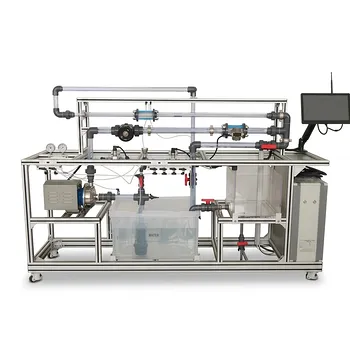
Providing all three types—orifice, Venturi, and rotameter—in a single fluid mechanics pilot plant enables students to compare permanent pressure losses, linearity, and calibration curves directly.
They see that a measurement principle isn’t a universal best; it’s a purposeful trade‑off.
Making the Right Choice for Your Pilot Plant Training Goals
Match the meter to the lesson you want to anchor.
- If your primary focus is teaching Bernoulli’s principle and energy conversions: Install a Venturi meter with a visible multi‑tap manometer board; students can trace the pressure profile and witness kinetic energy recovery.
- If your primary focus is industrial process control and signal transmission: Use an orifice plate with a DP transmitter and square‑root extractor to teach loop tuning and inferred measurement.
- If you need simple, low‑flow visual monitoring in a laboratory‑scale unit: A rotameter provides an intuitive, direct readout that reduces setup time and lets students focus on the unit operation, not the instrumentation.
- If you want students to compare permanent pressure losses and cost‑accuracy trade‑offs: Build a training skid with orifice, Venturi, and rotameter in series, so they can measure the energy sacrificed for each design in real time.
Ultimately, the “fundamental difference” is not just about constant pressure vs. constant area—it’s about the distinct mental models these meters embed. Teach that, and you equip students to navigate any flow measurement challenge with clarity.
Summary Table:
| Feature | Rotameter (Variable Area) | DP Flow Meter (Constant Area) |
|---|---|---|
| Flow Area | Variable (widens as float rises) | Constant (fixed orifice or throat) |
| Pressure Drop (ΔP) | Constant (balanced by float weight) | Variable (changes with flow rate) |
| Output Type | Direct visual readout | Calculated electrical/differential signal |
| Primary Use Case | Low-flow, local manual monitoring | Industrial automation, PID control loops |
| Energy Loss | Moderate and constant | High (Orifice) to Low (Venturi) |
Elevate Your Engineering Education with LABPARK
Looking to equip your laboratory with advanced training systems? LABPARK provides state-of-the-art Educational and Vocational Unit Operations Pilot Plants in chemical engineering, bioprocess & biotech, and environmental & water treatment for universities, research institutes, and enterprises.
Our systems allow students to compare flow measurement technologies, analyze energy losses, and gain hands-on process control experience. Contact LABPARK today to find the perfect pilot plant solution for your institution!
Related Products
- Educational Rotary Disc Liquid-Liquid Extraction Pilot Plant
- Centrifugal Pump Performance and Orifice Flowmeter Calibration Educational Pilot Plant
People Also Ask
- How do density and IFT affect liquid-liquid extraction pilot plants? Optimize Column Performance
- In a liquid-liquid extraction pilot plant, how is a ternary-phase diagram utilized to determine solvent feed requirements?
- How are ternary phase diagrams and LLE data applied in extraction experiments? Optimize Pilot Plant Scale-up
- How Do Selectivity & Distribution Coefficients Influence LLE Pilot Plant Solvent Choice?
- How to Validate BIPs for LLE Pilot Plants? Steps to Align Simulations with Reality