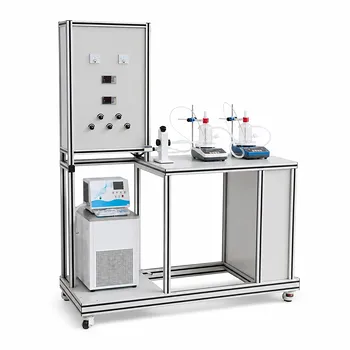
Liquid redistributors are the guardians of separation performance. In packed columns used in chemical engineering unit operations training systems, their primary function is to collect liquid that has migrated toward the column wall—the so-called “wall effect”—and re-spread it evenly across the packing bed below. This action restores uniform gas–liquid contact, directly preserving the mass transfer efficiency that students and researchers depend on for accurate, reproducible experimental data.
Packed columns naturally suffer from liquid maldistribution as flow progresses downward. Liquid redistributors interrupt this degradation by intercepting wall-directed fluid and re-dispensing it uniformly onto the next packing section. They are not just add-ons—they are the critical elements that make separation performance predictable, scalable, and teachable.
Why Uniform Liquid Distribution Is Non‑Negotiable
The Link Between Distribution and Separation Efficiency
Mass transfer in a packed column happens at the wetted surface of the packing. If liquid is unevenly spread, some areas run dry while others flood, creating gas–liquid channeling. This starves the column of effective interfacial area, causing separation efficiency to plummet.
In training pilot plants, the goal is to demonstrate fundamental principles clearly. A column with poor distribution delivers erratic results, masking the true relationship between operating variables and separation performance. Liquid redistributors eliminate that noise.
The Wall Effect – The Hidden Efficiency Killer
As liquid cascades through a packed bed, it tends to migrate toward the column wall. The packing near the wall offers a slightly easier path, and surface tension forces pull liquid outwards. This wall flow creates a liquid-rich annulus and a liquid-starved core.
The result is a severe loss of effective mass transfer area. The core packing volume—where gas ideally rises—becomes under‑utilized. For a training system, this means students see a column that suddenly performs far below theoretical predictions, often without an obvious explanation.
How Liquid Redistributors Solve the Problem
Collect‑and‑Redistribute: The Core Mechanism
A liquid redistributor does two things: it captures the liquid that has reached the wall and re‑dispenses it uniformly across the top of the next packing bed. It usually consists of a collection pan or trough that gathers wall flow, combined with a distribution deck (holes, notches, or weirs) that spreads the liquid evenly again.
Because it resets the initial distribution, the column behaves as a series of shorter packed sections, each starting with an ideal liquid pattern. This segmentation keeps the entire column close to its peak efficiency, regardless of total bed height.
Where They Are Installed
In any training column taller than about 9 meters, or whenever a single packed section exceeds roughly 20 theoretical stages, redistribution becomes mandatory. Research shows that if distribution is maintained, efficiency stays independent of column height—meaning the “scale‑up effect” is essentially a distribution problem.
In pilot‑scale educational equipment, redistributors are often installed between every packed bed segment. This allows students to see a direct before‑and‑after impact on pressure drop, flooding points, and purity profiles.
What This Means for Training Systems
Reproducible Data, Reliable Learning
Unit operations labs are built on consistency. When a student runs a distillation or absorption experiment, the measured HETP (Height Equivalent to a Theoretical Plate) or mass transfer coefficient should reflect the packing’s true capability—not a hidden maldistribution artifact.
By incorporating properly designed redistributors, instructors guarantee that the observed performance is repeatable run after run, letting students focus on analyzing thermodynamics and transport phenomena instead of chasing phantom inefficiencies.
Teaching Scale‑Up Principles
Liquid redistributors are a physical lesson in scale‑up reality. A small‑diameter lab column with a simple inlet nozzle may perform brilliantly. Scale it to industrial diameter without accounting for distribution, and the efficiency collapses. Training systems with segmented packing and intermixed redistributors give students a visceral demonstration that large columns need engineered distribution—and that identical packing height does not guarantee identical performance.
Understanding the Trade‑offs
Complexity and Cost
Redistributors add mechanical complexity. Every added internal increases the column’s cost, assembly time, and potential leak points. In a teaching environment where columns are frequently modified, too many redistributors can complicate maintenance and raise downtime.
Maldistribution Risks from Poor Installation
Gravity‑fed distributors must be perfectly horizontal; even a slight tilt leads to one‑sided flow, negating the redistributor’s purpose. For pressure‑fed designs, a constant flow rate is essential. If these conditions aren’t met, the redistributor itself becomes a source of uneven distribution—a common pitfall that teaches students a hard lesson about installation tolerances.
Liquid Holdup and Pressure Drop
Every redistributor adds a small amount of liquid holdup and creates a local pressure drop. While usually minor, in columns operating near the loading point, excessive redistribution can push the column into premature flooding. When designing a training system, you must balance redistribution frequency with the risk of adding too much resistance, especially for gas‑limited operations.
Not All Redistributors Fit All Duties
A simple orifice‑type redistributor works well with clean, low‑viscosity fluids but can clog with solids. A weir‑type handles wider flow rate turndown but demands careful leveling. Trough‑sieve designs combine collection, distribution, and gas passage in one compact unit, offering flexibility up to a 10:1 turndown ratio, but they come at a higher fabrication cost. Choosing the wrong style for a teaching exercise can hide the very phenomena you want to demonstrate.
Making the Right Choice for Your Training Goal
Use these decision points to select the best liquid redistribution strategy for your educational system.
- If your primary focus is demonstrating baseline separation fundamentals: Install one redistributor per packed section, using a simple weir‑type distributor. This guarantees near‑ideal performance so students can trust the thermodynamically predicted stage counts.
- If your primary focus is studying scale‑up effects and maldistribution: Deliberately design a column that can be run with and without an active redistributor. Let students measure the efficiency drop from wall flow, then show how redistribution restores it—turning a theoretical concept into a quantifiable experiment.
- If your primary focus is handling a wide range of test mixtures (including viscous or slurry feeds): Opt for a trough‑sieve redistributor. Its high turndown and anti‑clogging characteristics let students explore diverse operating windows without changing internals.
- If your primary focus is teaching installation and operational discipline: Use a gravity distributor with leveling indicators and run trials where a deliberate tilt is introduced. The immediate loss of separation sharpens students’ understanding that good engineering is in the details.
Ultimately, liquid redistributors are not just correction devices; they are the instruments that make a packed column a precise, predictable, and pedagogical tool.
Summary Table:
| Feature | Primary Function | Impact on Training |
|---|---|---|
| Wall Effect Mitigation | Collects liquid migrating to column walls and re-spreads it | Ensures accurate simulation of large-scale columns |
| Channeling Prevention | Eliminates dry zones and vapor-liquid bypass | Delivers predictable, reproducible experimental data |
| Segmented Packing | Resets liquid distribution at key bed heights | Teaches students physical scale-up realities |
| Leveling & Installation | Requires strict horizontal alignment | Teaches critical mechanical & operational discipline |
Empower Your Chemical Engineering Lab with LABPARK
Ensure your students and researchers work with high-precision systems that deliver accurate, reproducible experimental data. LABPARK offers advanced Educational and Vocational Unit Operations Pilot Plants in chemical engineering, bioprocess & biotech, and environmental & water treatment designed specifically for universities, research institutes, and enterprises.
Our pilot plants feature industry-standard column internals—including precision-designed liquid redistributors—to help students master mass transfer, fluid dynamics, and scale-up challenges.
Boost your teaching and research outcomes today. Contact LABPARK to discuss your laboratory requirements!
Related Products
- Educational Rotary Disc Liquid-Liquid Extraction Pilot Plant
- Comprehensive Liquid-Liquid Extraction Pilot Plant for Engineering Education
- Ternary Liquid-Liquid Equilibrium Educational Pilot Plant
- Liquid-Liquid Mass Transfer Coefficient Determination Educational Pilot Plant
People Also Ask
- How do density and IFT affect liquid-liquid extraction pilot plants? Optimize Column Performance
- How to Estimate KD for Liquid-Liquid Extraction Pilot Plants Using Henry's Law when Lab Data is Limited
- How are ternary phase diagrams and LLE data applied in extraction experiments? Optimize Pilot Plant Scale-up
- How to resolve emulsion in liquid-liquid extraction? 5 ways to ensure efficient phase separation
- Why is the plait point a critical limit in liquid-liquid extraction pilot plants? Safe LLE Operation