Constant rate period drying is controlled by heat transfer, while falling rate period is limited by internal mass transfer. This fundamental shift changes which process parameters actually matter. During the constant period, increasing the jacket temperature or lowering pressure directly accelerates drying. Once the critical moisture content is crossed, those same adjustments bring diminishing returns—drying time becomes governed by how fast moisture can diffuse out of the solid, not by how hard you drive heat in.
The drying mechanism flips from external to internal control. In the constant rate period, you’re boiling off surface moisture as fast as you can supply heat. In the falling rate period, drying slows dramatically because moisture must travel from inside the solid to the surface. Process optimization needs to pivot from maximizing heat transfer to managing diffusion time and preventing product damage.
The Two Stages of Drying in a Contact Dryer
A contact pilot dryer passes through two distinct periods. Each one imposes a different physical bottleneck and calls for different control strategies.
Constant Rate Period: The Heat-Transfer-Limited Phase
During this initial stage, the solid’s surface remains fully saturated with solvent. Evaporation behaves much like a boiling liquid over a heated surface. The drying rate stays steady as long as operating conditions don’t change.
The primary driving force is the temperature difference between the heating jacket and the solvent’s boiling point at the system pressure. You can increase the drying rate by:
- Raising jacket temperature
- Lowering system pressure (which reduces the boiling point)
- Using cake agitation to continuously expose fresh wet solids to the heated wall
Vapor generation is high during this period. Vacuum pump sizing is critical—the pump must remove large vapor volumes without letting pressure rise, which would weaken the temperature driving force.
Falling Rate Period: The Shift to Mass-Transfer Control
The constant rate period ends when the critical moisture content (X_c) is reached. At that point, the solid surface is no longer saturated. Visible surface liquid disappears, and the drying rate starts to drop.
Mass transfer becomes the limiting mechanism. Residual moisture must diffuse from the interior of the wet cake to the surface before it can evaporate. This internal migration is slow, so the drying curve bends downward and total drying time extends significantly.
In this regime, adding more heat yields diminishing returns. The surface may dry out and overheat while interior moisture is still moving slowly outward. Agitation becomes less effective because simply turning over dry surface doesn’t speed up internal diffusion.
Identifying the Transition: Critical Moisture Content
The transition point is not a universal constant. It depends on wet cake properties such as cake thickness, particle size distribution, and particle morphology. A thicker cake or denser agglomerates push internal moisture transport to become the bottleneck earlier.
On a pilot plant, the critical moisture content is determined experimentally by recording weight loss over time and plotting the drying rate versus moisture content. The moment the rate deviates from its constant plateau, you’ve entered the falling rate period. Knowing this number is essential for scale-up predictions.
How the Mechanism Shift Affects Process Parameters
Because the physical bottleneck changes, the same control knobs deliver completely different results before and after X_c.
Jacket Temperature and Vacuum Level
During the constant rate period, raising jacket temperature or pulling a deeper vacuum increases the driving force for heat transfer and directly boosts the drying rate. The relationship is nearly linear.
In the falling rate period, the impact flattens out. A higher jacket temperature may overheat already-dry surface material while doing little to pull moisture from deep inside. Deepening the vacuum still helps vapor removal but cannot overcome the internal diffusion limit. The risk shifts toward product degradation without meaningful cycle-time gains.
Agitation Strategy
Agitation shines during the constant rate period. It renews the wetted surface, replacing dried crust with fresh wet cake against the heated wall. This keeps the apparent drying rate high.
Once the falling rate period takes over, agitation’s benefit collapses. The limiting step is now inside individual particles. Unless the agitation physically breaks up particles (changing the diffusion path length), it does not accelerate moisture release and may only waste energy or damage particle integrity.
Vacuum Pump Sizing
The maximum vapor load occurs during the constant rate period. If the vacuum pump is undersized, pressure can spike and erode the ΔT driving force exactly when it matters most.
During the falling rate period, vapor evolution is much lower, so the pump is under less stress. Sizing should always be based on the peak vapor generation rate seen before the critical moisture content is reached, not the average.
Understanding the Trade-offs
Optimizing one period can easily hurt the other. Recognizing these tensions is important for any pilot drying study.
The Risk of Over-Driving Heat
Pushing jacket temperature aggressively during the falling rate period is a common mistake. It consumes more energy, can cause hot spots, and may degrade heat-sensitive products without significantly shortening drying time. A smarter approach is to taper heat input after X_c.
Scale-Up Pitfalls
Critical moisture content is cake-depth dependent. A pilot run with a 2-cm bed may show a fast transition; a production dryer with a 15-cm bed will shift to falling rate control much earlier and for much longer. Directly transferring pilot jacket temperatures and cycle times without accounting for thickness will lead to under-dried product or overheated surfaces.
Balancing Cycle Time vs. Product Quality
Aggressive constant-rate drying shortens the overall cycle but leaves you with a longer, more stubborn falling rate tail. Gentle constant-rate drying can produce a more uniform moisture profile and a smoother transition, reducing the risk of surface crusting and degradation. The right balance depends on whether throughput or final quality is the higher priority.
Making the Right Choice for Your Goal
Align your control strategy to the mechanism that actually limits the rate at each stage.
- If your primary focus is maximizing throughput: Push jacket temperature and vacuum hard during the constant rate period. Ensure agitation is active and the vacuum pump is sized for peak vapor load. Accept that the falling rate period will be slow and focus your optimization on the early phase.
- If your primary focus is product quality (avoiding thermal degradation): Reduce jacket temperature once you approach or enter the falling rate period. Use gentle agitation only if it doesn’t produce fines. Monitor surface temperature to prevent hotspots.
- If your primary focus is scale-up predictability: Experimentally determine the critical moisture content for your actual cake thickness and particle size distribution at pilot scale. Use that data to build a falling-rate drying model that accounts for diffusion limitations, rather than blindly scaling heat input.
Tailoring your process parameters to the dominant drying mechanism—external heat transfer first, internal mass transfer second—is what separates an efficient pilot campaign from one that wastes time and product.
Summary Table:
| Feature | Constant Rate Period | Falling Rate Period |
|---|---|---|
| Limiting Mechanism | External Heat Transfer | Internal Mass Transfer (Diffusion) |
| Moisture Location | Saturated Surface | Internal Solid Structure |
| Temp/Vacuum Impact | High (Directly increases drying rate) | Low (Diminishing returns, degradation risk) |
| Agitation Effect | High (Exposes wet solids to wall) | Low (Minimal impact unless breaking particles) |
| Vapor Generation | Peak load (Sizing bottleneck) | Low / Declining load |
Optimize Your Drying and Scale-Up Processes with LABPARK
Transitioning from pilot-scale drying to full production requires precise control over heat and mass transfer. LABPARK provides state-of-the-art Educational and Vocational Unit Operations Pilot Plants in chemical engineering, bioprocess & biotech, and environmental & water treatment designed specifically for universities, research institutes, and enterprises.
Ready to elevate your research and process optimization? Contact us today to discover how our pilot plants can streamline your operations!
Related Products
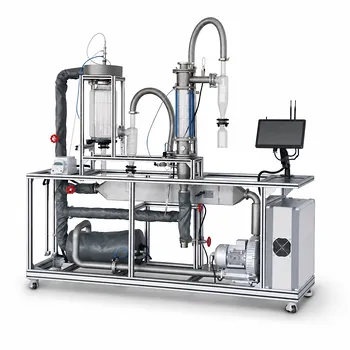
- Multi-Functional Drying Educational Unit Operations Pilot Plant
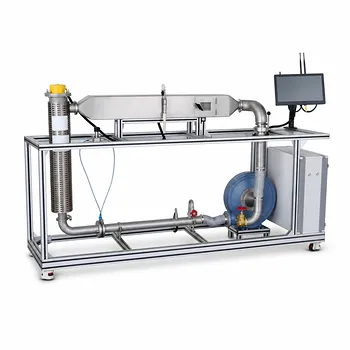
- Circulating Wind Tunnel Drying and Convective Heat Transfer Coefficient Determination Educational Pilot Plant
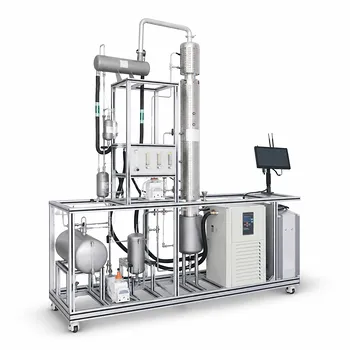
- Continuous Batch Extractive Distillation Educational Pilot Plant
- Continuous Sieve-Plate Distillation Pilot Plant for Unit Operations Laboratory Education
People Also Ask
- How do deviations in estimating latent heat impact pilot plant thermal systems? Avoid hardware mis-sizing.
- Why is the chemical plant startup schedule crucial? De-risk scale-up with pilot plants.
- Why Use PTFE & Hastelloy in Chemical Pilot Plants? Prevent Corrosion & Ensure Safety
- How to study gasification in pilot plants? Compare exit gas composition & efficiency
- When to transition from PID to adaptive control in pilot plants? Key process indicators.