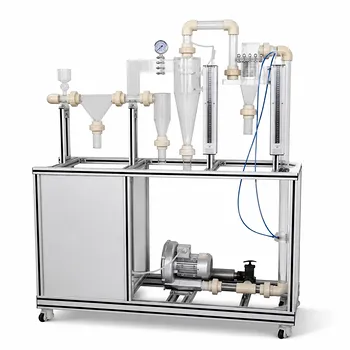
When operating a hydrocyclone in a pilot unit, the separation efficiency you achieve and the rate of material wear are locked in a direct, physical trade-off. Efficiency is dictated by the cyclone’s diameter, the properties of your slurry, and the feed pressure you apply. Material wear, however, is an unavoidable consequence of the high particle velocities needed to hit fine cut points, demanding that pilot-scale equipment be built with robust, wear-resistant designs from the start.
The core challenge in a hydrocyclone pilot plant is that the same centrifugal forces required to achieve a sharp d50 cut size also drive severe abrasive wear against the cyclone walls. Managing this means selecting the right cyclone diameter and materials while using the pilot system to map the trade-offs between pressure, throughput, and equipment longevity.
The Physics of Separation: How Particle and Fluid Properties Dictate Efficiency
In a unit operations pilot plant, the hydrocyclone serves as a hands-on model of industrial centrifugal sedimentation. Everything you can adjust—from feed composition to pressure—shifts the separation outcome in a measurable way.
The Role of Cyclone Diameter and the d50 Cut Point
The diameter of the hydrocyclone is the dominant geometric factor setting your separation capability. Mini-hydrocyclones, with diameters under 15 mm, are essential to separate ultra-fine particles in the 2 to 5 μm range.
The target performance metric is the cut size, or d50—the particle diameter at which separation efficiency reaches 50%. The smaller the cyclone, the smaller the d50 it can achieve. The empirical relationship between fractional efficiency and d50 underscores why: any shift in d50 dramatically reshapes how much of each particle size class is recovered.
Feed Characteristics: Concentration, Viscosity, and Particle Size Distribution
Separation efficiency is not a property of the cyclone alone. It is a response to the slurry you feed it. Higher solids concentrations increase particle-particle interactions that can hinder separation sharpness. Similarly, a more viscous liquid medium resists particle migration, coarsening the effective cut size.
In a pilot plant, you can manipulate feed concentration and fluid properties deliberately. This allows you to observe how a thicker suspension pushes the d50 upward or how a wider particle size distribution challenges separation performance, directly linking fluid dynamics to a critical design parameter for scale-up.
Operating Pressure and Flow Rate: The Efficiency-Energy Trade-off
Increasing feed pressure forces a higher volumetric flow rate through the cyclone, intensifying centrifugal forces. This improves separation efficiency for a given particle size but at the cost of a steep pressure drop. The energy consumption rises disproportionately, and the heightened velocity inside the vortex can generate enough turbulence to degrade separation performance if pushed too far.
Pilot units are specifically designed to let operators map this balance. By varying feed pressure, you can plot the exact relationship between pressure drop, d50, and overall separation sharpness, yielding the data required to design an energy-efficient industrial installation.
The Abrasive Reality: Managing Material Wear in Pilot Units
While you chase higher separation efficiency by shrinking cyclone diameter or raising pressure, you accelerate a destructive mechanism: abrasive wear. This is not a secondary concern—it is a primary design criterion for any pilot-scale hydrocyclone.
Why High Separation Efficiency Accelerates Wear
To trap fine particles, you must accelerate the slurry to high tangential velocities along the internal wall. Those particles, even if microscopic, become miniature cutting tools. The result is severe abrasive wear concentrated at the inlet and along the cyclone cone.
The smaller the cyclone, the tighter the radius, and the higher the wall velocity for a given throughput. Thus, the same mini-hydrocyclone that delivers a 2 μm cut point is also the most susceptible to rapid material loss, directly threatening reproducibility in a training or research setting.
Material Selection and Liner Strategies
Because wear is inevitable, the primary line of defense is material choice. Pilot and vocational training units must be constructed from wear-resistant materials or feature replaceable protective liners. Options include hardened alloys, polyurethane, or ceramic inserts, each offering a different balance of lifespan, cost, and chemical compatibility.
Using liners is a particularly educational strategy. It allows students to compare the wear rate of different materials under identical conditions, making the economic and operational trade-off between upfront material cost and long-term replacement frequency a tangible lesson.
Pilot Plant Design for Experimentation and Scale-Up
The true value of a hydrocyclone pilot unit lies in its ability to reveal how these individual factors interact. The physical configuration of the system itself is a key teaching and research tool.
Single-Stage vs. Multi-Cyclone Configurations
A single hydrocyclone has a fixed capacity-efficiency curve. To demonstrate industrial optimization, a pilot system should be plumbed to allow both single-stage and multi-stage (series/parallel) configurations.
Series operation achieves a sharper overall separation, as the overflow from a first cyclone is re-processed in a second. Parallel arrangements multiply throughput while maintaining the cut size of an individual cyclone. Being able to switch between these modes on a pilot skid shows how to reconcile purity, recovery, and capacity requirements.
Demonstrating the d50 Shift
When you alter feed concentration, viscosity, or pressure, the d50 value shifts predictably. The empirical fractional efficiency formula quantifies this: a smaller d50 tightens the separation curve, capturing more fine material. A pilot unit equipped with pressure sensors, flow meters, and sample ports makes this shift observable in real time, cementing the connection between theoretical models and actual process behavior.
Understanding the Trade-offs and Limitations
The hydrocyclone is not a universal separator. Acknowledging its inherent compromises is as important as showcasing its strengths.
- Sharpness vs. Energy: A very high feed pressure may nominally improve d50 but creates turbulent eddies that re-entrain particles, reducing sharpness and wasting energy.
- Fine Separation vs. Wear: The mini-hydrocyclones required for sub-10 μm cuts suffer the highest wear rates, demanding frequent liner inspection and replacement.
- Liquid-Liquid Applications: In a pilot context, attempting to use a hydrocyclone for liquid-liquid systems is a valuable cautionary demonstration. The intense shear forces can break droplets, causing re-emulsification and rendering the separator less effective than a gravity decanter.
Making the Right Choice for Your Pilot Unit
Your specific educational or research goal should dictate how you configure and operate the hydrocyclone pilot plant.
- If your primary focus is training on ultra-fine separation: Select mini-hydrocyclones with sacrificial ceramic liners and a multi-stage series configuration to demonstrate cut size improvement and the direct consequence of wear.
- If your primary focus is generating scale-up data: Use a flexible system where you can independently vary feed pressure, slurry concentration, and cyclone diameter to map the full d50 and pressure drop relationship for your target slurry.
- If your primary focus is maximizing equipment longevity: Prioritize hydrocyclones with thick, replaceable polyurethane liners and design experiments to stay within moderate feed pressure ranges, sacrificing a degree of fine-particle efficiency for sustained, reproducible operation.
Master the interplay between particle physics and material durability, and your pilot hydrocyclone becomes more than a teaching tool—it becomes a predictive instrument for industrial design.
Summary Table:
| Parameter | Impact on Separation Efficiency | Impact on Material Wear |
|---|---|---|
| Smaller Cyclone Diameter | Decreases $d_{50}$ (finer cut size) | Increases wear due to higher wall velocities |
| Higher Feed Pressure | Improves efficiency (higher centrifugal force) | Accelerates abrasive wear on walls & inlet |
| Higher Solids Concentration | Lowers efficiency (hinders particle separation) | Increases mechanical abrasion |
| Higher Fluid Viscosity | Coarsens cut size (increases $d_{50}$) | Negligible impact compared to solids |
Optimize Your Unit Operations Training with LABPARK
Are you looking to demonstrate complex process dynamics like hydrocyclone separation and wear trade-offs? LABPARK provides premium Educational and Vocational Unit Operations Pilot Plants in chemical engineering, bioprocess & biotech, and environmental & water treatment for universities, research institutes, and enterprises. Our robust systems are built to withstand rigorous training while delivering clear, reproducible data.
Ready to elevate your engineering lab? Contact our expert team today to discuss your customized pilot plant requirements!
Related Products
People Also Ask
- Why is pressure drop characterization critical in separation pilot plants? Key operational insights.
- What are the key thermodynamic considerations for gas mixture modeling? Expert Guide
- What are the primary operational objectives and physical requirements when running heterogeneous separation pilot plants?
- What are the trade-offs in olefin-paraffin separation? Optimize Pilot Plant Performance
- What are the material limitations of gas separation pilot plants? Key factors to consider.