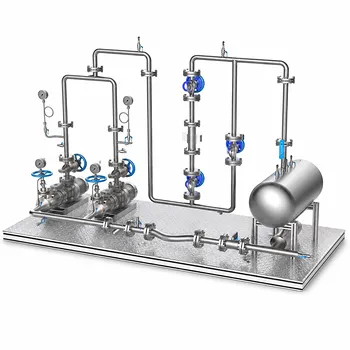
Clean-in-Place (CIP) is the critical, non‑negotiable backbone of contamination control in any educational bioprocess pilot plant. The standard design requirements demand a gravity‑drained system that eliminates dead zones, crevices, and pockets, using diaphragm valves and plate heat exchangers for inspectability. The proven cleaning sequence follows a rigorous 12‑step cycle that combines high‑pressure water, an alkaline wash (1 mol/L NaOH), an acid wash (phosphoric or nitric acid), and staged rinses to remove organic soils and neutralize mineral deposits.
Effective CIP in educational pilot plants rests on two pillars: a physical design that leaves no place for biological residue to hide, and a disciplined chemical sequence that ensures both organic and inorganic foulants are completely removed before the next batch.
The Design Imperative: Why Every Detail Matters
Gravity Drainage: The Non‑Negotiable Principle
The entire piping and vessel network must be freely draining by gravity.
This eliminates dead legs, crevices, and sharp bends where process fluids or cleaning chemicals could pool.
Without complete drainage, even the most aggressive chemical wash leaves behind pockets of contamination that trigger cross‑contamination between batches.
Valve and Heat Exchanger Selection
Diaphragm valves are preferred because their design has no internal crevices and can be easily inspected or disassembled.
Plate heat exchangers are favored over shell‑and‑tube designs because they can be fully opened for visual inspection and manual cleaning.
Both choices directly support the core design goal: no hidden surfaces where soil or microbes can survive an automated cycle.
The Role of Inspectability
In a teaching environment, automated CIP alone is not enough.
Components prone to scaling, such as heat exchangers, must allow easy disassembly and manual inspection to verify cleaning effectiveness.
This hands‑on check reinforces engineering principles and catches failures that a purely automated sensor might miss.
The Standard 12‑Step CIP Cycle
Pre‑Rinse and Initial Drain
- High‑pressure water spray to displace loose soils and wet all surfaces.
- Draining to remove the gross soil load before chemicals are introduced.
Alkaline Wash – Organic Soil Removal
- Alkaline wash using a 1 mol/L NaOH solution. This caustic step saponifies fats, hydrolyzes proteins, and lifts organic biofilms.
- Draining to remove the spent chemical and loosened soils.
Intermediate Rinse
- Tap water rinse to flush residual alkaline solution from the system.
- Draining to ensure no rinse water dilutes the next chemical step.
Acid Wash – Mineral Deposit Control
- Acid wash using 1 mol/L phosphoric or nitric acid. This neutralizes mineral scales, removes inorganic deposits, and passivates stainless steel surfaces.
- Draining to eliminate all spent acid.
Final Rinses and Final Drain
- Tap water rinse to remove residual acid and any lingering particulates.
- Draining to clear the rinse water.
- Deionized water rinse to eliminate any trace ions that could interfere with the next bioprocess run.
- Final draining to leave the system absolutely dry and ready for the next cycle.
Understanding the Trade‑offs and Pitfalls
Limitations of Automated CIP
Even a perfect 12‑step cycle may not clean complex geometries that violate the gravity‑drainage principle.
A single dead leg or sharp bend can shield microbes from chemical contact, demanding manual intervention or redesign.
Educational plants must teach that automation is an enabler, not a substitute for sound hydraulic design.
Chemical Safety and Material Compatibility
1 mol/L caustic and acid solutions are corrosive and pose handling risks.
Stainless steel components are generally compatible, but extended contact with hot acids can cause pitting, especially if the system is not fully drained between steps.
Process safety measures—such as conductivity sensors to verify complete rinsing—are essential when students are operators.
When Frequent Manual Inspection Is Still Required
Plate heat exchangers can develop micro‑scaling between plates that only a trained eye can spot.
Relying solely on CIP outputs without periodic disassembly and visual check risks a slow buildup of deposits that eventually compromises heat transfer and sterility.
Making the Right Choice for Your Pilot Plant
The best approach depends on the educational goals you prioritize.
- If your primary focus is teaching core bioprocess engineering: Embed the 12‑step sequence into every batch run, but spend equal time explaining why the plant is gravity‑drained and why valves and heat exchangers are chosen for inspectability.
- If your primary focus is maximizing flexibility for multiple organisms or products: Select components that can be completely disassembled manually, so students can experience both automated CIP and the mechanical side of cleaning.
- If your primary focus is process safety and analytical skill‑building: Integrate inline conductivity and pH probes between each rinse step, and let students decide when a rinse is truly complete before proceeding.
Mastering CIP in a pilot plant means you never treat cleaning as an afterthought; you design it into every pipe and every step, creating a system that reliably clears the way for the next breakthrough.
Summary Table:
| CIP Element | Specifications / Steps | Primary Function / Benefit |
|---|---|---|
| Drainage Design | Gravity-drained layout | Eliminates dead legs, pockets, and chemical pooling |
| Valve Selection | Diaphragm valves | Crevice-free construction for easy inspectability |
| Heat Exchanger | Plate heat exchangers | Allows complete disassembly for visual verification |
| Alkaline Wash | 1 mol/L NaOH solution | Saponifies fats and removes organic biofilms |
| Acid Wash | 1 mol/L Phosphoric/Nitric Acid | Neutralizes mineral scales and passivates stainless steel |
| Final Rinse | Deionized water rinse | Eliminates trace ions to prevent batch interference |
Elevate Your Practical Training with Industry-Grade Pilot Plants
Building a reliable, contamination-free learning environment requires robust engineering. LABPARK provides premium Educational and Vocational Unit Operations Pilot Plants in chemical engineering, bioprocess & biotech, and environmental & water treatment for universities, research institutes, and enterprises worldwide. Our systems are engineered to industrial standards, giving your students hands-on experience with realistic CIP sequences and gravity-drained architectures.
Contact LABPARK today to discuss how we can customize a pilot plant solution to fit your educational and research goals!
Related Products
People Also Ask
- Why distinguish Newtonian & non-Newtonian fluids in pilot plants? Prevent design errors.
- Gear vs Centrifugal Pumps in Pilot Plants: How do operating characteristics and power requirements differ?
- How is shaft work (We) used to determine pump specifications? Optimize pilot plant fluid transport design.
- How to determine the operating point of a centrifugal pump in a pilot plant? A practical guide.
- How does fluid density affect pump head and pressure? Avoid Pilot Plant Motor Overload