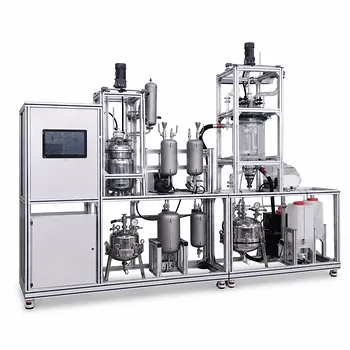
Supercritical fluid extraction (SFE) with CO₂ turns a safe, abundant gas into a tunable, residue-free solvent—directly reshaping what a pilot plant can achieve. In practice, this means shorter extraction times, complete elimination of toxic organic solvents, and the ability to process heat-sensitive materials without thermal degradation. The operation also gives researchers hands-on control over supercritical state variables—temperature, pressure, and co-solvents—to precisely tune selectivity and yield. It’s a cleaner, faster, and more instructive way to run extraction unit operations.
The central insight: SFE with CO₂ compresses the extraction timeline, simplifies downstream purification, and aligns pilot operations with green chemistry principles—all while making supercritical thermodynamics a tangible, teachable process.
Why SFE with CO₂ Redefines Pilot Plant Workflows
The operational advantages go far beyond substituting one solvent for another. They hinge on the unique physical properties that emerge when CO₂ is compressed and heated past its critical point (31 °C, 7.38 MPa). In that supercritical state, the fluid marries liquid-like density with gas-like diffusivity, reshaping mass transfer, safety, and process simplicity.
Eliminating Toxic Solvent Residue and Disposal Headaches
SC-CO₂ is non-toxic, non-flammable, and leaves zero chemical residue in the final product. Unlike dichloromethane or other chlorinated solvents—which present toxicity and carcinogenicity risks and require elaborate recovery trains—CO₂ simply gasifies when pressure is released. The extract precipitates pure while the solvent vents or is recompressed for reuse. This cuts waste disposal steps and dramatically reduces volatile organic compound (VOC) emissions, often by 60–80 %.
Unlocking High-Speed Mass Transfer
Supercritical CO₂ possesses gas-like low viscosity and high diffusivity, coupled with the dissolving power of a liquid. That combination shrinks the boundary layer resistance that slows conventional liquid extractions. The result is rapid mass transfer and a fast approach to equilibrium—so extractions that once took hours can often be completed in minutes.
Preserving Heat-Sensitive and Bioactive Compounds
The critical temperature of CO₂ sits near room temperature (31.1 °C). Extractions can be run at mild thermal conditions, preventing the denaturation or oxidation of fragile molecules. Essential oils, vitamins, antibiotics, and delicate natural flavours retain their potency—an impossibility with hot solvent reflux or steam distillation methods.
Fine-Tuning Selectivity On-the-Fly
In a pilot plant SFE unit, operators adjust pressure, temperature, and co-solvent ratios to dial in solvent strength. At higher pressures, density climbs, dissolving heavier or more polar species; adding a small percentage of ethanol or another modifier tailors polarity. This hands-on manipulation of supercritical state variables makes selectivity a controllable operating parameter, not a fixed property of the solvent.
Simplifying Solvent Recovery and Recycle
After extraction, reducing the pressure causes CO₂ to revert to a gas instantly. The product drops out cleanly, with no need for distillation or evaporation. The gas can be captured, condensed, and pumped back into the process, slashing energy consumption and eliminating the multi-step solvent‑recovery trains typical of organic‑solvent plants.
Navigating the Operational Trade-offs
No technology is without its constraints. Being aware of them is crucial for realistic pilot plant design and scale-up.
High-Pressure Equipment Demands
Operating reliably above 7.38 MPa requires robust, capital-intensive vessels and precision control systems. The upfront investment and safety engineering are non-trivial. However, for high-value extracts and educational settings, the process safety record of CO₂ compared to flammable or carcinogenic solvents often justifies the cost.
Solubility Limitations for Polar Compounds
Pure CO₂ is a non-polar solvent. Highly polar or ionic species show low solubility without a co-solvent. While adding modifiers mitigates this, it reintroduces some of the separation complexity that SFE aims to avoid. A clear solubility screening is essential before committing a target compound to scCO₂ extraction.
Energy for Compression and Cooling
Bringing CO₂ to the supercritical state does consume energy. Yet this energy penalty is frequently offset by the avoidance of solvent recovery distillation, waste treatment, and the shortened batch cycle times.
Making the Right Choice for Your Pilot Plant Goals
The decision to adopt SFE with CO₂ should be driven by the specific outcomes you value most.
- If your primary focus is green chemistry and regulatory compliance: SFE eliminates hazardous air pollutants and solvent waste streams at the source, making environmental permitting and operator safety far simpler.
- If your primary focus is processing thermally labile high-value compounds: The near-ambient critical temperature preserves bioactivity and flavour profiles that no hot-solvent method can match.
- If your primary focus is rapid process development and hands-on learning: The immediate response of selectivity to pressure and temperature turns each run into a dynamic lesson on phase behaviour and mass transfer.
- If your primary focus is streamlining downstream processing: The self-removing solvent collapses an entire purification step, delivering a pure product and recyclable CO₂ with minimal energy input.
A well-configured SFE pilot plant doesn’t just extract—it compresses the entire development cycle into a safer, faster, and more instructive operation.
Summary Table:
| Operational Advantage | How It Works | Main Benefit |
|---|---|---|
| Zero Toxic Residues | CO2 gasifies at ambient pressure | Eliminates solvent disposal & VOC emissions |
| Fast Mass Transfer | High diffusivity & low viscosity of SC-CO2 | Shorter batch times (minutes vs. hours) |
| Low-Temp Processing | Critical temperature is only 31.1°C | Prevents thermal degradation of bioactives |
| Tunable Selectivity | Adjust pressure, temperature, & co-solvents | Precise control over extraction yields |
| Simple Recovery | CO2 depressurizes and recycles easily | Eliminates complex distillation steps |
Elevate Your Lab with Advanced Unit Operations
Are you looking to integrate cutting-edge extraction technologies like supercritical fluid extraction into your curriculum or research? LABPARK designs and provides premium Educational and Vocational Unit Operations Pilot Plants in chemical engineering, bioprocess & biotech, and environmental & water treatment for universities, research institutes, and enterprises.
Bring hands-on, industry-standard training and research capabilities to your institution. Contact LABPARK today to discuss your custom pilot plant configuration!
Related Products
- Supercritical High-Gravity Flash Evaporation Educational Unit Operations Pilot Plant
- Comprehensive Liquid-Liquid Extraction Pilot Plant for Engineering Education
- Educational Rotary Disc Liquid-Liquid Extraction Pilot Plant
- Gallium and Indium Selective Extraction Educational Pilot Plant
People Also Ask
- How is the heat transfer area calculated for an evaporation unit operations pilot plant during experimental design? Guide
- How to select educational evaporator pilot plants for thermal & scaling solutions? Complete Guide
- How to Connect Benchtop Evaporation to Pilot Plants in Chemical Engineering Education
- What is the practical significance of Kb in pilot plant evaporation? Master process design.
- How are Dühring plots applied in evaporation pilot plants? Practical guide to boiling point prediction