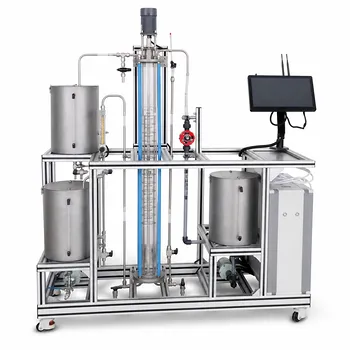
Integrating an extractive process directly into a single, partitioned column shell transforms how we teach advanced separation. This is the Extractive Dividing Wall Column (EDWC)—a process-intensified system that combines an entrainer’s ability to break azeotropes with a vertical dividing wall to separate a ternary mixture into three pure products in one unit. In a pilot-plant setting, the key operational principle revolves around strategic thermal coupling and heat integration, which drastically lowers energy demand while giving students a live, hands-on platform to study sustainability and advanced process control.
The EDWC merges the azeotrope-breaking selectivity of extractive distillation with the spatial and thermal efficiency of a dividing wall column. The result is a single-column system that slashes energy consumption by up to 30% or more, eliminates an entire column shell, and transforms a pilot plant into a hub for learning real-world process intensification, dynamic optimization, and modern control strategies like Model Predictive Control (MPC).
How an Extractive Dividing Wall Column Works
To appreciate the energy-saving edge, you first need to understand the operational principles that make an EDWC orchestrate three separations inside one vessel.
The Role of the High-Boiling Entrainer
Extractive distillation overcomes close-boiling or azeotropic mixtures by feeding a heavy, non-volatile solvent into the column.
This entrainer selectively alters the relative volatility of the key components, making one of them more volatile and easier to separate.
In an EDWC, the entrainer is introduced above the feed stage on the same side of the dividing wall, maximizing its interaction with the feed before internal splits occur.
The Dividing Wall Principle in Action
A vertical partition wall splits the column shell into separate zones—typically a prefractionator side and a main rectification/stripping section.
The feed and entrainer enter the prefractionator side, where an initial separation removes the lightest component from the top.
Meanwhile, the intermediate-boiling product is recovered as a side draw from the opposite side of the wall, and the heaviest component plus entrainer exit from the bottom, ready for solvent recovery and recycle.
Thermal Coupling That Eliminates Remixing
In a conventional two-column sequence, the intermediate component can remix at the intermediate streams, wasting heat.
An EDWC uses internal thermal coupling: vapor and liquid flows across the dividing wall are shared between sections, preventing remixing and reducing the overall reboiler duty.
This self-contained energy loop is a pivotal teaching tool for demonstrating energy balances and pinch-point analysis in a live environment.
Managing the Degrees of Freedom
An EDWC inherently possesses more control degrees of freedom—multiple product draws, side heater/cooler options, and varying entrainer-to-feed ratios.
Integrating such a column into a pilot plant lets students and researchers program advanced control strategies, such as Model Predictive Control (MPC) and real-time optimization (RTO), to maintain product purities under fluctuating feed conditions.
Hands-on experience with these complex loops directly connects theoretical control engineering to rugged industrial practice.
The Direct Energy-Saving Advantage
The energy benefits are not merely incremental; they stem from a fundamental redesign of the separation task.
Reduced Reboiler and Condenser Load
By combining two or more column sections into one thermally coupled envelope, an EDWC eliminates the need for a separate reboiler and condenser on an intermediate column.
The primary reference highlights that this configuration significantly lowers overall energy consumption through thermal coupling and heat integration—often 25–40% less than a traditional extractive distillation sequence.
These savings are immediately observable on a pilot-plant utility meter, turning energy efficiency into a tangible metric for students and operators.
Smaller Footprint, Lower Capital and Operational Costs
Less equipment means a smaller physical plant, which directly reduces capital investment.
In vocational and university settings, this smaller footprint frees up lab space and simplifies maintenance, allowing more pilot-plant units to be installed in the same teaching facility.
More importantly, the operational cost savings translate into longer, more meaningful experimental campaigns without straining budgets.
Synergy With Continuous Learning
Because real-time data from an EDWC pilot plant consistently shows lower steam and cooling water usage, learners can quantify the link between process intensification and sustainability.
They can model and validate those savings using steady-state and dynamic simulation tools, then compare predictions to live plant data—building an evidence-based mindset toward sustainable design.
Understanding the Trade-offs
While the EDWC offers compelling advantages, it also introduces operational complexity that must be managed in an educational context.
Increased Control Complexity
The same thermal integration that saves energy creates strong interactions between column sections, making the process less forgiving.
Tight control of reflux, entrainer flow, side draw, and differential pressure across the wall is mandatory.
For a pilot plant, this complexity is actually a training asset because it compels students to master advanced multivariable control and troubleshooting.
Steeper Start-Up and Shutdown Learning Curve
Establishing stable liquid and vapor splits across the dividing wall demands careful commissioning.
Unexpected disturbances—feed composition spikes or cooling water fluctuations—can rapidly degrade product purity if the control system is not well-tuned.
Instructors should budget extra lab time for students to study these transient behaviors, turning potential frustration into deeper process understanding.
Model Fidelity Requirements
Designing and operating an EDWC requires accurate thermodynamic models for the entrainer–feed system.
Pilot plants must be equipped with robust simulation software and possibly soft sensors to predict internal profiles, as direct measurement inside the partitioned zones is limited.
This reliance on models teaches the critical lesson that process intensification is as much about smart sensing and prediction as it is about hardware.
Making the Right Choice for Your Training Goal
How you incorporate an EDWC pilot plant depends entirely on the learning outcomes you want to emphasize.
- If your primary focus is industrial relevance and process intensification: Prioritize an EDWC because it mirrors modern refineries and chemical plants aiming for compact, energy-efficient designs. Use it to run case studies comparing utility consumption against a conventional two-column extractive setup.
- If your primary focus is fundamental thermodynamics and separations: Let students measure the tangible energy savings and calculate the entrainer’s effect on relative volatility. The transparent thermal coupling teaches the true cost of remixing in ways a textbook cannot.
- If your primary focus is advanced control engineering: Exploit the EDWC’s multiple degrees of freedom to implement MPC, RTO, and dynamic real-time optimization. This single unit becomes a playground for demonstrating how to stabilize an inherently coupled process.
- If your primary focus is sustainability metrics: Use the EDWC to generate real consumption data for life-cycle assessments, showing how process intensification translates into lower carbon footprints and resource consumption.
An EDWC in your pilot plant does more than separate chemicals—it separates the theoretical from the practical, preparing the next generation of engineers to design and operate the sustainable, intensified processes the industry demands.
Summary Table:
| Key Feature | Operational Principle | Educational / Energy Advantage |
|---|---|---|
| High-Boiling Entrainer | Feeds solvent to alter relative volatility | Breaks close-boiling/azeotropic mixtures in one shell |
| Dividing Wall Design | Splits column into prefractionator & main sections | Eliminates a secondary column, saving space and CAPEX |
| Thermal Coupling | Shares internal liquid and vapor flows | Prevents remixing, reducing utility consumption by 25–40% |
| Dynamic Control Loops | Manages multiple draws, reflux, and feed splits | Serves as a live platform for Model Predictive Control (MPC) |
Elevate Your Training and Research with LABPARK
Ready to bring cutting-edge process intensification to your labs? LABPARK provides state-of-the-art Educational and Vocational Unit Operations Pilot Plants in chemical engineering, bioprocess & biotech, and environmental & water treatment.
We help universities, research institutes, and enterprises bridge the gap between theory and industry. Our pilot systems—including advanced distillation and EDWC setups—equip your students and researchers with hands-on experience in thermal coupling, energy conservation, and modern process control.
Contact LABPARK today to design the ideal pilot plant solution for your institution!
Related Products
- Continuous Batch Extractive Distillation Educational Pilot Plant
- Educational Rotary Disc Liquid-Liquid Extraction Pilot Plant
- Comprehensive Liquid-Liquid Extraction Pilot Plant for Engineering Education
- Multi-Functional Special Distillation Educational Pilot Plant
People Also Ask
- How is an extractive distillation pilot plant configured? Setup & Entrainer Roles
- Wilson vs. UNIQUAC: How to Choose the Right Thermodynamic Model for Your Pilot Plant
- How does the feed thermal state influence distillation pilot plant design and utility consumption?
- How to Configure a Distillation Pilot Plant? Key Steps for Multi-Mode Setup
- Why use non-ideal VLE calculations in distillation pilot plants? Ensure accurate scale-up & purity