The primary design purpose of a diffusional (XLK-type) cyclone is to achieve high-efficiency separation of fine particles, while its unique base geometry is engineered specifically to create a "dead zone" that eliminates dust re-entrainment. In laboratory settings, it serves as a benchmark for demonstrating how advanced aerodynamic control can capture particles under 10 micrometers—material that would escape a conventional cyclone.
The XLK-type cyclone solves the central problem of dust re-entrainment by physically divorcing the high-velocity separation chamber from the settled dust hopper. It introduces an outwardly tapering shell and a shielded collection zone under an inverted reflection cone, ensuring that the powerful ascending gas vortex never makes contact with the already-separated powder.
Deconstructing the XLK-Type Cyclone Design
The surface-level question asks about preventing re-entrainment, but the deeper need is understanding how a passive mechanical shape can control a chaotic vortex to protect separation efficiency. The XLK-type achieves this through a two-part strategy.
How the Outwardly Tapering Shell Manages Flow
Unlike straight-walled cyclones, the XLK type uses an outer shell that tapers outwards. This means the body becomes wider as the gas spirals downward. This geometric choice slows the tangential velocity of the gas near the wall. By decelerating the outer vortex, the design reduces the turbulence caused by skin friction, which is a primary trigger for particle bounce and re-entrainment.
This tapering also provides a smooth transition for the settled dust. Particles are guided down a steep incline toward the collection gap, minimizing the chance of dust accumulating on ledges where velocity fluctuations could kick them back into the gas stream.
The Inverted Reflection Cone: A Critical Boundary
The most critical component for preventing re-entrainment is the inverted conical reflection plate at the bottom of the separator. It sits between the main cyclone body and the hopper, performing three distinct jobs:
- Physical Shielding: The plate acts as a literal roof over the hopper. The ascending inner vortex, which still carries centrifugal energy, is forced to turn back upward above the plate. It cannot extend its rotation deep into the hopper, creating a calm zone underneath.
- Stagnant Zone Creation: The space beneath the reflection cone is in an aerodynamic shadow. In this low-turbulence "dead zone," gravity becomes the absolute dominant force. Dust agglomerates can fall through the annular gap without fighting a swirling updraft.
- Discharge Gap Geometry: The gap between the edge of the reflection plate and the tapering wall is the only path for solids. The specialized XLK design optimizes this gap so that dust slides out efficiently, yet the high-speed vortex above is too structurally wide to squeeze through the narrow slot and disturb the hopper.
Why This Matters for Sub-10-Micron Particles
Fine dust (under 10 micrometers) is usually the hardest to separate and the easiest to re-entrain. Its low mass means it wants to follow the gas streamlines rather than settle out. The XLK’s purpose is specifically to capture this fraction. Because the reflection plate prevents the scrubbing action of the gas vortex on the hopper surface, even these ultra-fine, low-mass powders remain trapped once they sediment there.
The design makes it a vital teaching tool in laboratory experiments. It isolates a clean thermodynamic separation from a messy mechanical one, allowing students to measure ideal grade efficiency curves without the data distortion caused by re-entrained dust.
Understanding the Trade-offs
While the XLK-type design is exceptionally effective at preventing re-entrainment, objective evaluation requires acknowledging its compromises relative to standard designs.
- Increased Physical Size: The outwardly tapering shell occupies a larger footprint than a straight-walled cyclone with the same inlet capacity, which can be a constraint in dense laboratory setups or scale-up applications.
- Pressure Drop Sensitivity: The inverted reflection cone introduces a flow reversal that, if the geometry is not perfectly matched to the flow rate, can create a slight penalty in energy consumption compared to a simple hopper discharge.
- Hopper Sealing Requirements: The design relies on a stagnant hopper zone. If the hopper below the reflection cone is not adequately sealed, ambient air can leak in, instantly destroying the "dead zone" barrier and causing catastrophic re-entrainment, effectively neutralizing the device's main benefit.
Making the Right Choice for Your Laboratory Goal
The XLK-type cyclone is not always the default choice, but it excels under specific experimental conditions. Base your choice on the clarity of your separation data.
- If your primary focus is demonstrating ideal grade efficiency: Choose the XLK-type. Its ability to eliminate re-entrainment means your measured outlet emissions reflect only the actual separation limits of the vortex, not operational dust leakage.
- If your primary focus is maximizing throughput in a compact space: A straight-walled, high-throughput design might be more suitable. The XLK’s added volume and tapering prioritize separation precision over raw volumetric capacity.
- If your primary focus is recovering a valuable, fine catalyst or pharmaceutical powder: The "dead zone" collection makes this the superior choice. It prevents the loss of high-value ultrafine particles that conventional devices would simply blow back out the top.
Focusing on the aerodynamic isolation of the collection zone, rather than just the vortex speed, is the defining insight that guarantees clean, reliable particle recovery in your experiments.
Summary Table:
| Key Feature | Design Mechanism | Primary Benefit |
|---|---|---|
| Outwardly Tapering Shell | Decelerates gas velocity near the wall | Reduces turbulence, particle bounce, and friction |
| Inverted Reflection Cone | Shields the hopper, creating a stagnant "dead zone" | Prevents the vortex from re-entraining settled dust |
| Optimized Discharge Gap | Narrow slot geometry for particle gravity fall | Isolates high-speed vortex from the collection hopper |
Elevate Your Chemical Engineering Lab with LABPARK
Are you looking to demonstrate advanced gas-solid separation principles with precision? LABPARK provides state-of-the-art Educational and Vocational Unit Operations Pilot Plants in chemical engineering, bioprocess & biotech, and environmental & water treatment.
Tailored for universities, research institutes, and enterprises, our high-quality systems ensure reliable experimental data and hands-on teaching efficiency. Contact us today to optimize your lab setup!
Related Products
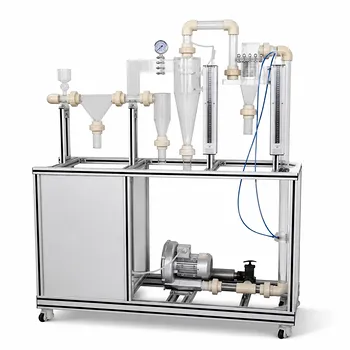
- Gas-Solid Heterogeneous Separation Demonstration Educational Unit Operations Pilot Plant
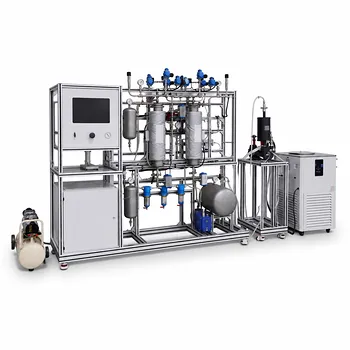
- Bench Scale Dual Column Gas Separation and Capture Educational Pilot Plant
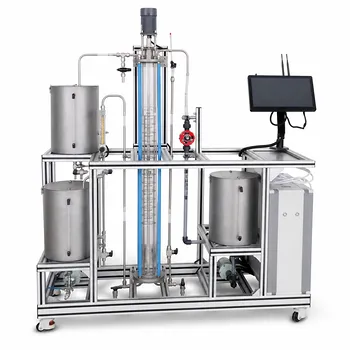
- Educational Rotary Disc Liquid-Liquid Extraction Pilot Plant
People Also Ask
- Why is pressure drop characterization critical in separation pilot plants? Key operational insights.
- What are the key thermodynamic considerations for gas mixture modeling? Expert Guide
- What are the primary operational objectives and physical requirements when running heterogeneous separation pilot plants?
- What are the material limitations of gas separation pilot plants? Key factors to consider.
- What are the trade-offs in olefin-paraffin separation? Optimize Pilot Plant Performance