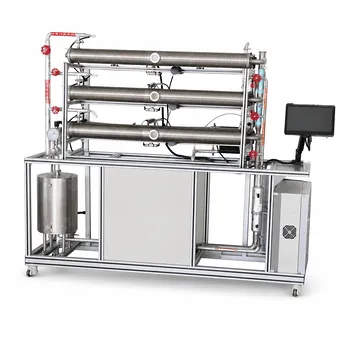
The boiling point of your distillate and the operational goal—distillation versus reflux—are the two parameters that dictate your condenser selection. For straightforward distillation of compounds with a boiling point below < 130°C, the Liebig (straight) condenser is the standard. If you are running a reflux reaction where vapor must be continuously condensed and returned to the flask, the Allihn (bulb) condenser provides the necessary surface area. For any distillate with a boiling point above 130°C, an air condenser is mandatory to prevent catastrophic thermal stress on the glassware.
While guidelines appear simple, the real skill lies in understanding why these rules exist. The choice is less about simple "efficiency" and more about balancing heat transfer with thermal safety, geometric design, and the fundamental difference between removing product from the system and retaining it.
The Fundamental Distinction: Distillation vs. Reflux
Understanding the fluid dynamics of your operation is the first step. The physical path the vapor takes determines which condenser design works best.
Product Removal vs. Solvent Return
In distillation, your goal is to separate and collect a condensate. The vapor travels downward through a vertical condenser and exits the system. Gravity assists the process, and a simple, straight vapor path minimizes hold-up and ensures a clean separation.
In reflux, the goal is to return all condensed liquid back to the reaction flask. The condenser is mounted vertically, and the liquid drips back against the rising vapor. This requires a design that can handle constant, high-volume condensation without flooding or losing solvent.
The Liebig Condenser: Standard for Low-Boiling Distillates
When you're distilling a liquid that boils below 130°C, the Liebig condenser is the workhorse choice. Its design is a testament to functional simplicity.
Straight-Tube Efficiency
The Liebig consists of a straight inner vapor tube surrounded by a cooling water jacket. Cooling water flows through the jacket counter-currently to the vapor, maximizing the temperature gradient. The straight path ensures a low-pressure drop and swift, complete condensation for low-to-moderate boiling point substances.
For distillations where you are collecting a product, the Liebig's minimal internal surface area prevents excessive liquid hold-up. This means your distillate reaches the collection flask quickly, with minimal loss of material clinging to the condenser walls.
The Allihn Condenser: Designed for Reflux Operations
When the primary instruction in your process is "heat under reflux," the Allihn—also known as the bulb condenser—is the correct tool. Its geometry solves a problem specific to returning condensate.
Maximizing Surface Area for Vapor Contact
The Allihn condenser replaces the straight inner tube with a series of bulbs. These bulbs dramatically increase the internal surface area available for heat exchange. As vapor rises through a reflux setup, it encounters a much larger cooled glass surface, ensuring it condenses efficiently before it can escape.
The bulbous shape also creates drip points that promote the smooth, even return of liquid droplets. This design inherently supports the counter-current flow of falling liquid and rising vapor in a reflux column, providing superior cooling capacity for the sustained boiling of reaction solvents over hours.
The Air Condenser: Essential for High-Boiling Compounds
Once the temperature of your vapor crosses the 130°C threshold, water-cooled condensers become a liability. An air condenser isn't merely an alternative; it's the only safe choice.
Eliminating the Risk of Thermal Shock
The primary danger with high-boiling vapors is the extreme temperature gradient. If 150°C vapor contacts a water jacket chilled to 10-15°C, the differential thermal expansion can crack the borosilicate glass instantly. This is a hard safety rule, not a suggestion.
An air condenser uses only the ambient air to cool the vapor. The slow, gentle cooling path prevents thermal shock. While the condensation surface area is much lower than a water-cooled option, the boiling point of the substance is high enough that it readily condenses at room temperature, often requiring only a long, unjacketed tube.
Understanding the Thermal and Process Trade-offs
No single condenser is universally optimal. Each selection involves deliberate compromises you must weigh against your specific process parameters.
Condenser Hold-Up and Yield
The high surface area of an Allihn condenser is a drawback in distillation. It retains more liquid (hold-up), which can smear your boiling point fractions and reduce the yield of a small-scale distillation. For precise separations, the Liebig's lower hold-up often wins.
Cooling Water Management
A Liebig or Allihn condenser requires a continuous, reliable water supply and proper tubing connections. This introduces a setup complexity and a potential failure point (leaks, pressure drops) not present with an air condenser. For a high-boiling solvent where an air condenser suffices, you eliminate this hassle and risk.
The Misuse of an Air Condenser for Low Boilers
Conversely, using an air condenser for a low-boiling solvent like diethyl ether (b.p. 35°C) will result in massive vapor losses. The ambient air temperature is simply not cold enough to effectively condense the vapor, leading to flammable, hazardous vapors escaping into the lab atmosphere.
Making the Right Choice for Your Goal
Your operating procedure defines the correct glassware. Use these final decision-points to guide your setup.
- If your primary focus is collecting a distillate boiling below 130°C: Choose a Liebig condenser. Its straight-path design gives you clean separation with minimal hold-up.
- If your primary focus is sustaining a reflux reaction with a solvent boiling below ~130°C: Choose an Allihn condenser. Its increased surface area ensures efficient solvent return and prevents vapor loss during prolonged heating.
- If your primary focus is distilling or refluxing any compound with a boiling point above 130°C: Choose an air condenser exclusively. This protects your equipment from thermal stress cracking and is perfectly adequate for condensation.
- When scale and flexibility matter: Consider that a pilot-plant or teaching lab setup might hard-code these choices with quick-connect fittings, reinforcing the safety rules for boiling points above/below the 130°C threshold.
By matching the condenser's core design purpose—linear product collection vs. sustained solvent return—and respecting the fundamental thermal limits of your glassware, you ensure both a successful separation and a safe operation.
Summary Table:
| Condenser Type | Ideal Operation | Boiling Point Range | Key Advantage | Major Limitation |
|---|---|---|---|---|
| Liebig | Distillation (Product collection) | < 130°C | Low hold-up, clean separation | Poor reflux cooling capacity |
| Allihn | Reflux (Solvent return) | < 130°C | High surface area, efficient return | High hold-up, fraction smearing |
| Air | Distillation & Reflux | > 130°C | Prevents glass thermal shock | Insufficient for low-boiling solvents |
Optimize Your Chemical Engineering Labs with LABPARK
Looking to scale up your distillation and reflux operations? LABPARK designs and manufactures state-of-the-art Educational and Vocational Unit Operations Pilot Plants in chemical engineering, bioprocess & biotech, and environmental & water treatment.
Whether you are equipping a university training lab, a research institute, or an industrial R&D facility, our pilot plants provide safe, hands-on learning and precise process control.
Contact LABPARK today to consult with our experts and find the perfect pilot plant solution for your institution!
Related Products
People Also Ask
- When is ε-NTU preferred over LMTD in pilot plants? Predict heat exchanger performance without iteration.
- Why is emissivity critical in heat transfer pilot plants? Bridge the Gap Between Theory & Industrial Design
- How can a heat transfer pilot plant demonstrate waste heat recovery? Learn to optimize industrial thermal systems.
- How does cascade control achieve superior disturbance rejection in heat transfer pilot plants?
- What engineering trade-offs must students analyze in a heat transfer pilot plant? Balance performance & cost.