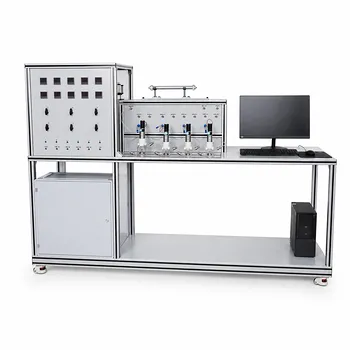
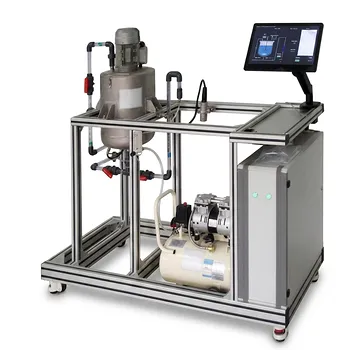
Jet collision mixing is the go-to choice when your process stream contains particles or is prone to precipitation, while passive channel mixers excel in high-velocity, particle-free flows. The selection turns on two practical questions: Will solids clog a narrow channel? And can your pumping system deliver the velocity needed to make the mixer work?
The core decision for a microfluidic pilot plant is straightforward: if clogging is a risk, use a channel‑free jet collision mixer; if you have a clean, high‑speed stream, leverage the engineered precision of a passive channel mixer. For a research facility designed to teach and compare, the highest‑value configuration features both technologies side by side.
Understanding the Two Mixing Philosophies
What Jet Collision Mixing Actually Does
Jet collision mixing forgoes internal flow channels entirely. Two (or more) fluid streams are brought together in open space, colliding at a defined angle. The momentum of the streams themselves creates the mixing energy. A 180° frontal collision delivers maximum shear and turbulence, while a Y‑type contact offers a gentler blending action. Because there is no physical wall where the streams meet, the biggest advantage is a virtual immunity to clogging from particles, crystals, or precipitates.
What Passive Channel Mixers Rely On
Passive mixers use precisely structured internal channels to divide, recombine, compress, and reorient fluid streams. They have no moving parts and depend solely on the pumping pressure to drive the mixing. Designs that repeatedly split and stack fluid layers radically increase the interfacial area for diffusion. This makes passive mixers extremely effective in high‑velocity microfluidic flows, provided the streams contain absolutely no solid particles that could foul the fine internal structures.
When Fluid Composition Dictates Your Choice
Handling Particle‑Laden or Precipitating Solutions
Any stream that carries suspended solids, or where a reaction creates an immediate precipitate, poses a terminal threat to a passive channel mixer. The intricate structures that make passive mixing efficient become a trap. A single clogged channel can halt a pilot‑plant run and require costly downtime. Jet collision mixing solves this by removing the channel entirely at the mixing point. The risk of blockage shifts from a certainty to a near‑zero probability, making it the most robust choice for nanoparticle synthesis, crystallization studies, or any catalytic slurry system.
Protecting Shear‑Sensitive Materials
The energy of mixing is not without consequence. A frontal jet collision at high velocity can generate intense local turbulence that may damage shear‑sensitive biologicals or break fragile crystals. In these cases, a jet mixer can still be used, but the configuration matters: switching to a Y‑type, angled‑impact geometry provides a softer touch. Passive channel mixers, by contrast, provide a more uniform and often lower shear environment, as the energy is distributed through the network of flow divisions rather than concentrated in a single impingement zone.
The Overlooked Factor: Flow Regime and Velocity
Why High Velocity Is a Common Requirement
Both jet collision mixers and high‑performance passive channel mixers demand a certain minimum flow velocity to function. Jet mixing relies on inertial forces to create chaotic eddies and rapid entrainment; below a critical Reynolds number, the jets simply flow past each other with only weak, wet‑contact mixing. Similarly, while the internal geometry of passive mixers enhances mass transfer, the underlying mixing mechanism is still dependent on the pumping energy that pushes the fluid through the structure. At very low flow rates, the splitting and recombination steps become slow, and mixing remains diffusion‑limited.
The Low‑Flow Pitfall for Microfluidic Work
For analytical microflow devices operating at microliters to milliliters per hour, neither jet collision nor purely passive channel mixing may be sufficient on its own. The required velocities simply cannot be reached without pushing the pressure drop to impractical levels. This is the domain where active mixing methods—using external energy like magnetic stirrers, acoustic waves, or pulsed flows—become necessary. A pilot plant designed to explore the full microfluidic landscape should acknowledge this boundary and include at least one active‑mixing station for sub‑milliliter‑per‑hour demonstrations, even though the core comparison between jet and passive mixing will focus on higher‑throughput microscale operations.
Enhancing Passive Mixing Through Channel Design
A powerful, often‑overlooked lever is the diameter of the mixing channel itself. Reducing a mixing‑tee capillary from 254 µm to 100 µm can dramatically improve the observed mixing quality at the same Reynolds number. The smaller dimension shortens the diffusion path and inflates the surface‑area‑to‑volume ratio, accelerating mass transfer by orders of magnitude. When configuring a passive mixer, you are not just choosing a geometry—you are also making a deliberate decision about the channel size to tune the mixing time. This relationship is a cornerstone of process intensification and should be a core learning objective in any pilot‑plant exercise.
Configuring the Pilot Plant as a Research Tool
The Case for a Dual‑Technology Design
In an educational or R&D pilot plant, the goal is not simply to “get mixing done,” but to build a data‑backed understanding of which technology wins under which conditions. The primary reference confirms that a facility featuring both jet collision and passive channel mixing enables comprehensive benchmarking against conventional equipment. This approach lets researchers directly compare pressure drop, mixing time, selectivity for competing reactions, and the handling of solids. Such side‑by‑side data are gold for techno‑economic evaluations and for training engineers to think critically about unit operation selection.
Understanding the Trade‑offs
Jet Collision: Robustness vs. Energy Cost
While jet collision mixers are extremely forgiving with dirty feeds, they do not come free of drawbacks. Achieving the necessary high impact velocities can require significant pumping power, which increases the overall energy footprint. The open‑flow configuration also means that the mixing zone is less spatially controlled than in a closed passive channel, potentially complicating multi‑step sequential reactions where precise residence time distributions are needed. The pressure drop can be substantial, and scale‑up from a lab jet mixer to production may be less linear than for a scaled‑out passive channel network.
Passive Channel Mixers: Precision vs. Fouling Sensitivity
Passive mixers offer unmatched control and repeatability for clean, single‑phase systems. Their pressure drop can be predicted with high fidelity, and their performance scales predictably with geometry. The dark side is their intolerance for solids. Even a small amount of unexpected precipitation can turn a precision‑engineered mixer into a ruined consumable. Additionally, the fabrication of high‑performing internal structures (split‑and‑recombine geometries) can be costly and requires advanced microfabrication or high‑precision additive manufacturing. Maintenance is essentially replacement, not cleaning, for many disposable microfluidic chips.
Making the Right Choice for Your Research Goal
Your selection must align with what you are trying to demonstrate, evaluate, or scale up. Match your mixer to the dominant priority.
- If your primary focus is synthesizing nanoparticles, crystals, or any reaction that forms solids: Start with a jet collision mixer. The channel‑free design is the only reliable way to run continuously without incurable clogging.
- If your primary focus is comparing process intensification or teaching the fundamentals of mass transfer in confined geometries: Build your pilot plant around passive channel mixers, and deliberately vary the channel diameter to show how diffusion path length governs performance.
- If your primary focus is benchmarking microfluidic performance against conventional stirred tanks or static mixers: Design the facility to include both jet collision and passive channel mixing units operating side‑by‑side on the same feed chemistry, creating direct efficiency and quality data.
- If your primary focus is exploring the full range of micro‑to‑micro scales and you cannot guarantee a consistently high, particle‑free flow: Establish a clear velocity threshold. Use passive mixers above that threshold for clean streams, jet collision mixers for any stream with solids, and integrate active mixing stations for the lowest‑flow analytical regimes.
The mixer you choose becomes a vehicle for teaching the fundamental trade‑off between robustness and precision. A well‑configured pilot plant doesn’t hide that lesson—it puts it front and center.
Summary Table:
| Selection Criteria | Jet Collision Mixing | Passive Channel Mixing |
|---|---|---|
| Primary Mechanism | Open-space fluid stream collision | Internal micro-channels split/recombine |
| Clogging/Solids Risk | High tolerance (virtually immune) | High risk (prone to blockage by particles) |
| Shear Sensitivity | Higher local shear (impact dependent) | More uniform, lower local shear |
| Flow Velocity Req. | High velocity required for collision | Minimum velocity needed for mass transfer |
| Best Suited For | Nanoparticle synthesis, slurries, crystals | Clean, single-phase liquid reactions |
Optimize your laboratory's process intensification and research capabilities with the right mixing configuration. LABPARK provides state-of-the-art Educational and Vocational Unit Operations Pilot Plants in chemical engineering, bioprocess & biotech, and environmental & water treatment tailored for universities, research institutes, and enterprises. Let our engineering team help you design the perfect microfluidic benchmark system—contact LABPARK today to discuss your project requirements!
Related Products
- Gas Phase Mixing and Residence Time Distribution Determination Educational Unit Operations Pilot Plant
- Agitation and Mixing Educational Unit Operations Pilot Plant
People Also Ask
- Why do gas-flow unit operations pilot plants require an expansion factor? Achieve Precise Flow Calculations
- Pulse vs. Step Injection for RTD: Practical Differences in Pilot Plants Explained
- How do pressure changes affect gas-phase reaction rates? Safely Optimize Your Kinetics
- Why use an experimental factor for terminal velocity in gas flow pilot plants? Streamline Frictional Flow Analysis
- How is the pressure-volume extrapolation method applied in educational pilot plants to calibrate gas sensors?