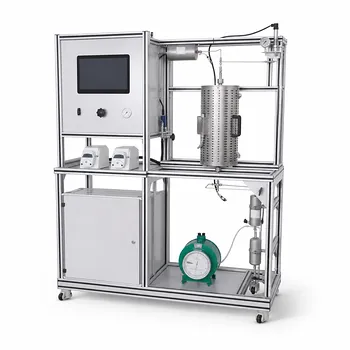
The simplest rule is particle size— if your catalyst particles are larger than 1 mm, a trickle-bed reactor is the natural choice; if they are smaller, a slurry reactor usually wins. This heuristic stems from how the solid phase is managed. A trickle-bed keeps a coarse catalyst fixed in place while liquid trickles downward and gas flows co‑currently, eliminating downstream filtration. A slurry reactor suspends fine catalyst powders (often 10–100 µm) in the liquid, requiring agitation and a dedicated separation step. But in a research pilot plant, the decision runs far deeper than a single dimension.
The surface need is a quick binary rule, but the deep need is to understand when that rule fails—how heat transfer, catalyst fouling, residence‑time control, and the very purpose of the pilot plant reshape the choice. In an educational or exploratory setting, the best answer often isn’t one reactor, but a flexible platform that lets you probe both worlds.
Beyond the 1‑mm Rule: What Really Drives the Decision
The Two‑Sided Nature of Catalyst Management
Trickle‑bed reactors fix the catalyst in a packed bed. This means no fines get into the product, and you never need a downstream hydrocyclone or filter. The trade‑off? Coarse particles can create significant pressure drop (~50 kPa/m) and are slow to replace if the catalyst deactivates.
Slurry reactors suspend the catalyst as a mobile phase. You can add and withdraw solids continuously, which is a lifesaver when feedstocks foul the catalyst rapidly. But the penalty is catalyst attrition and the need to separate product from a catalyst‑laden stream—a nontrivial unit operation in itself.
Heat Transfer: The Hidden Decider for Exothermic Reactions
Slurry reactors behave like a backmixed, isothermal pot. The intense liquid‑solid mixing wipes out temperature gradients and gives heat transfer coefficients an order of magnitude higher than those of a fixed bed. For strongly exothermic chemistries (think hydrogenation of benzene or Fischer‑Tropsch wax), a slurry pilot plant prevents hot spots and thermal runaway with minimal engineering.
Trickle‑bed reactors struggle to dissipate heat. The stagnant catalyst particles and thin liquid films act as insulators, so even moderate exotherms can lead to hot spots that damage the catalyst or shift selectivity. Managing this often requires diluting the bed with inerts, using a multi‑stage adiabatic design, or embedding complex heat‑exchange surfaces—all of which complicate a research setup.
Residence‑Time Distribution and Kinetic Studies
A trickle‑bed pushes liquid and gas through a plug‑flow‑like regime. This yields narrow residence‑time distributions, making it far easier to extract intrinsic kinetics and study the effect of space velocity. If your primary aim is to measure rate constants or validate a reactor model, the trickle‑bed gives cleaner data.
Slurry reactors are inherently backmixed on the liquid side. The continuous stirred‑tank behavior means that any kinetic measurement requires deconvolution of mixing effects. That said, the uniform composition also lets you study catalyst deactivation in a well‑defined liquid environment—something a trickle‑bed cannot offer as cleanly.
Handling “Dirty” Feeds and Solids‑Producing Reactions
If the feedstock contains fine solids or the reaction itself generates a solid product (e.g., wax precipitation, polymerization), a trickle‑bed is a recipe for plugging. The fixed voids quickly fill with debris, sending pressure drop through the roof.
Slurry reactors, with their suspended solids, can cope with moderate amounts of in‑situ fines. The continuous backmixed liquid phase and the ability to purge catalyst/solids make them the safer bet for heavy residua, biomass‑derived feeds, or reactions that foul the bed.
Understanding the Trade‑offs
Pressure Drop and Energy Consumption
Trickle‑bed: pressure drops typically land around 50 kPa/m, which escalates quickly in tall pilot columns or with viscous liquids. The pump or compressor energy demand is not negligible, even at lab scale.
Slurry reactor: the frictional pressure drop is dominated by the liquid head and the gas holdup, often far lower than a packed bed of similar throughput. However, the agitator power input must be factored into the energy picture.
Catalyst Attrition vs. Permanent Fixation
Slurry: the mechanical action of the impeller and particle‑particle collisions grind the catalyst over time, generating fines that can blind downstream separation equipment. Pilot‑plant operators must monitor particle size distribution and may need make‑up catalyst.
Trickle‑bed: catalyst is pristine until chemical deactivation sets in. But when it does deactivate, the entire bed must be unloaded and regenerated off‑line—a disruptive process for a teaching or research schedule.
The Separation Step
Slurry reactors demand a solid‑liquid separation stage, be it a filter, a settler, or a hydrocyclone. In a pilot plant, this adds cost, complexity, and a potential source of product contamination. Trickle‑bed reactors discharge a clean liquid product directly, simplifying the downstream train.
Scale‑up Fidelity
Trickle‑bed scale‑up is relatively predictable if you can maintain similar liquid distribution and wetting efficiency at larger diameters. The fluid dynamics of two‑phase flow through a porous medium are well‑studied.
Slurry reactor scale‑up is notoriously chaotic. The complex interplay of mixing, gas holdup, and solid suspension does not translate linearly from a 1‑L vessel to an industrial autoclave. Researchers who plan to generate scale‑up correlations must invest in detailed hydrodynamic characterization.
Making the Right Choice for Your Pilot Plant
After considering these layers, tie your decision to the primary goal of your pilot plant.
- If your primary focus is educational flexibility and demonstrating multiple reaction engineering principles: Procure a modular unit that can be reconfigured from trickle‑bed to slurry mode, allowing side‑by‑side study of hydrodynamics, mass transfer, and pressure drop.
- If your primary focus is studying plug‑flow kinetics without the complications of catalyst separation: The trickle‑bed reactor provides a clean, well‑defined residence time distribution and a product stream free of solids.
- If your primary focus is maintaining strict isothermal control for a highly exothermic reaction: Select a slurry reactor; its backmixed, heat‑transfer‑optimized design will protect the catalyst and yield reproducible temperature profiles.
- If your primary focus is handling a feedstock notorious for rapid catalyst fouling or generating solid by‑products: A slurry reactor’s ability to continuously withdraw and replenish catalyst will keep your pilot plant running where a trickle‑bed would clog.
- If your primary focus is avoiding downstream separation complexity altogether: Stick with the trickle‑bed reactor—there is no suspended catalyst to remove from the product.
The single most valuable asset in a unit‑operations laboratory is not one reactor configuration but the ability to compare configurations under the same feed and catalyst, because that is where deep, transferable understanding is born.
Summary Table:
| Criterion | Trickle-Bed Reactor | Slurry Reactor |
|---|---|---|
| Catalyst Size | Coarse (>1 mm), fixed bed | Fine (10–100 µm), suspended |
| Heat Transfer | Limited (susceptible to hot spots) | Excellent (isothermal, high heat removal) |
| Reaction Kinetics | Plug-flow (ideal for kinetic studies) | Backmixed (CSTR-like, complex modeling) |
| Fouling Tolerance | Poor (prone to plugging) | High (handles dirty feeds/fines well) |
| Downstream Separation | Not required (clean product stream) | Required (filtration/hydrocyclones needed) |
Optimize Your Unit Operations Lab with LABPARK
Are you looking to enhance your laboratory's research and teaching capabilities? LABPARK provides state-of-the-art Educational and Vocational Unit Operations Pilot Plants in chemical engineering, bioprocess & biotech, and environmental & water treatment.
Designed specifically for universities, research institutes, and enterprises, our modular systems allow you to easily compare reactor configurations like trickle-bed and slurry beds under real-world conditions.
Contact us today to request a quote or discuss your custom pilot plant needs!
Related Products
- Fixed-Bed Chemical Reaction and Gas Dust Tar Removal Unit Operations Pilot Plant
- Multi Functional Catalytic Reaction and Reactor Evaluation Educational Unit Operations Pilot Plant
- Fixed Bed Gas Solid Catalytic Reaction Educational Pilot Plant
- Fluidized Bed Gas Solid Catalytic Reaction Educational Pilot Plant
- Multi-Reactor Educational Pilot Plant for Reaction Engineering Unit Operations
People Also Ask
- When to transition from PID to adaptive control in pilot plants? Key process indicators.
- How do deviations in estimating latent heat impact pilot plant thermal systems? Avoid hardware mis-sizing.
- Why Compare Predicted and Experimental Excess Enthalpy? Key to Accurate Pilot Plant Scale-up
- How to study gasification in pilot plants? Compare exit gas composition & efficiency
- Why Use PTFE & Hastelloy in Chemical Pilot Plants? Prevent Corrosion & Ensure Safety