The temperature dependence of the chemical equilibrium constant is your most powerful lever for controlling reaction yield in a pilot plant.
Understanding it transforms a reactor from a fixed-condition device into a dynamic system where product distribution can be precisely steered. Engineers who apply the van ’t Hoff equation can predict how yield shifts with temperature, avoid counterproductive operating points, and gather the experimental evidence needed to confidently scale up equilibrium-limited processes.
By applying the van ’t Hoff relationship in a pilot plant, you can experimentally verify thermodynamic models, pinpoint the temperature that best balances fast kinetics with high equilibrium conversion, and extract critical thermodynamic data. This empirical validation de‑risks full‑scale reactor design and ensures that process economics are grounded in reality, not just theory.
The Thermodynamic Foundation: The van ’t Hoff Equation
How Temperature Governs the Equilibrium Constant
The equilibrium constant (K) (or (K_p)) is not a fixed number—it is a function of temperature. For an exothermic reaction ((\Delta H^\circ < 0)), (K) decreases as (T) rises, meaning higher temperatures actually reduce the maximum possible conversion. For an endothermic reaction ((\Delta H^\circ > 0)), (K) increases with (T), making heat your ally. This behavior is captured quantitatively by the van ’t Hoff equation.
What This Means for Your Reactor
In a pilot plant, you have precise control over temperature. Knowing the sign and magnitude of the reaction enthalpy lets you predict which direction the equilibrium will shift when you change the setpoint. Without this knowledge, you could unknowingly operate in a regime where the thermodynamic ceiling severely limits yield, even if the reaction appears to be running.
Bridging Theory and Practice in a Pilot Plant
Experimental Validation of Thermodynamic Models
Pilot‑scale reactors equipped with temperature regulation and inline gas chromatography (or other analytical tools) allow you to measure steady‑state concentrations at multiple temperatures. By calculating (K) from these concentrations and plotting (\ln(K)) versus (1/T), you directly test whether the van ’t Hoff relationship holds for your specific system—revealing any deviations caused by non‑idealities or side reactions.
Calculating Reaction Enthalpy from Real Data
The slope of that (\ln(K)) vs (1/T) plot gives (-\Delta H^\circ / R). This means a single pilot‑plant campaign can experimentally determine the reaction enthalpy, validating (or correcting) literature values before you commit to a commercial design. This is invaluable when working with complex feedstocks or novel catalysts.
Overcoming the Kinetic‑Equilibrium Trade‑off
The Conflict Between Rate and Yield
A high temperature often speeds up the reaction but hurts equilibrium conversion for exothermic processes. Conversely, a low temperature can maximize the thermodynamic potential but slow kinetics to a crawl. In a pilot plant, you can systematically explore this trade‑off by measuring actual product output at various temperatures.
Finding the Economic Optimum
By combining equilibrium predictions with rate measurements, you can identify the temperature that maximizes space‑time yield—the true economic optimum. This temperature is rarely the one that gives the highest (K), nor the fastest rate. The pilot plant gives you the real‑world data to pinpoint this sweet spot, avoiding the guesswork that leads to inefficient commercial reactors.
Practical Implications for Plant Operation and Scale‑up
Designing Temperature Control Strategies
Understanding how (K) shifts with (T) informs the design of heating and cooling systems. For exothermic reactions, you need robust cooling to manage heat release while maintaining a temperature that does not cripple equilibrium. The pilot plant lets you test control algorithms and thermal management before scaling up.
Selecting Operating Pressure and Phase Conditions
Temperature and pressure often work in tandem. The equilibrium composition of a gas‑phase reaction depends on both. By verifying the temperature‑dependent equilibrium constant, you can then apply Le Chatelier’s principle to fine‑tune pressure and inert concentrations—strategies that are first proven at pilot scale.
Understanding the Trade‑offs and Pitfalls
When Temperature Alone Isn’t Enough
Focusing solely on equilibrium can be misleading. In real systems, side reactions, catalyst deactivation, or product degradation may occur at the temperature that maximizes (K). A pilot plant reveals these hidden constraints, allowing you to pick a temperature that balances equilibrium against overall selectivity and catalyst longevity.
The Cost of Precision
Maintaining a tight temperature window for a finely balanced equilibrium may require expensive heating/cooling utilities and sophisticated control systems. At pilot scale, you can quantify this energy cost and decide whether the yield improvement justifies the operational complexity at full scale.
Measurement Uncertainty and Data Quality
Calculating (\Delta H^\circ) from a van ’t Hoff plot demands accurate concentration measurements over a narrow temperature range. Small errors can lead to significant enthalpy miscalculations. A well‑designed pilot‑plant campaign must therefore include rigorous sensor calibration and steady‑state confirmation protocols.
Making the Right Choice for Your Pilot Plant Campaign
Based on your primary objective, use the following guidelines to focus your experiments:
- If your primary focus is maximizing per‑pass conversion: Start with the van ’t Hoff equation to estimate the temperature that gives the highest (K), then run a temperature ramping study to verify actual yields and detect any kinetic limitations that might require a compromise.
- If your primary focus is generating data for reactor scale‑up: Collect steady‑state concentration data at three to five well‑spaced temperatures to construct a van ’t Hoff plot, experimentally determine (\Delta H^\circ), and validate the thermodynamic model you will feed into the commercial reactor simulation.
- If your primary focus is managing energy consumption: Use the pilot plant to quantify the heating or cooling duty required to maintain the optimal temperature, and compare the cost against the value of the additional product—turning a theoretical equilibrium insight into a hard economic decision.
- If your primary focus is educational or model validation: Directly compare the (K) values you compute from pilot‑plant data with textbook calculations, and use the deviations to investigate real‑world complexities such as non‑ideality and mass‑transfer limitations.
Harnessing the temperature dependence of the equilibrium constant in a pilot plant transforms abstract thermodynamics into a practical engineering tool that de‑risks scale‑up and anchors process decisions in experimental fact.
Summary Table:
| Reaction Type | Temp Change | Effect on Equilibrium (K) | Kinetic vs. Thermodynamic Trade-off | Pilot Plant Strategy |
|---|---|---|---|---|
| Exothermic ((\Delta H^\circ < 0)) | Increase | Decreases | Faster reaction rate, but lower maximum possible conversion | Identify economic optimal temperature; design robust cooling systems |
| Endothermic ((\Delta H^\circ > 0)) | Increase | Increases | Heat benefits both rate and yield; high temperatures are favorable | Optimize heat supply; monitor catalyst stability at elevated temperatures |
Bring Thermodynamic Theory to Life in Your Lab
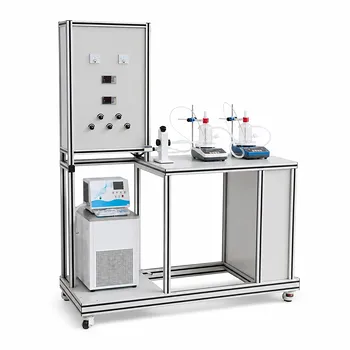
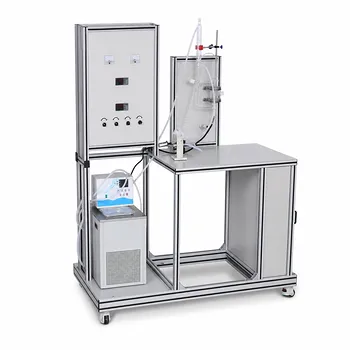
Ready to optimize your chemical processes and bridge the gap between theory and practice? LABPARK provides state-of-the-art Educational and Vocational Unit Operations Pilot Plants in chemical engineering, bioprocess & biotech, and environmental & water treatment.
Engineered specifically for universities, research institutes, and enterprises, our pilot plants empower your team to experimentally validate thermodynamic models, de-risk full-scale reactor designs, and master process scale-up.
Contact LABPARK today to find the ideal pilot plant solution for your laboratory or training facility!
Related Products
- Ternary Liquid-Liquid Equilibrium Educational Pilot Plant
- Binary System Vapor Liquid Equilibrium Data Determination Educational Unit Operations Pilot Plant
People Also Ask
- Why is precise temperature control necessary in LLE experiments? Ensure accurate pilot plant data
- How do pilot plants explain ternary phase diagrams? Bridge thermodynamic theory and practice
- How do liquid-phase reactor pilot plants address mass transfer limitations like the 'cage effect'?
- What is the thermodynamic basis for phase equilibrium? How pilot plants validate Gibbs energy & fugacity.
- How to resolve emulsion in liquid-liquid extraction? 5 ways to ensure efficient phase separation