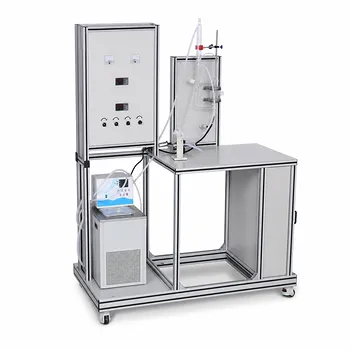
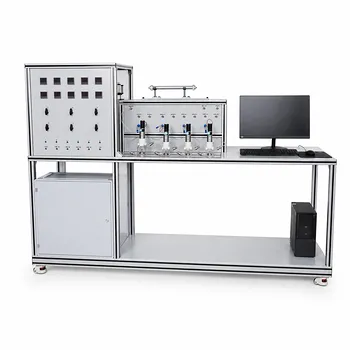
Understanding the criticality criteria is fundamentally a safety and optimization tool. For binary and ternary mixtures in pilot plants, these criteria define the exact thermodynamic boundaries where liquid and vapor phases merge or become unstable. This knowledge allows operators to avoid sudden phase collapses, predict azeotropic pinch points, and deliberately operate near supercritical regions for enhanced mass transfer, transforming an abstract stability analysis into a concrete operational map.
While phase equilibria theory can appear purely mathematical, its core deliverable in a pilot plant is the ability to answer two decisive questions: “At what pressure and temperature will my separation fail?” and “How can I run right up to that edge without breaking equipment?” Mastering binary and ternary criticality criteria gives you that control.
Why Criticality Criteria Are the Hidden Lever for Pilot Plant Safety
Preventing Catastrophic Phase Instabilities
When a mixture approaches its spinodal curve—the limit of intrinsic phase stability—a minor fluctuation in temperature or pressure can trigger instantaneous, uncontrolled phase separation. In high-pressure units like supercritical extraction columns, this manifests as density inversions or rapid condensation that can physically hammer view cells and compressor valves.
The derivatives of Legendre transforms of internal energy, such as ((\partial P/\partial V)_{T,\mu_i} = 0), define that spinodal boundary. By encoding these stability criteria into the pilot plant’s control logic, you create a thermodynamic safety interlock that prevents the system from ever entering the unstable region.
Designing Safety Interlocks Using Spinodal Limits
Modern pilot units don't just rely on crude pressure alarms. They use calculated spinodal curves as dynamic red lines. If a ternary mixture’s composition drifts due to a feed disturbance, the control system cross-references a real-time thermodynamic model and will reduce heating or open a vent before the mixture catastrophically collapses.
This replaces reactive safety measures with true predictive protection, saving sensitive instrumentation from the mechanical shock of sudden phase splitting and protecting researchers working near a mixture’s critical point.
Driving Separation Efficiency by Mapping Operational Envelopes
Leveraging Binary Azeotropic and Critical Loci
In distillation, the intersection of the azeotropic locus with the mixture’s critical locus is a thermodynamic hard stop. For a binary system like n-hexane and 2-propanone, tracking how the activity coefficient ratio drifts with temperature signals exactly where separation becomes impossible, regardless of how many plates you add.
Understanding this prevents you from wasting energy chasing an unachievable purity. It also reveals opportunities: operating just inside a single-phase supercritical region leverages sharply changing solvent power for extraction, while staying slightly outside the two-phase dome optimizes conventional VLE driving forces.
Navigating Ternary Systems Without Trial-and-Error
A ternary phase diagram is built from the common tangent planes on the Gibbs energy surface. Manually mapping this surface through exhaustive experimental runs is prohibitively slow. Applying criticality criteria—the conditions where two phases lose identity and the tangent plane becomes unique—pinpoints the plait point and the exact terminus of tie-lines.
Knowing this boundary lets you instantly predict the direction of mass transfer. You can set a feed composition, glance at the ternary map, and know whether you’ll get a clean split or a muddy emulsion, reducing startup time from days to hours.
Bridging Theory and Reality: Validating Models Against Physical Data
Reducing Reliance on Empirical Guesswork
Solution models like the associated solution or multiple sublattice models predict activities and Gibbs energy minima for non-ideal mixtures. By solving for phase compositions where chemical potentials equalize, you feed a distillation column simulator with a first-principles description of the system.
This eliminates the classic pilot plant trap of using a pre-set “generic” reflux ratio. Instead, you set the reflux ratio based on the predicted phase envelope’s shape, directly targeting the minimum energy input required to achieve specification at the column’s actual operating pressure.
Educating Through Tangible Verification
For students and researchers, running a pilot distillation tower while simultaneously measuring tie-lines and comparing them to thermodynamic databank calculations closes the loop. They physically see how an abstract stability criterion—a determinant going to zero—translates to the liquid in a view cell becoming opalescent and then a single, uniform phase.
This tangible feedback cements the link between molecular-level physics and large-scale unit operations, creating engineers who instinctively factor thermodynamic feasibility into process designs.
Understanding the Practical Limitations of Criticality-Based Approaches
The Purity Gap
Theoretical criticality criteria assume perfect, well-defined components. In a real pilot plant, trace impurities or degradation products can shift the critical point by several degrees and bar. Relying solely on pristine simulation data without an on-line calibration check can still push you into a two-phase region unexpectedly, causing column flooding.
Non-Equilibrium and Dynamic Delays
The equations define static equilibrium boundaries. A rapidly heating reboiler or a sudden pressure surge creates non-equilibrium transient states where the actual composition lags behind the measured temperature. A stability calculation will report a safe condition while the local fluid at the heat transfer surface is already boiling violently. Layering transient mass transfer models on top of static stability criteria is essential.
Parameter Sensitivity Runs
The flat topology of the Gibbs energy surface near a critical point means infinitesimal errors in binary interaction parameters produce huge errors in predicted critical pressure. Before trusting your spinodal interlock points, you must perform a parameter sensitivity run—varying the model’s key interaction coefficients ±5%—to verify your safe operating window has a sufficient margin against uncertainty.
Making the Right Choice for Your Pilot Plant Goal
Apply your understanding of criticality criteria based on what your facility needs most. The approach changes depending on whether you prioritize safety, rapid scale-up, or deep education.
- If your primary focus is safe operation near high-pressure critical regions: Encode the spinodal condition directly into a dynamic safety interlock, linking it to the emergency depressurization system and using parameter-sensitivity margins to define conservative trip points.
- If your primary focus is optimizing separation efficiency in distillation or extraction: Use the binary azeotropic intersection and ternary plait point to define the realistic endpoint of your separation, and set operating conditions to run at the edge of the phase envelope where transport properties are most favorable.
- If your primary focus is rapid scale-up and model transfer: Validate your thermodynamic model’s stability predictions against a small set of pilot-scale tie-line measurements from a single well-instrumented run, then lock the model in as the digital twin for the larger plant.
- If your primary focus is education and building intuitive thermodynamic reasoning: Require students to manually calculate the tangent plane condition for a ternary system, then have them identify the exact composition and temperature where that plane disappears during a real pilot plant run, solidifying the link between the equation and the observation.
Knowing these criteria doesn't just keep a pilot plant running—it transforms your operation from a cautious empirical exercise into a precise, boundary-pushing exploration of what the mixture will truly allow.
Summary Table:
| Focus Area | Operational Benefit | Thermodynamic Driver |
|---|---|---|
| Safety & Stability | Prevents catastrophic phase collapse & mechanical shock | Spinodal curve limits & thermodynamic interlocks |
| Separation Efficiency | Avoids binary azeotropic limits & targets optimal VLE | Azeotropic/critical loci mapping |
| Modeling & Design | Cuts empirical trial-and-error; validates digital twins | Gibbs energy surface & tangent planes |
Bring Thermodynamic Theory to Life with LABPARK
Whether you are teaching the next generation of engineers or scaling up complex chemical processes, LABPARK delivers high-performance Educational and Vocational Unit Operations Pilot Plants across chemical engineering, bioprocess & biotech, and environmental & water treatment. Our state-of-the-art pilot plants help universities, research institutes, and enterprises safely validate phase equilibria models, optimize separation efficiency, and prevent operational failures.
Ready to elevate your research and training capabilities? Contact LABPARK today to discover the perfect pilot plant solution for your facility!
Related Products
- Ternary Liquid-Liquid Equilibrium Educational Pilot Plant
- Binary System Vapor Liquid Equilibrium Data Determination Educational Unit Operations Pilot Plant
- Gas Phase Mixing and Residence Time Distribution Determination Educational Unit Operations Pilot Plant
People Also Ask
- Why is precise temperature control necessary in LLE experiments? Ensure accurate pilot plant data
- How do pilot plants explain ternary phase diagrams? Bridge thermodynamic theory and practice
- How are ternary phase diagrams and LLE data applied in extraction experiments? Optimize Pilot Plant Scale-up
- How to Validate BIPs for LLE Pilot Plants? Steps to Align Simulations with Reality
- In a liquid-liquid extraction pilot plant, how is a ternary-phase diagram utilized to determine solvent feed requirements?