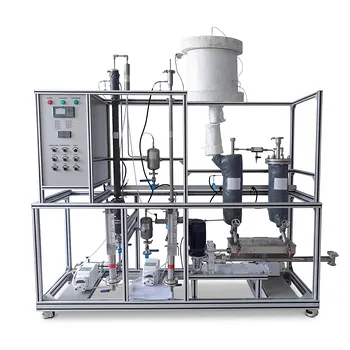
Sulfur poisoning fundamentally reshapes pilot-scale steam reforming by making feedstock desulfurization a non-negotiable process step. Without it, even trace sulfur compounds permanently deactivate standard transition-metal catalysts by blocking their active sites. In an educational setting, this forces the unit’s design to include a dedicated purification stage upstream of the reformer—turning a hidden industrial necessity into a powerful, hands-on teaching moment about the criticality of impurity management.
While the choice of active metals and supports determines coking and sintering resistance, sulfur’s universal and rapid poisoning mechanism means that process configuration—specifically the mandatory addition of a desulfurization guard bed—is the primary variable under control. This single unit operation protects the catalyst, prolongs experimental campaigns, and demonstrates a core principle of catalytic process engineering.
How Sulfur Poisons Reforming Catalysts
Sulfur compounds present in natural gas or light hydrocarbons react irreversibly with transition-metal catalysts. This deactivation is not a gradual fouling but a stable chemical binding that quickly extinguishes catalytic activity.
The Mechanism: Formation of Stable Surface Sulfides
Sulfur molecules adsorb dissociatively onto metal surfaces. They then form strong metal-sulfur bonds, creating stable surface sulfides that permanently cover the active sites required for reforming reactions.
This is a chemical poisoning, not just physical blockage. The adsorbed sulfur is tightly bound and not easily removed under normal reforming conditions.
Universal Impact on Base Metals
Virtually all non-noble transition metals—including nickel, copper, and cobalt—are susceptible to this attack. Because nickel is the workhorse catalyst for methane steam reforming due to its cost-effectiveness and high activity, sulfur poisoning rapidly halts its ability to cleave C-H bonds and drive the endothermic reforming chemistry.
Even catalysts formulated with advanced promoters and stabilized on robust supports cannot withstand continuous sulfur exposure without protection.
The Mandatory Process Configuration: Desulfurization Before the Reactor
Because the poisoning is so severe, the only practical defense is to eliminate sulfur from the feedstock entirely before it contacts the reformer. This directly dictates the pilot plant’s layout.
Guard Beds Using Adsorption and Reactive Metal Oxides
A desulfurization unit must be placed in the feed line immediately before the reforming reactor. This is typically a packed bed containing activated carbon (adsorption) or zinc oxide (reactive absorption).
The guard bed removes hydrogen sulfide and other organic sulfur species down to the parts-per-billion level. In a pilot-scale educational unit, this configuration mirrors industrial practice and visibly demonstrates that feed purification is not optional—it is a prerequisite for stable operation.
Pedagogical Value of Purification Layout
Teaching this configuration helps students grasp a fundamental concept: catalytic unit operations are only as reliable as the cleanliness of their feedstocks. The necessity of a separate vessel, its routine replacement cycle, and the monitoring of sulfur slip become embedded design considerations, not afterthoughts.
Catalyst Selection in a Sulfur-Poisone-Prone Environment
Because sulfur poisons essentially all economic transition-metal catalysts, catalyst selection is not driven by sulfur tolerance but by other performance factors. The desulfurization step handles the sulfur threat; the catalyst itself must then be optimized for activity, thermal stability, and resistance to coking.
The Dominance of Nickel on a Stable Support
Nickel remains the preferred active metal in educational pilot units due to its affordability and high activity for C-H bond cleavage. To combat the separate (and equally critical) problems of sintering and coke deposition, nickel is dispersed on thermally stable supports.
Supports like alumina (α-Al₂O₃), magnesium aluminate spinel (MgAl₂O₄), and ceria-zirconia (CeO₂-ZrO₂) prevent metal particle agglomeration at high temperatures (500–800°C) and provide oxygen storage capacity to gasify carbon deposits. These choices ensure that, once sulfur has been removed, the catalyst can deliver a long and stable experimental lifetime.
The Role of Alternative Metals
- Copper is preferred for low-temperature methanol reforming, but it is even more sensitive to sulfur and coking. Desulfurization remains mandatory, and precise temperature control is critical.
- Cobalt can offer better carbon resistance in ethanol reforming, but it shares the universal vulnerability to sulfur. The process configuration—guard bed first—does not change.
Thus, the selection of active metal and support is a downstream decision focused on specific reforming chemistry and operational window, while the process configuration is the upstream, sulfur-driven gatekeeper.
Understanding the Trade-offs and Practical Realities
While adding a desulfurization stage is technically simple, it introduces real compromises that must be managed in a pilot-scale educational setting.
Operational Complexity and Cost
The guard bed adds another vessel, requires regular monitoring of its sulfur breakthrough capacity, and demands periodic replacement or regeneration of the sorbent. If the bed is not properly maintained, sulfur slip will rapidly poison the expensive reforming catalyst, leading to misleading data and forced bed replacement.
Educational Lag in Visible Deactivation
Because desulfurization effectively masks sulfur poisoning, students may not directly observe the dramatic activity loss unless a deliberate bypass experiment is performed. A powerful trade-off exists: you can either protect the catalyst for long-term studies or, for a designated short experiment, intentionally remove the guard bed to quantify the poisoning kinetics and illustrate why purification is critical.
Reactor Configuration and Deactivation Timescales
Sulfur poisoning of a properly guarded reformer occurs only when the guard bed fails. In that scenario, the deactivation can be rapid. The pilot plant’s standard fixed-bed tubular reactor is appropriate for the normally long catalyst lifetime (months to years). However, if sulfur breakthrough occurs, the reactor design must allow for catalyst change-out—this reinforces the need for modular, easy-to-service reactor configurations often built into educational pilot plants.
Applying This to Your Educational Pilot Plant
How you prioritize sulfur management depends on your primary learning objective. Use the following guidelines to align your design choices:
- If your primary focus is demonstrating industrial best practice: Configure the pilot plant with a ZnO guard bed upstream of a Ni/MgAl₂O₄ reforming catalyst. This replicates full-scale purification and highlights the inseparable link between feedstock quality and stable reactor performance.
- If your primary focus is studying deactivation mechanisms: Build the capability to bypass the desulfurization unit in controlled experiments. Run short campaigns with trace H₂S to measure activity loss, then compare against regenerated or fresh catalyst to drive home the irreversibility of poisoning.
- If your primary focus is long-duration, hands-on student operation: Prioritize a reliable, easily replaceable activated carbon or ZnO cartridge and standard Ni-on-alumina pellets. This minimizes downtime and lets students focus on operational parameters rather than constant catalyst troubleshooting.
Removing sulfur is not an afterthought in steam reforming—it is the first process decision that defines the entire pilot plant’s architecture and its educational power.
Summary Table:
| Parameter | Details | Impact on Pilot Plant Design |
|---|---|---|
| Poisoning Mechanism | Irreversible formation of stable surface metal-sulfides | Requires active site protection |
| Catalyst Selection | Nickel on stable supports (e.g., $\text{Al}_2\text{O}_3$, $\text{MgAl}_2\text{O}_4$) | Chosen for thermal stability and coking resistance |
| Process Configuration | Mandatory upstream desulfurization guard bed (ZnO/carbon) | Protects catalyst & teaches feedstock purification |
| Pedagogical Options | Bypass loop configuration | Allows hands-on study of deactivation kinetics |
Optimize Your Engineering Labs with LABPARK Pilot Plants
Equip your students and researchers with hands-on experience in managing real-world chemical process constraints like catalyst poisoning and feedstock purification. LABPARK provides state-of-the-art Educational and Vocational Unit Operations Pilot Plants in chemical engineering, bioprocess & biotech, and environmental & water treatment.
Specially engineered for universities, research institutes, and enterprises, our systems feature modular configurations—such as integrated desulfurization guard beds and robust reactor controls—to maximize teaching efficiency and research reliability.
Ready to elevate your engineering curriculum or R&D capabilities? Contact LABPARK today to customize your pilot plant solution!
Related Products
- Steam Methane Reforming Hydrogen Production and Purification Educational Pilot Plant
- Dual-Mode Rectification Pilot Plant for Practical Training Unit Operations
People Also Ask
- How Do Temp, Pressure & S:C Ratio Affect Methane Reforming? Optimize Your Pilot Reactor
- How to Integrate WGS & Purification in Steam Reforming Pilot Plants to Protect Fuel Cells from CO Poisoning
- What are the differences between steam reforming and ATR in pilot plants? Key Design Guide
- How is carbon deposition controlled in steam reforming? The Critical Role of S/C Ratio
- What is the difference between allothermal and autothermal steam reforming in pilot plants?