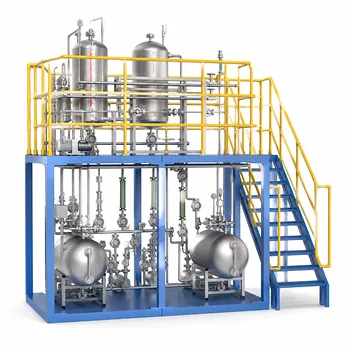
The wrong polymer in a pilot plant isn’t just a maintenance headache—it’s a direct threat to experimental data integrity and operator safety.
PVC offers cost-effective resistance to many inorganic acids and salts below 60°C, but it swells in organic solvents. Polypropylene (PP) extends the temperature ceiling to 120°C with decent chemical tolerance, yet struggles with strong oxidizers. PTFE is the ultimate inert barrier, handling virtually any chemical from -200°C to 250°C but is mechanically weak and expensive. PVDF bridges the gap by combining near-PTFE chemical resistance with superior structural strength and weldability, making it practical for aggressive fluid handling up to 140°C.
Polymer selection in environmental and chemical pilot plants is a classic cost-versus-performance equation. For the most aggressive or ultra‑pure streams, PTFE’s unmatched inertness is non‑negotiable, but for the majority of pilot‑scale operations, PVDF delivers the best balance of chemical resistance, fabricability, and long‑term reliability.
Why Material Choice Makes or Breaks a Pilot Plant
Pilot plants are miniature chemical kingdoms where every pipe, gasket, and seal directly touches process fluids. A poor material choice distorts data, contaminates streams, and creates safety hazards. The question isn’t just “what resists this chemical?”—it’s “what survives repeated cleaning cycles, temperature swings, and the inevitable pilot‑plant improvisations?”
In water treatment and chemical trials, you’re often dealing with corrosive brines, sanitizing acids, organic solvents, or metal‑sensitive ultrapure systems. The polymer must maintain structural integrity, prevent leaching, and often weld seamlessly into complex assemblies. The four front‑runners—PVC, PP, PTFE, and PVDF—excel at different points along this spectrum.
The Polymer Showdown: PVC vs PP vs PTFE vs PVDF
PVC – The Economical Workhorse for Mild Conditions
Unplasticized PVC is the go‑to choice when the application stays below 60°C and free of organic solvents. It handles most inorganic acids, alkalis, and salt solutions at a fraction of the cost of fluoropolymers.
Its Achilles’ heel is organic solvent swelling. Expose it to ketones, esters, or aromatic hydrocarbons, and the pipe softens, dimensional stability vanishes, and leaks follow. In environmental pilot plants, PVC often serves in raw water intakes, non‑aggressive feed lines, and drainage—anywhere cost trumps extreme performance.
PP – Stepping Up Temperature and Strength
Polypropylene (PP) offers higher strength than polyethylene and can operate continuously up to 120°C. This makes it a solid candidate for hot brine concentrates, mild acid streams, and many aqueous process lines in water treatment pilots.
PP resists a broad range of acids, bases, and salts but is attacked by strong oxidizing agents (like concentrated nitric acid) and some chlorinated organics. It’s lightweight and easy to weld, but its thermal expansion is significant, requiring careful piping support. PP fills the gap where PVC would deform and PTFE would be over‑engineered.
PTFE – The Gold Standard for Chemical Inertness
Polytetrafluoroethylene (PTFE) is in a league of its own. Its carbon‑backbone is completely shielded by fluorine atoms, creating a molecular shield that defeats everything from aqua regia to uranium hexafluoride. It functions from -200°C to 250°C and is the default material for trace‑metal analysis, ultra‑pure reagent storage, and the most aggressive chemical pilot units.
For piping and seals, PTFE is unbeatable as a gasket, valve stem packing, pump lining, or membrane housing. However, pure PTFE has low mechanical strength and tends to creep under load. That’s why it is often reinforced with glass or carbon fibers. In pilot plants, you’ll rarely see a full PTFE pipe—it’s instead used strategically in flexible tubing, seals, and as a lining where its unique inertness is essential.
PVDF – The Practical High‑Performance All‑Rounder
Polyvinylidene fluoride (PVDF) offers chemical resistance very close to PTFE, yet it can be easily fabricated and welded into rigid pipes, fittings, and structural components. With a maximum operating temperature of 140°C, it comfortably handles hot acids, alkalis, organic solvents, and many oxidizers.
In environmental and chemical pilot plants, PVDF is the preferred material for process piping, valve bodies, and seal housings that must survive aggressive cleaning‑in‑place cycles or mixed solvent‑acid streams. Its balance of inertness, strength, and weldability often makes it a more practical and reliable choice than PTFE for the bulk fluid‑handling infrastructure.
Understanding the Trade‑offs
Choosing a polymer is never about finding the “best” material—it’s about aligning properties with real‑world constraints.
When Low Cost Bites Back
PVC’s price advantage evaporates the moment a process stream carries an organic solvent or a temperature spike above 60°C. Swelling and distortion can compromise not just the pipe but the entire experiment. Similarly, PP’s temperature headroom doesn’t save it against strong oxidizers; a single mis‑specified cleaning chemical can cause embrittlement and sudden failure.
Fabrication Challenges and Workability
PTFE’s extreme non‑stick nature makes it difficult to bond or weld. In pilot plants, this often means PTFE parts must be machined or used as liners and gaskets, not as primary load‑bearing piping. PVDF, in contrast, can be hot‑gas welded, solvent‑cemented in some cases, and machined into custom fittings—an enormous advantage when modifying a pilot setup on the fly.
Mechanical Limitations of Fluoropolymers
Pure PTFE suffers from cold flow (creep) , meaning a gasket under constant bolt load can thin over time and leak. Reinforced grades address this, but the cost rises further. PVDF, while mechanically stronger, still expands and contracts with temperature, demanding proper support. PP’s high thermal expansion coefficient can lead to sagging if pipe spans are too long. These mechanical quirks often dictate that the most chemically resistant material is best used as a thin‑wall lining or seal rather than a structural pipe.
Making the Right Choice for Your Pilot Plant
The optimal polymer depends on which constraint tops your priority list. Use the following guide to match material to mission.
- If your primary focus is low cost and you handle ambient‑temperature, non‑organic solutions: PVC gives you safe, simple transport for process water, neutralized effluents, and mild reagent feeds. Just stay below 60°C and keep organic solvents out.
- If you need reliable hot‑water or mildly corrosive service (up to 120°C): PP is the pragmatic choice for brine concentrators, hot alkali dosing, or pretreatment stages—provided strong oxidizers aren’t present in high concentration.
- If your pilot plant handles highly corrosive acids, solvents, or demands ultra‑pure integrity: PTFE is non‑negotiable for all wetted seals, gaskets, and linings. Its absolute inertness protects both your process and your data.
- If you need a rigid, weldable piping system for mixed chemical streams at up to 140°C: PVDF delivers the best overall balance of chemical resistance, mechanical toughness, and on‑site workability. It’s the go‑to for flexible pilot‑scale setups facing aggressive cleaning chemicals and variable process conditions.
Every polymer solves a specific set of problems—aligning your choice with the real thermal, chemical, and mechanical demands of your pilot plant ensures that what flows inside the pipe never threatens what happens outside it.
Summary Table:
| Material | Max Temp | Chemical Resistance | Key Advantages | Main Limitations |
|---|---|---|---|---|
| PVC | < 60°C | Inorganic acids & salts | Low cost, easy installation | Poor solvent resistance, low temp limit |
| PP | < 120°C | Mild acids, bases, & salts | High strength, lightweight | Attacked by strong oxidizers |
| PTFE | -200°C to 250°C | Universal (acids, solvents) | Maximum inertness, wide temp range | Low mechanical strength, cold flow (creep) |
| PVDF | < 140°C | Strong acids, solvents, oxidizers | High strength, weldable, durable | Higher cost than PVC/PP |
Optimize Your Pilot Plant with LABPARK
Choosing the right polymer is critical to safeguarding your experimental data and pilot plant longevity. LABPARK provides premium Educational and Vocational Unit Operations Pilot Plants in chemical engineering, bioprocess & biotech, and environmental & water treatment. Designed specifically for universities, research institutes, and enterprises, our systems utilize precision-engineered materials tailored to your specific process parameters.
Ready to build a safe, reliable, and high-performing pilot system? Contact our experts today to discuss your material and design requirements!
Related Products
People Also Ask
- Gear vs Centrifugal Pumps in Pilot Plants: How do operating characteristics and power requirements differ?
- How is shaft work (We) used to determine pump specifications? Optimize pilot plant fluid transport design.
- Why distinguish Newtonian & non-Newtonian fluids in pilot plants? Prevent design errors.
- How does active time pulsing mixing enhance fluid homogenization? Configuration Guide for Educational Pilot Plants
- Why is the attenuation path length (lA) critical when positioning pressure sensors in a fluid flow unit operations pilot plant?