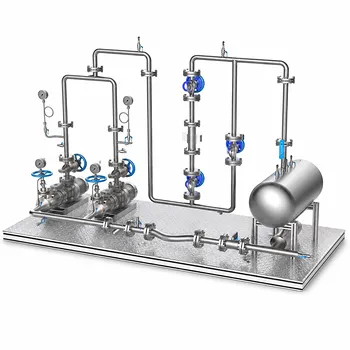
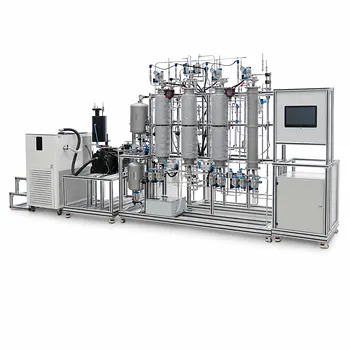
Your definitive guide starts with a clear, binary threshold. A laboratory vessel transitions from a simple container to a regulated pressure vessel when its inner diameter exceeds 150 mm and it operates under a pressure differential greater than 0.5 bar. While this is the fundamental line in the sand, a safe and compliant pilot plant design demands a far deeper analysis than just checking the gauge. The core of your evaluation must ensure that the vessel’s mechanical design is fully aligned with its chemical process function to prevent catastrophic failure.
The regulatory trigger is a fixed, numerical limit (inner diameter > 150 mm, pressure differential > 0.5 bar). However, the real engineering judgment lies in documenting the process conditions—temperature, pressure, and fluid properties—so your mechanical designer can calculate the precise wall thickness, select the correct material, and specify a relief system that protects against all credible overpressure scenarios.
Unpacking the "Why" Behind the Code
The numerical limits are driven by a simple physical principle: stored energy. A vessel that is both large and pressurized contains significant potential energy, and its failure can release forces powerful enough to cause severe damage. The 0.5 bar and 150 mm cutoff is a regulatory acknowledgment that beyond these limits, the risk justifies formal certification. But your role as a laboratory engineer goes further to answer "what specific inputs are needed to make this safe?"
The Regulatory Benchmark is Your Starting Point
This is the non-negotiable line. You must check these two conditions first.
The Face Value Test
If your vessel's inner diameter is under 150 mm, even with high internal pressure, it may fall under different, less stringent categories in many codes. Conversely, even a large-diameter vessel can be exempt if its pressure differential never exceeds 0.5 bar. For most pilot-scale reactors and separators, you will almost certainly exceed both limits, placing you squarely in pressure vessel territory.
Verify Before You Act
The primary standard is clear but not exhaustive. A vessel operating at full vacuum (an external pressure differential of 1 bar) is equally dangerous and is covered by the same design standards. Never assume a vacuum condition is "just negative pressure." From a design perspective, it carries a similar risk of collapse and is a formal design case.
The Deeper Engineering Drivers for a Pilot Plant
Once the 150 mm / 0.5 bar threshold is crossed, your focus shifts from determination to specification. The law requires the vessel to be certified; good engineering requires it to be correctly designed. Your supplementary references highlight the pieces of this puzzle.
Defining the Operating Envelope
A mechanical designer cannot begin without your process definition. You must provide the maximum allowable working pressure (MAWP) and design temperature, not just normal operating conditions. The vessel's function dictates the hazards. For a reactor, this means clearly defining the heat of reaction and ruling out hazardous side reactions or rapid decomposition that could generate uncontrolled pressure.
Selecting Heads as a Pressure Indicator
Your choice of vessel head is a direct economic and engineering consequence of pressure. For low-pressure (<10 bar) separators, a torispherical head is the cost-effective standard. However, if your reaction generates pressure above 15 bar, an ellipsoidal head becomes more economical because its better stress distribution allows for a thinner, lighter wall. The existence of a hemispherical head on a pilot plant is a clear visual signal of very high-pressure operation, as it minimizes stress but maximizes fabrication cost.
Addressing the Heat of the Matter
For a reactor, the pressure vessel calculation is inseparable from the thermal analysis. The vessel must not only contain the static pressure but also handle the rapid pressure surge from a runaway reaction. This requires you to specify the relief system’s worst-case load—the vapor or gas generation rate at the maximum design temperature—to ensure the emergency relief system can prevent the pressure from exceeding the vessel's design limit.
Understanding the Trade-offs and Hidden Costs
Designating a vessel as a pressure vessel is an act of safety, but it introduces significant project trade-offs that extend far beyond a label.
Cost, Schedule, and Operational Flexibility
Certified pressure vessels are inherently more expensive and require longer lead times than atmospheric tanks. More critically, any future welding modification—such as adding a new nozzle—requires post-weld heat treatment and recertification. This reduces the flexibility you might expect in a research pilot plant setting.
The Scale-Up Knowledge Gap
Certain pilot plant processes almost always demand this level of design rigor. Extractors, dryers, and highly reactive systems have complex scale-up behaviors that are not well-predicted by theory, making the pilot plant the first—and most critical—line of safety defense. In contrast, simple single-phase fluid transport may not require a pilot plant at all unless a specific complication like two-phase flow invalidates the standard design models.
Material Compatibility as a Moving Target
A vessel mechanically rated for pressure can still fail chemically. A common mistake is specifying a high-strength steel for pressure containment but overlooking that the gaskets, sight glasses, and connection seals are equally vulnerable to the process fluid at operating temperature. The entire pressure boundary must be compatible, not just the shell.
Making the Right Choice for Your Goal
Your strategy for ensuring safety and compliance should adapt to your primary project focus.
- If your primary focus is regulatory compliance and basic safety: Immediately verify the 150 mm / 0.5 bar rule. If the vessel exceeds either limit, treat it as a certified pressure vessel and begin the specification process without exception.
- If your primary focus is experimental flexibility in a research setting: Avoid the temptation to bypass certification. Instead, work with the mechanical designer to permanently include a few extra, plugged nozzle connections of various sizes into the initial design. This forward-thinking step provides future experimental access points without voiding the certification.
- If your primary focus is managing project cost and lead time for low-pressure work: Know that standard components are your friend. Specifying a torispherical head and a standard material grade for a vessel operating under 10 bar will be a far faster and more economical procurement than a custom-engineered, high-pressure ellipsoidal design.
Ultimately, the determination is not a bureaucratic hurdle but a signal to start a rigorous engineering dialogue between the process you intend to run and the physical vessel that must safely contain it.
Summary Table:
| Parameter/Component | Threshold/Specification | Engineering Design Guidance |
|---|---|---|
| Regulatory Threshold | ID > 150 mm & Pressure > 0.5 bar | Mandatory pressure vessel design & certification. |
| Vacuum Operation | External Differential = 1 bar | Treated as pressure vessel due to collapse risk. |
| Torispherical Head | Low Pressure (< 10 bar) | Cost-effective standard for separators & reactors. |
| Ellipsoidal Head | High Pressure (> 15 bar) | Better stress distribution, allows thinner walls. |
| Hemispherical Head | Extremely High Pressure | Maximum stress minimization; higher fabrication cost. |
Ensure Safety & Compliance in Your Pilot Plant Designs
Navigating pressure vessel regulations and scale-up engineering can be challenging. LABPARK provides state-of-the-art Educational and Vocational Unit Operations Pilot Plants in chemical engineering, bioprocess & biotech, and environmental & water treatment. Tailored for universities, research institutes, and enterprises, our pilot plants combine safety, regulatory compliance, and experimental flexibility.
Ready to design a safe, compliant, and efficient pilot scale system? Contact our expert team today to discuss your project requirements!
Related Products
- Chemical Pipeline Assembly and Fluid Transport Practical Training Unit Operations Pilot Plant
- Constant Pressure Filtration Educational Unit Operations Pilot Plant
- Educational Pressure Swing Adsorption Ethylene Capture Unit Operations Pilot Plant
People Also Ask
- Why distinguish Newtonian & non-Newtonian fluids in pilot plants? Prevent design errors.
- Gear vs Centrifugal Pumps in Pilot Plants: How do operating characteristics and power requirements differ?
- How is shaft work (We) used to determine pump specifications? Optimize pilot plant fluid transport design.
- How to determine the operating point of a centrifugal pump in a pilot plant? A practical guide.
- How does fluid density affect pump head and pressure? Avoid Pilot Plant Motor Overload