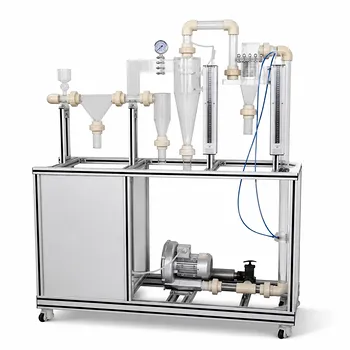
The preference for a parallel configuration of multiple small-diameter hydrocyclones over a single large unit comes down to a fundamental physical trade-off: separation precision versus volumetric capacity. In bioprocess and environmental engineering pilot plants, you need to handle meaningful flow rates to generate representative data, but you also must reliably capture fine particles—biomass flocs, precipitates, or micron-sized contaminants. Small hydrocyclones excel at sharp, high-efficiency cuts, while running them in parallel simply multiplies their throughput.
The deep need in a pilot plant is to generate trustworthy, scalable data. A single large hydrocyclone may handle the volume, but it sacrifices the fine-particle separation ability that is critical in bioprocess and environmental streams. The parallel configuration is the only design that delivers both high throughput and high separation precision, enabling you to study true cut points and pressure drops that are directly relevant to an industrial-scale installation using a cluster of small cyclones.
The Physics of Separation: Why Diameter Matters
The heart of the answer lies in how a hydrocyclone’s geometry governs the centrifugal force field inside it.
Centrifugal Force and Sedimentation Velocity
A smaller diameter device spins the fluid on a tighter radius. This drastically increases the centrifugal acceleration experienced by the particles. Higher centrifugal force directly translates to a higher radial sedimentation velocity, driving even fine, low-density solids toward the wall and out of the underflow.
The Cut Size ($d_{50}$) Relationship
The practical consequence is quantified by the cut size, $d_{50}$, the particle diameter at which 50% separation efficiency occurs. The relationship between cyclone diameter $D_c$ and $d_{50}$ shows a powerful dependence: as diameter increases, the cut size grows significantly, approximately proportional to $D_c^{1.5}$. For example, a doubling of the cyclone diameter can increase the $d_{50}$ by almost three times, meaning a particle that was easily separated in a small unit would now largely escape to the overflow in a large one.
The Pilot Plant Paradox: Throughput vs. Precision
Pilot plants exist in a tension between industrial relevance and scientific rigor.
Why a Single Large Cyclone Fails for Fine Particles
Selecting a single large-diameter hydrocyclone to match the plant’s flow rate would dramatically raise the $d_{50}$. The result is a blurred cut point and poor efficiency for the fine solids you are trying to separate. Critical data on biomass recovery, crystal washing, or contaminant removal becomes misleading, as the unit operation no longer reflects the achievable separation in a well-designed industrial system.
Parallelization as the Scale-Up Solution
The parallel configuration breaks the trade-off. You choose a single small cyclone that delivers the required cut size with crisp efficiency. Then, you simply install $N$ identical units in parallel—each taking an equal split of the total flow—to multiply the capacity by $N$. This strategy preserves the fluid dynamics and cut point of the small cyclone, making it a perfect scale-up from a single laboratory test unit to a pilot-scale battery. It also directly mimics the industrial practice of using multicyclone clusters.
Understanding the Trade-offs of Parallel Configuration
While the separation performance is superior, this choice is not without its engineering challenges, which a pilot plant must manage.
Increased System Complexity
A parallel system requires a carefully designed flow distribution manifold to feed each cyclone evenly, along with equivalent back-pressure on the overflow and underflow lines. Poor distribution will cause some cyclones to be over- or under-loaded, eroding the collective cut point.
Potential for Uneven Flow Distribution
In bioprocess streams with variable viscosity or solids loading, unequal splitting can lead to some cyclones experiencing a different effective $d_{50}$. This can be mitigated with a symmetrical, “harp” or “ladder” piping arrangement, but it demands more floor space and careful piping design than a single vessel.
Higher Wear and Maintenance
Multiple small cyclones mean more individual vortex finders and apex orifices that can wear or clog. Depending on the solids’ abrasiveness and the biological fouling tendency, the maintenance workload can be higher. However, this is often a small price to pay for the dramatic improvement in separation data quality.
Making the Right Choice for Your Pilot Plant Goal
Your selection between a single large cyclone and a parallel bank of small ones depends on the primary objective of your pilot trial. Here is how to decide:
- If your primary focus is generating scalable data for an industrial process train: Choose the parallel small-cyclone configuration. It directly replicates the commercial solution and provides high-fidelity separation efficiency curves.
- If your primary focus is to maximize throughput with simple, robust piping and you are only performing a coarse classification: A single large hydrocyclone may be acceptable. It trades precision for operational simplicity and is adequate when the target solids are large (e.g., grit removal) and a sharp cut is not required.
- If your primary focus is educating students or investigating the effect of pressure drop on cut point: The parallel setup is ideal. It makes the principles of scale-up tangible, allowing direct observation of how total flow rate can be increased without altering the fundamental separation physics.
Understanding this design choice teaches the crucial lesson of pilot-scale engineering: true scale-up is achieved by multiplying the perfect small-scale performance, not by geometrically scaling a single piece of equipment beyond its efficient limit.
Summary Table:
| Feature | Single Large Hydrocyclone | Parallel Small Hydrocyclones |
|---|---|---|
| Cut Size ($d_{50}$) | Large (Poor precision) | Small (High precision) |
| Throughput Capacity | High | High (Scalable by adding units) |
| Scale-up Reliability | Low (Hard to predict) | High (Mimics industrial clusters) |
| Piping Complexity | Simple | High (Requires flow manifold) |
| Maintenance Needs | Low | High (More orifices to monitor) |
Optimize Your Separation Processes with LABPARK
Are you looking to equip your lab or pilot plant with scalable, high-precision unit operations? LABPARK provides state-of-the-art Educational and Vocational Unit Operations Pilot Plants in chemical engineering, bioprocess & biotech, and environmental & water treatment. Designed specifically for universities, research institutes, and enterprises, our systems ensure your students and researchers generate reliable, scalable data.
Contact LABPARK today to discover how our customizable pilot plant solutions can elevate your training and research capabilities!
Related Products
People Also Ask
- Why is pressure drop characterization critical in separation pilot plants? Key operational insights.
- What are the key thermodynamic considerations for gas mixture modeling? Expert Guide
- What are the primary operational objectives and physical requirements when running heterogeneous separation pilot plants?
- What are the trade-offs in olefin-paraffin separation? Optimize Pilot Plant Performance
- What are the material limitations of gas separation pilot plants? Key factors to consider.