Precise temperature control between 900°C and 1500°C is the thread that ties thermodynamic possibility to kinetic reality.
In syngas production, this range defines the window where the core endothermic gasification reactions are both thermodynamically favored—driving CO and H₂ formation—and kinetically transform from sluggish chemistry to diffusion-limited mass transport. For chemical engineering laboratories, maintaining pinpoint control is not just about yield; it is the experimental key that allows students and researchers to directly observe the shift from equilibrium-driven product distributions to rate phenomena that govern real reactors.
The 900–1500°C interval is a critical experimental corridor. Below it, reaction rates are too slow to yield meaningful data; above it, the process surrenders entirely to physical mixing and the chemistry’s intrinsic fingerprint vanishes. Only by stabilizing and methodically stepping through this window can you isolate thermodynamic driving forces and distinct kinetic regimes, turning a black-box reaction into a transparent teaching tool.
The Thermodynamic Imperative: Why Syngas Wins at High Temperature
A Battle of Equilibria: Promoting CO and H₂
The principal syngas-forming reactions—such as C + H₂O → CO + H₂ and C + CO₂ → 2CO—are strongly endothermic.
According to Le Chatelier’s principle, these reactions are pushed to the product side only when enough heat is supplied.
Below 900°C, the equilibrium constants ((K_p)) are still too small to suppress methane (CH₄) and carbon dioxide (CO₂), meaning your product gas is more a mix of lower-value hydrocarbons than true syngas.
The Temperature Sensitivity of the Equilibrium Constant
Temperature does not merely nudge equilibrium—it often dictates the outcome.
For dissociation-type reactions, even a 50 K rise can cause the equilibrium constant to change by an order of magnitude.
In the lab, any uncontrolled temperature drift therefore smears out the true equilibrium composition, making it impossible to compare theory with experiment accurately.
Turning Heat into Chemical Work: ΔG° and Experimental Validation
By fixing temperature at several precisely known points between 900°C and 1500°C, students can measure equilibrium gas compositions and directly calculate the standard Gibbs free energy change ((\Delta G^\circ)) for each reaction.
This transforms a pilot-plant run into a robust thermodynamic validation exercise.
Without stable, measured temperatures, such calculations become guesswork, undermining the educational and research value of the experiment.
The Kinetic Transformation: From Chemical Control to Mass Transport
The Low-Temperature Quagmire (<900°C)
Below 900°C, the reaction rate is dominated by chemical kinetics.
This means the inherent chemical reactivity of the feedstock is so slow that simply waiting for equilibrium is impractical.
Laboratory observations in this regime are painfully sluggish, offering little insight into reactor performance at industrially relevant speeds.
The Transition Zone (900–1200°C): A Dual-Dependence Regime
Between 900°C and 1200°C, the process enters a transition zone where both chemical kinetics and physical transport compete.
Here, the Arrhenius equation becomes the critical tool: (k = A e^{-E_a/RT}).
If temperature is held absolutely constant, students can reliably plot (\lg k) versus (1/T) and extract the activation energy ((E_a)) from the slope. Any fluctuation, however, corrupts the measured rate constants and ruins the Arrhenius analysis.
The Diffusion-Dominated Plateau (1200–1500°C)
From 1200°C to 1500°C, the overall rate is controlled by diffusion—how fast gas molecules can shuttle to and from the solid carbon surface.
In this regime, stepping up temperature further does less to accelerate the reaction than factors like increasing gas velocity or reducing particle size.
Precise temperature control remains vital, but the teaching focus shifts: you must demonstrate that the rate-determining step is no longer chemical.
Beyond 1500°C: When Chemistry Becomes Irrelevant
Above 1500°C, the system is entirely under diffusion control.
The intrinsic chemical rate is so fast that physical mixing alone sets the pace.
For an educational laboratory, operating in this ultra-high region yields no new kinetic knowledge and risks masking the very principles the experiment is meant to reveal.
Common Pitfalls and Hidden Costs of High-Temperature Control
The Illusion of Unlimited Chemistry: Above 1500°C You Learn Nothing New
Pushing beyond 1500°C may boost conversion in absolute terms, but it teaches nothing about the kinetic regime transitions.
The chemical signature is completely drowned out by mass transport, turning a sophisticated reaction-engineering exercise into a mere heating test.
Heat Loss, Thermal Gradients, and Reactor Integrity
Maintaining a stable 1500°C is a formidable engineering challenge.
Thermal gradients across the reactor bed can create local cold spots where the reaction reverts to chemical control, giving misleading overall rate data.
Moreover, extreme temperatures push materials to their limits, introducing contamination or reactor failure that compromises the entire data set.
When More Heat Doesn’t Mean More Conversion (The Diffusion Ceiling)
Once the diffusion ceiling is hit, adding more heat yields diminishing returns and wastes energy.
The real control levers become bed geometry and flow dynamics, not temperature.
Failing to recognize this leads students to misinterpret process intensification—a core mistake the laboratory must prevent.
How to Design Your Lab Campaign for Maximum Insight
Tailor your experimental temperature profile to the principle you want to illuminate. The following goals will guide your control strategy:
- If your primary focus is demonstrating thermodynamic principles: Set precise, stable temperatures across the 900–1500°C range and measure equilibrium compositions to calculate (\Delta G^\circ) and validate thermodynamic models.
- If your primary focus is measuring activation energy: Operate within the 900–1200°C transition zone with minimal temperature fluctuations, generate reliable (\lg k) vs. (1/T) data, and extract (E_a) from a clean Arrhenius plot.
- If your primary focus is exploring the shift from chemical to diffusion control: Design a stepwise temperature ramp across the entire 900–1500°C window while holding particle size constant, then quantify the changing rate-determining step.
- If your primary focus is optimizing syngas throughput: Conduct runs in the 1200–1500°C regime and systematically vary gas velocity and particle size, as these become the dominant rate‑limiting factors.
By treating temperature not as a fixed setpoint but as an independent variable with distinct thermodynamic and kinetic dimensions, your laboratory transforms syngas production into a powerful investigative tool that reveals the heart of reaction engineering.
Summary Table:
| Temperature Range | Thermodynamic Significance | Kinetic Regime | Experimental Focus |
|---|---|---|---|
| < 900°C | Poor CO/H₂ yield; CH₄/CO₂ dominant | Chemical Control (Sluggish) | Limited; reaction rates too slow for practical data |
| 900°C – 1200°C | Shift toward favorable CO/H₂ equilibria | Transition (Chemical & Transport) | Arrhenius analysis & activation energy ($E_a$) calculation |
| 1200°C – 1500°C | Maximum thermodynamic yield of syngas | Diffusion-Dominated (Mass Transport) | Process intensification; flow dynamics & particle size effects |
| > 1500°C | Complete thermodynamic conversion | Total Diffusion Control | High risk of material failure; minimal new kinetic insight |
Bring Theoretical Reaction Kinetics to Life with LABPARK
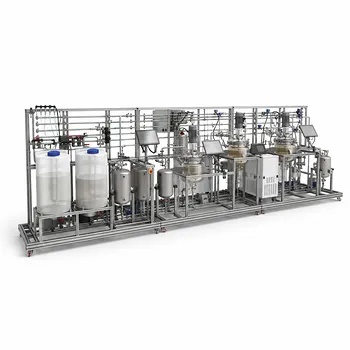
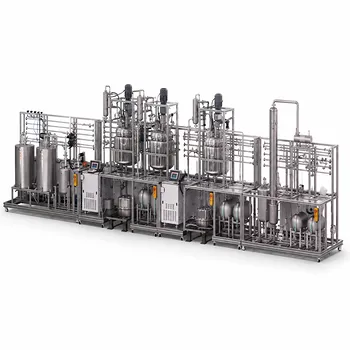
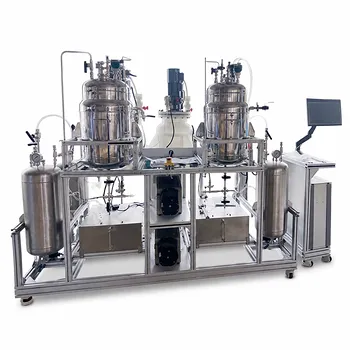
Achieving precise temperature control is the difference between messy data and breakthrough learning. LABPARK provides advanced Educational and Vocational Unit Operations Pilot Plants in chemical engineering, bioprocess & biotech, and environmental & water treatment. Specifically designed for universities, research institutes, and enterprises, our pilot plants enable students and researchers to safely and accurately isolate thermodynamic and kinetic phenomena.
Ready to elevate your laboratory’s experimental capabilities? Contact LABPARK today to discuss the perfect pilot plant solution for your department!
Related Products
- General Purpose Cosmetics Production Unit Operations Training Pilot Plant
- Aspirin API Synthesis Unit Operations Training Pilot Plant
- Carbon Dioxide Hydrogen Methanol Synthesis Educational Unit Operations Pilot Plant
- Electrolytic Hydrogen Production Educational Unit Operations Pilot Plant
- Bio-fermentation Ethanol Production Practical Training Unit Operations Pilot Plant
People Also Ask
- Why is the chemical plant startup schedule crucial? De-risk scale-up with pilot plants.
- How do deviations in estimating latent heat impact pilot plant thermal systems? Avoid hardware mis-sizing.
- When to transition from PID to adaptive control in pilot plants? Key process indicators.
- Why Compare Predicted and Experimental Excess Enthalpy? Key to Accurate Pilot Plant Scale-up
- Why Use PTFE & Hastelloy in Chemical Pilot Plants? Prevent Corrosion & Ensure Safety