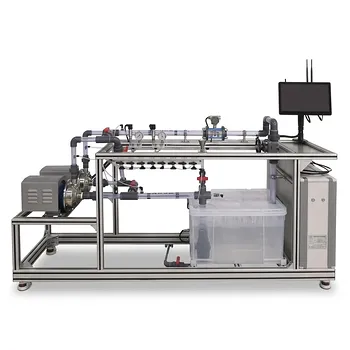
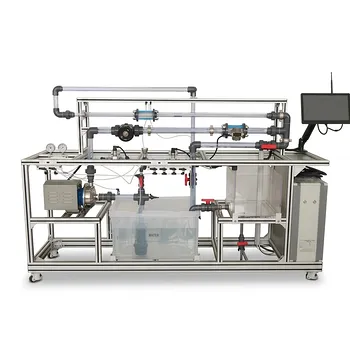
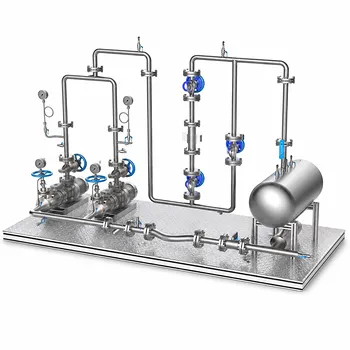
The simple answer is safety. Throttling the discharge valve of a reciprocating pump is prohibited because it creates a rapid, uncontrollable pressure spike that can violently rupture piping, destroy the pump casing, or stall the drive motor. In fluid transport pilot plants, flow must instead be regulated using a bypass loop that recycles excess fluid back to the suction side, or by directly adjusting the pump’s displacement through variable stroke length or motor speed.
The core danger stems from the pump’s nature: it is a positive displacement machine. Unlike centrifugal pumps that slip under high resistance, a reciprocating pump will force its full swept volume against any blockage until something breaks. Understanding this fundamental difference is the key to safe pilot plant design and operation.
The Fundamental Difference: Positive Displacement vs. Centrifugal Pumps
How a Reciprocating Pump Moves Fluid
A reciprocating pump uses a piston, plunger, or diaphragm to trap a fixed volume of liquid and then mechanically push it out. The flow rate is rigidly determined by the pump’s geometry and speed—the cross‑sectional area of the piston, its stroke length, and the cycling frequency. There is no internal feedback that allows the pump to “ease off” when the downstream pressure rises.
Why Throttling Works for a Centrifugal Pump
A centrifugal pump generates flow by spinning an impeller. When its discharge valve is partially closed, the added resistance simply shifts the system curve. The pump moves up its performance curve to a new operating point with lower flow and higher head. The process is safe because the pump can slip against high pressure without generating destructive forces.
The Deadly Mismatch: Throttling a Positive Displacement Pump
Throttling a discharge valve on a reciprocating pump does not gently reduce flow—it tries to restrict an incompressible liquid while the pump stubbornly continues to displace the same volume per stroke. The pump’s mechanism delivers the full motor torque directly into the trapped liquid, causing pressure to skyrocket almost instantly. There is no inherent relief valve in a standard pump or piping system, so the pressure rises until mechanical failure occurs.
The Physics of a Pressure Spike
When the discharge path is narrowed or closed, the liquid has nowhere to go. Because liquids are nearly incompressible, even a single piston stroke against a blocked outlet can create pressures many times the design limit of the system. A cast-iron pump casing can shatter, gaskets can blow out, and thin‑walled tubing seen in pilot plants can burst explosively. The motor may also stall suddenly, drawing excessive current and potentially burning out. Even partial throttling is dangerous, as it generates enough heat and localized high pressure to damage seals and valves over time.
Safe Regulation Methods for Pilot Plant Reciprocating Pumps
Bypass Regulation – The Simple Loop
A bypass line with a control valve routes a portion of the discharged fluid straight back to the suction tank. The pump runs constantly at its full design flow, but only the net difference goes forward to the process. This is the easiest method to implement in a pilot plant because it requires nothing more than piping and a standard globe or needle valve. However, it is energy‑inefficient: all the fluid in the bypass loop is being pumped against the full discharge pressure only to be depressurized again.
Variable Stroke or Speed Control – The Efficient Path
Instead of wasting flow, you change how much the pump displaces. Adjusting the stroke length directly alters the volume per stroke, while using a variable frequency drive (VFD) varies the motor speed. According to the pump’s fundamental equation ($Q = 60nFs$), both methods let you match the pump’s output precisely to the process demand without creating artificial restrictions. This approach is highly energy‑efficient because the pump only does the work that is needed, but it is mechanically and electrically more complex, often involving expensive actuators or drives.
Why This Matters in a Pilot Plant Environment
Pilot plants are designed for flexibility, education, and often rapid reconfiguration. A bursting pipe not only endangers students and researchers but also destroys expensive instrumentation and disrupts teaching. More importantly, pilot plants serve as learning models for industrial practice. Allowing students to witness the consequences of throttling a reciprocating pump—even conceptually—cements the distinction between positive displacement and centrifugal technologies, a lesson that prevents far costlier mistakes in full‑scale chemical plants.
Understanding the Trade-offs
No single regulation method is perfect for every pilot plant scenario. An honest assessment of their limitations is essential.
- Bypass regulation provides robust over‑pressure protection by ensuring the pump never runs against a closed valve. However, it wastes electricity and can heat the recycled fluid over long periods, which may be unacceptable for temperature‑sensitive solutions.
- Variable stroke or speed control eliminates the energy waste but introduces control complexity. Mechanical stroke adjusters wear over time, and VFDs require compatible motors and careful shielding to avoid electrical noise interfering with sensitive flow meters.
- Cost vs. education often dictates the choice. A simple bypass loop costs very little and still illustrates the fundamentals of positive displacement flow control, whereas a fully variable system better prepares students for modern, energy‑conscious industrial processes.
Making the Right Choice for Your Pilot Plant
The correct regulation approach depends on your primary objective.
- If your primary focus is maximum safety and simplicity: Install a well‑sized bypass loop with a throttling valve on the return line. It guarantees the pump can never be dead‑headed and requires no electrical or mechanical pump modifications.
- If your primary focus is energy efficiency and precise process control: Invest in a variable speed drive or a pump with an adjustable stroke mechanism. This lets you dial in exact flow rates while minimizing wasted power, a critical advantage in sustained experimental runs.
- If your primary focus is educational demonstration: Integrate both methods into the same pilot plant. Students can directly measure the power consumption and control response of each, learning firsthand why industry is steadily moving toward variable displacement and VFD solutions.
Choose the regulation method that aligns with your plant’s safety requirements and learning goals, and never treat a reciprocating pump like a centrifugal one. Its unwavering displacement is its greatest strength—and, when mismanaged, its most dangerous trait.
Summary Table:
| Method | Operating Principle | Safety & Efficiency | Ideal Application |
|---|---|---|---|
| Throttling Valve (Prohibited) | Restricts fluid outlet directly | Dangerous: Causes instant, destructive pressure spikes | Never use |
| Bypass Loop | Recycles excess fluid back to suction | Safe and simple; causes energy waste and potential fluid heating | Budget-friendly & basic educational setups |
| Variable Stroke/Speed | Adjusts pump displacement or motor RPM | Safe and highly energy-efficient; higher initial equipment cost | Advanced research & precise process control |
Build Safer, Industry-Ready Engineering Labs with LABPARK
Ensure maximum safety and efficiency in your training facilities. LABPARK provides advanced Educational and Vocational Unit Operations Pilot Plants in chemical engineering, bioprocess & biotech, and environmental & water treatment for universities, research institutes, and enterprises.
Our custom-built pilot plants feature robust safety mechanisms—including engineered bypass loops and precise VFD speed controls—to give students hands-on experience without the hazards.
Looking to upgrade your laboratory equipment? Contact LABPARK today to request a quote and design the perfect pilot plant for your curriculum!
Related Products
- Centrifugal Pump Performance Determination Educational Unit Operations Pilot Plant
- Centrifugal Pump Performance and Orifice Flowmeter Calibration Educational Pilot Plant
- Chemical Pipeline Assembly and Fluid Transport Practical Training Unit Operations Pilot Plant
People Also Ask
- Why start a centrifugal pump with a closed outlet valve? Protect your pilot plant motors.
- How can cavitation and slurry erosion be studied and mitigated using fluid transport and centrifugal pump pilot plants?
- How does fluid density affect pump head and pressure? Avoid Pilot Plant Motor Overload
- How does fluid viscosity affect centrifugal pump performance? Key pilot plant correction methods.
- How does fluid density affect centrifugal pump performance & motor safety in pilot plants?