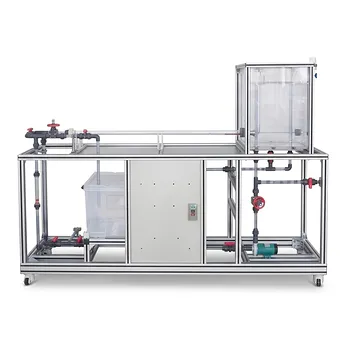
Precision in measurement isn’t a given—it’s earned through rigorous calibration.
In chemical engineering pilot plants, flow meters such as Venturi tubes and orifice plates cannot simply rely on textbook discharge coefficients. Their real-world performance shifts with fluid dynamics, geometry, wear, and process conditions. Calibration becomes the essential exercise that turns a theoretical device into an accurate instrument, while teaching students the profound gap between ideal equations and operational reality.
The discharge coefficient (Cd) is not a fixed constant—it varies with Reynolds number, edge sharpness, surface roughness, and fluid properties. Without experimental calibration, flow measurements can be off by several percent, undermining both data integrity and the educational mission of the pilot plant.
Why Textbook Coefficients Fail in the Real World
The Discharge Coefficient Is Not a Constant
For a standard orifice meter, Cd typically ranges from 0.59 to 0.68, while a Venturi sits higher at 0.97 to 0.99.
These ranges are just starting points. Cd drifts with flow rate (Reynolds number) and can decrease by 1–2% over time in a Venturi due to surface roughening or internal scale deposits.
Geometry and Wear Redefine Performance
A sharp-edged orifice is especially vulnerable. Continuous fluid circulation in educational labs can erode the upstream edge, altering the vena contracta and permanently shifting the discharge coefficient.
Without recalibration, you’re measuring with a fundamentally different device each semester.
No Universal Theoretical Baseline
There is no universally agreed-upon theoretical Cd for many flow elements.
This uncertainty makes experimental calibration the only reliable way to anchor your measurements in reality, revealing how the contraction coefficient (Cc) and velocity coefficient (Cv) combine to produce the actual discharge behavior.
When Fluids Refuse to Behave as Predicted
The Compressibility Trap
Incompressible fluid equations work well for water, but move to air or steam and the rules change.
As pressure drops across the restriction, the specific weight decreases, causing the basic incompressible formula to overestimate true flow.
An expansion factor (Y) must be introduced and validated—often through calibration—to correct this error.
Complex Rheology and System Anomalies
Pilot plants may handle fluids with unexpected rheological behavior.
Calibration exercises force students to observe how discharge rates deviate from Newtonian textbook predictions, reinforcing that practical, not just theoretical, expertise is required for accurate metering.
Calibration as a Pedagogical Imperative
Bridging the Gap Between Equations and Reality
Calibration’s deepest value in a teaching lab is making the limits of theory visible.
Students see firsthand that a Venturi’s discharge coefficient is essentially a velocity coefficient (Cv), while an orifice’s is a combined product of Cv and a contraction coefficient (Cc).
This distinction becomes visceral only through measurement.
Building Professional Data Discipline
Good experimental habits start with questioning sensor data.
By executing weight-based or reference-meter calibrations across multiple Reynolds numbers, students internalize that no instrument is inherently trustworthy—a lesson that pays immediate dividends in industry.
Understanding the Trade-offs
Accuracy vs. Permanent Pressure Loss
Calibration cannot eliminate inherent losses. An orifice meter delivers moderate accuracy but creates significant frictional head loss from vortex dissipation downstream of the vena contracta.
A Venturi recovers far more pressure, but even its high Cd needs regular verification.
Calibration helps you decide which trade-off is acceptable for your energy budget and measurement tolerance.
Sensitivity to Surface Conditions vs. Maintenance Burden
A Venturi’s Cd degrades slowly as its interior roughens; an orifice’s sharp edge can blunt rapidly.
Skipping calibration to save time ensures data drift, while over-calibrating wastes labor. Calibration teaches the engineering judgment to find the right recalibration interval for your system.
Making Calibration a Cornerstone of Your Pilot Plant Program
A thoughtful calibration strategy turns a simple flow sensor into a source of genuine insight.
- If your primary focus is teaching fundamentals: Have students calibrate both an orifice and a Venturi across a wide Reynolds number range, documenting how Cd changes and why. This directly connects fluid mechanics theory to measurement practice.
- If your primary focus is high-accuracy research data: Establish a pre-experiment calibration routine using gravimetric methods or reference meters, especially after any system change or extended downtime. For compressible flows, explicitly determine the expansion factor.
- If your primary focus is long-term plant health and data reliability: Monitor pressure drop trends across fixed orifice plates as a wear indicator, and schedule recalibration whenever the discharge coefficient drifts beyond your acceptable error threshold (typically 1–2%).
Calibration transforms the flow meter from a blind sensor into a dependable reporting instrument—and turns students into engineers who never take a number at face value.
Summary Table:
| Feature | Venturi Tube | Orifice Plate |
|---|---|---|
| Typical Cd Range | 0.97 – 0.99 | 0.59 – 0.68 |
| Pressure Recovery | High (low head loss) | Low (significant head loss) |
| Wear Resistance | High (degrades slowly) | Low (edges erode quickly) |
| Primary Drift Cause | Scale deposits & roughness | Upstream edge erosion |
Optimize Your Lab's Fluid Mechanics Education with LABPARK
Bridge the gap between textbook equations and real-world engineering. LABPARK provides state-of-the-art Educational and Vocational Unit Operations Pilot Plants in chemical engineering, bioprocess & biotech, and environmental & water treatment. Designed specifically for universities, research institutes, and enterprises, our pilot plants empower students and researchers to master flow meter calibration, data discipline, and process control.
Ready to upgrade your laboratory training equipment? Contact LABPARK today to discover how our hands-on pilot plants can elevate your engineering curriculum and research accuracy!
Related Products
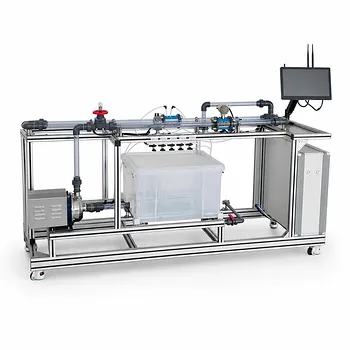
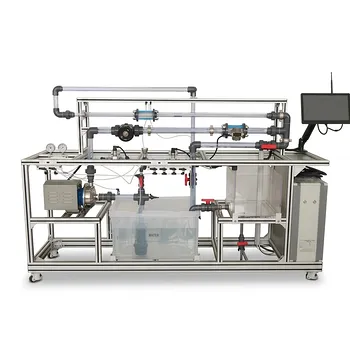
- Orifice and Venturi Flowmeter Calibration Educational Pilot Plant for Fluid Mechanics Laboratory
- Centrifugal Pump Performance and Orifice Flowmeter Calibration Educational Pilot Plant
- Cavitation Phenomenon Demonstration and Analysis Educational Unit Operations Pilot Plant
- Quantitative Dosing and Liquid Flow Control Educational Unit Operations Pilot Plant
- Fluid Reynolds Number Demonstration Educational Unit Operations Pilot Plant
People Also Ask
- What is the difference between static and stagnation pressure? Master Pilot Plant Flow Measurement
- How do pilot plants demonstrate siphon pressure variations? Visualizing Bernoulli's Energy Balance
- How do fluid mechanics training pilot plants facilitate the visualization and calculation of laminar and turbulent flows?
- How to update chemometric calibration models in pilot plants? Best practices for process engineers.
- Why are the laws of similitude critical in fluid flow pilot plants? Scale Up Safely