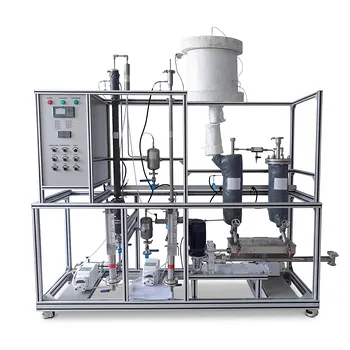
The most intuitive control strategy fails in a reboiler and evaporator. Direct temperature control is avoided because a saturated vapor-liquid system at constant pressure maintains a constant boiling point, rendering temperature measurement useless for regulating heat transfer. Instead, chemical engineering pilot plants teach students to use liquid level and feed flow control loops that leverage mass balance to indirectly manage the evaporation rate.
The core challenge in reboiler and evaporator control is that phase-change systems are invariant to temperature under constant pressure. The solution is to abandon direct thermal regulation and instead impose discipline through inventory management (level control) and mass flow, which then force the heating utility to follow automatically. This teaches the fundamental principle: in a phase-change process, energy balance is subservient to mass balance.
The Futility of Direct Temperature Control
The Physics of Saturation
In a reboiler or evaporator, a liquid is being boiled to produce vapor. The liquid and vapor are at equilibrium. For a pure substance or a constant-composition mixture, this equilibrium temperature is fixed solely by the operating pressure. As long as the pressure is constant, the temperature cannot change, regardless of how much heat is added.
Any extra heat duty does not raise the temperature; it simply increases the boil-up rate. A temperature sensor placed in the boiling pool or vapor space would therefore remain stubbornly fixed. A feedback controller trying to adjust steam flow based on this signal would see no error to correct, rendering it completely ineffective.
The Educational Flaw
Pilot plants are designed to teach fundamentals before exposing students to advanced process control. Introducing direct temperature control on a saturated system would be a pedagogical dead end. It would demonstrate a control configuration that is physically doomed to fail, failing to teach the student the critical distinction between sensible heat transfer and latent heat transfer. The lesson is that you cannot drive a process with a variable that the process itself holds constant.
The Taught Alternative: Mass Balance-Driven Control
Primary Loop: Liquid Level Control
Instead of temperature, the primary control structure uses liquid level control. The level in the reboiler or evaporator sump is measured and controlled by manipulating the bottom product flow. This loop maintains a constant inventory of liquid in the vessel.
A stable level provides a fixed heat transfer surface area in the boiling zone. More importantly, it decouples the separation performance from downstream inventory fluctuations, allowing the energy balance to be handled separately. This is the first pillar of the alternative strategy.
Primary Loop: Feed Flow Control
The second pillar is flow control on the feed stream. A flow controller sets a precise, constant rate of material entering the vessel. This is critical. In a continuous process, the feed rate sets the production rate. Since the liquid level is held constant by the level controller, any material entering must leave—either as liquid bottom product or as vapor. Because the bottom product flow is relatively small in an evaporator or reboiler, the vast majority of the feed must be vaporized.
Therefore, setting a constant feed flow effectively sets the required boil-up duty. The heating steam flow is then regulated in cascade by the feed flow, or it is left to float on a pressure controller to meet the energy demand imposed by the mass balance. The steam flow becomes a slave to the feed rate, not the temperature.
The Resulting Control Structure
The classic teaching configuration is:
- Feed Flow Controller (FIC) on the inlet, providing a stable process load.
- Level Controller (LIC) on the sump, manipulating bottoms flow to keep inventory constant.
- Heating Steam Scheme: The steam can be set manually, ratioed to the feed flow, or controlled by a separate steam pressure controller. Crucially, the energy input is tied to the mass balance constraints, not an unresponsive temperature signal.
This structure teaches students that for phase-change systems, mass balance and inventory management are the true levers for stable operation.
Understanding the Principle: Energy Follows Mass
Why This Works
The system works because the latent heat of vaporization is a physical constant that governs the energy demand per unit mass of feed. By fixing the mass flow rate of the feed (and the liquid level's outflow), the required energy is predetermined. The heating utility doesn't need a temperature target; it simply needs to supply whatever energy the mass balance demands at the boiling point. If the steam pressure is controlled, it provides a constant temperature driving force, and the boiling rate adjusts naturally to the available heat transfer area (which is constant due to level control).
The Deeper Lesson for Students
This teaches a broader chemical engineering truth: control strategies must match the degrees of freedom of the system. A saturated mixture has lost the temperature degree of freedom, so a different one must be found. By forcing the mass balance with flow and level controllers, the process becomes self-regulating. The student learns to look for the "missing" manipulated variable and to use first-principles thermodynamics to design a viable control scheme.
Common Pitfalls and Trade-offs
The Illusion of Pressure Control
A student might argue that if temperature is fixed, why not control pressure directly instead? In many reboilers, pressure control is indeed part of the scheme, but it is often downstream on the condenser side of a distillation column. Directly pressure-controlling a reboiler by throttling steam can work, but it introduces a slower, integrating response and can interact poorly with the column. Pilot plants focus on the pure mass-balance method first because it isolates the concept and prevents confusion from interacting loops.
The Limits of Purity
The explanation assumes a pure component or a narrow-boiling mixture at constant composition. In a multi-component distillation reboiler, the composition changes along the column, but in a pilot plant simplified binary separation, the boiling point is still predominantly set by the column pressure and the current composition. The mass-balance approach remains the robust starting point, with temperature sometimes used later for composition control in a cascade via internal reflux or heat duty rather than as a direct reboiler input.
Why Not Just Use an Analyzer?
As the supplementary references point out, online composition analyzers are expensive, slow, and high-maintenance. In a teaching environment, relying on them would obscure the fundamental physics. The preferred method teaches reliable, fast-responding principles that don't require delicate instrumentation. The goal is to understand the process, not to mask poor control with an expensive sensor.
Making the Right Choice for Your Educational Goal
To select the appropriate control strategy for a reboiler or evaporator in a pilot plant, align the configuration with the learning objective.
- If your primary focus is teaching mass and energy balance fundamentals: Use the classic level-plus-feed-flow control scheme. It forces students to confront the invariant nature of saturated systems and proves that stable operation comes from mass flow discipline.
- If your primary focus is demonstrating advanced multivariable control: First implement the mass-balance scheme to establish baseline stability, then introduce a composition analyzer in cascade with the steam flow or feed temperature to show how quality constraints overlay on top of the fundamental inventory controls.
- If your primary focus is simulating an exothermic reaction system where boiling acts as cooling: Move beyond the reboiler concept to the “reactor with reflux condenser” model, where temperature can change, and controlling the condenser duty or system pressure becomes the primary thermal management method.
The mark of a well-trained process control engineer is knowing when a measured variable is powerless to drive a loop. Mastering the reboiler teaches you to first look at the physics, then define the strategy.
Summary Table:
| Control Approach | Primary Mechanism | Why It's Used or Avoided |
|---|---|---|
| Direct Temperature Control | Adjusts heating utility based directly on temperature sensors | Avoided: Saturated phase-change systems maintain a constant boiling point at constant pressure, making sensors unresponsive. |
| Mass Balance-Driven Control | Pairs Feed Flow Control (FIC) with Liquid Level Control (LIC) | Taught Alternative: Manages inventory and mass flow to force the heating utility to adjust naturally to the energy demand. |
Teach Real-World Process Control with LABPARK
Building an effective educational lab requires equipment that demonstrates true thermodynamic and process control principles. LABPARK provides industry-grade Educational and Vocational Unit Operations Pilot Plants in chemical engineering, bioprocess & biotech, and environmental & water treatment.
Designed specifically for universities, research institutes, and enterprises, our pilot plants help students safely master mass balance, level control, and advanced automation structures.
Ready to upgrade your department's training capabilities? Contact LABPARK today to find the perfect pilot plant solution for your curriculum!
Related Products
People Also Ask
- How Do Temp, Pressure & S:C Ratio Affect Methane Reforming? Optimize Your Pilot Reactor
- How to Integrate WGS & Purification in Steam Reforming Pilot Plants to Protect Fuel Cells from CO Poisoning
- What are the differences between steam reforming and ATR in pilot plants? Key Design Guide
- How is carbon deposition controlled in steam reforming? The Critical Role of S/C Ratio
- What is the difference between allothermal and autothermal steam reforming in pilot plants?