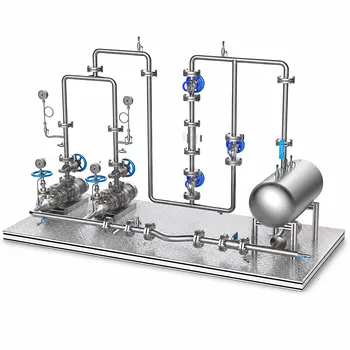
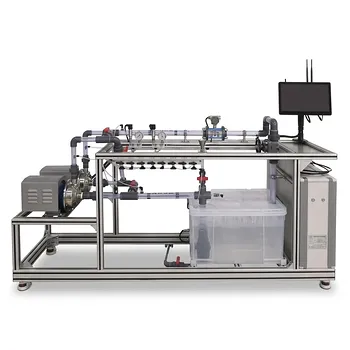
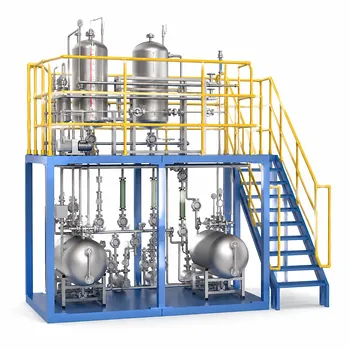
Both pump types are used because chemical process plants must handle fundamentally different transport duties. Centrifugal pumps are preferred for continuous, relatively high-flow transfer at low-to-moderate pressure heads, while positive displacement pumps are selected when the process requires high pressure, accurate metering, or reliable flow with viscous liquids. Their key performance difference is that centrifugal-pump flow changes substantially with system resistance, whereas positive-displacement flow remains nearly constant as discharge pressure changes.
Centrifugal pumps are flow-producing machines whose operating point depends strongly on system head; positive displacement pumps deliver a defined volume per cycle and therefore maintain flow more independently of discharge pressure. Plants use both because bulk circulation and precise high-pressure dosing are different engineering requirements.
Why Process Plants Need Both Pump Types
Continuous Bulk Transfer
Centrifugal pumps are well suited to moving large quantities of liquid continuously through process equipment. Typical duties include feed transfer, column circulation, cooling-water service, and reboiler circulation.
Their compact construction, steady delivery, and relatively low maintenance make them practical for routine process circulation.
High-Pressure Delivery and Metering
Positive displacement pumps are used when the plant must deliver a controlled volume against substantial pressure. Reciprocating pumps are common for low-flow, high-pressure dosing, while rotary pumps are useful for relatively uniform delivery of viscous liquids.
This makes positive displacement technology suitable for injecting reactants, catalysts, additives, or other process chemicals at controlled rates.
Different Fluid Properties
Centrifugal pumps generally perform best with low-viscosity liquids. Their performance can deteriorate as viscosity increases because internal friction raises power requirements and reduces flow and efficiency.
Positive displacement pumps are often better suited to viscous fluids because they move a defined volume mechanically rather than relying primarily on imparted fluid velocity.
Training and Pilot-Plant Flexibility
Including both pump types in a pilot plant allows operators and students to observe how pump characteristics interact with piping resistance. They can measure head, flow, pressure response, viscosity effects, and changes in operating point under realistic process conditions.
This comparison is valuable because pump selection depends on the combined requirements of flow rate, pressure head, viscosity, and control accuracy.
How Centrifugal Pump Performance Changes
Head Falls as Flow Increases
A centrifugal pump transfers kinetic energy to the liquid and converts part of that energy into pressure. At a given speed, its pressure rise is generally highest near zero flow and decreases as volume flow increases.
The resulting pump curve typically slopes downward: higher system resistance produces lower flow, while lower resistance permits higher flow.
Flow Depends on the System Curve
A centrifugal pump does not operate at one fixed flow rate under all conditions. Its actual operating point is where the pump curve intersects the piping system’s resistance curve.
Opening a discharge valve reduces system resistance and usually increases flow. Closing the valve increases resistance and usually reduces flow while increasing the developed head toward the pump’s shutoff condition.
Speed Changes the Pump Curve
Changing rotational speed shifts the centrifugal pump’s performance curve. Increasing speed generally increases available head and flow, while reducing speed lowers both.
This provides a useful method of capacity control, although the effects on power consumption and equipment limits must also be considered.
Typical Process Strengths
Centrifugal pumps are effective for:
- High or moderate flow rates
- Low-to-moderate pressure heads
- Continuous and relatively smooth liquid delivery
- Clean, low-viscosity process fluids
- Compact installations with straightforward operation
They are available in corrosion-resistant materials such as stainless steel, polypropylene, and stoneware, depending on chemical compatibility.
How Positive Displacement Pump Performance Differs
Flow Is Determined by Displacement
A positive displacement pump traps and moves a defined volume of liquid during each cycle or rotation. Its theoretical flow is therefore determined primarily by displacement and operating speed.
For a reciprocating pump, flow is related to piston displacement and stroke frequency. For a rotary pump, flow is related to displacement per revolution and rotational speed.
The Performance Curve Is Nearly Vertical
Unlike a centrifugal pump, a positive displacement pump can maintain nearly the same volume flow as discharge pressure increases. Its characteristic curve is therefore often represented as nearly vertical.
Actual flow still changes somewhat because of leakage, compressibility, valve behavior, slip, and mechanical limitations. “Nearly constant” is more accurate than perfectly constant.
Pressure Is Created by System Resistance
A positive displacement pump continues trying to displace liquid when downstream resistance rises. The pump does not simply reduce flow in response to pressure in the way a centrifugal pump does.
Consequently, pressure can increase rapidly if the discharge path is blocked. A properly sized relief valve, bypass, or other pressure-protection system is essential.
Flow Control Uses Displacement or Bypass
Positive displacement pump flow is commonly controlled by changing speed, piston stroke length, or stroke frequency. A bypass loop can also return excess liquid to the suction side, although this may waste energy and can affect fluid temperature or product quality.
Throttling the discharge valve is not an adequate primary flow-control method for a positive displacement pump.
How the Operating Point Is Established
Centrifugal Pump Intersection
For a centrifugal pump, the operating point is established by the intersection of:
- The pump’s head-versus-flow characteristic
- The piping system’s resistance curve
Changing a valve changes the system curve. Changing pump speed changes the pump curve.
Positive Displacement Pump Interaction
A positive displacement pump is less sensitive to the system curve in terms of flow. As resistance increases, the flow tends to remain similar while the required discharge pressure rises.
The system still determines the pressure that the pump must develop, but pressure protection becomes the controlling safety concern.
What Pilot Plants Demonstrate
A pilot plant can show these differences directly by varying valves, pump speed, or fluid viscosity. Centrifugal-pump experiments reveal changing flow and head, while positive-displacement experiments reveal relatively stable flow and rising pressure.
These observations connect pump theory with practical equipment selection and process control.
Understanding the Trade-offs
Centrifugal Pump Limitations
Centrifugal pumps are generally less effective with highly viscous liquids and may not produce high pressures in a single-stage arrangement. They also commonly require priming because they are not inherently self-priming.
Their best efficiency is usually achieved within a defined operating range. Operating too far from that range can increase vibration, recirculation, wear, or energy consumption.
Positive Displacement Pump Limitations
Positive displacement pumps are more mechanically complex than many centrifugal pumps and may produce pulsating flow, particularly in reciprocating designs. They also require careful protection against blocked discharge conditions.
A bypass system can improve operational flexibility, but continuous recirculation may reduce energy efficiency. Rotary designs can provide smoother flow, but their suitability depends on viscosity, solids content, leakage, and material compatibility.
Valve Closure Is Not Equally Safe
A centrifugal pump can generally tolerate a brief discharge restriction because its flow falls as resistance rises, although prolonged operation at shutoff can cause overheating and damage.
A positive displacement pump must not be operated against a fully closed discharge without an appropriate relief path. Since it continues displacing liquid, the resulting pressure can damage the pump, piping, seals, or motor.
Selection Requires More Than Pressure and Flow
Choosing a pump solely by its rated flow or pressure can produce poor results. The selection must also consider viscosity, corrosion, solids, temperature, suction conditions, metering accuracy, pulsation, control method, and the consequences of failure.
Making the Right Choice for Your Goal
The correct choice follows from the process duty rather than from the pump name alone.
- If your primary focus is continuous high-flow transfer: Choose a centrifugal pump when the liquid has relatively low viscosity and the required pressure head is low to moderate.
- If your primary focus is precise chemical dosing: Choose a positive displacement pump because its displacement and speed provide more direct control of delivered volume.
- If your primary focus is high-pressure, low-flow service: Prefer a positive displacement pump, with suitable relief and pressure-protection equipment.
- If your primary focus is viscous-liquid handling: Evaluate rotary or reciprocating positive displacement pumps before selecting a centrifugal pump.
- If your primary focus is process education or pilot-plant study: Include both types so operators can compare pump curves, system resistance, pressure response, viscosity effects, and control methods.
Centrifugal pumps match changing-flow circulation duties, while positive displacement pumps match controlled-volume and high-pressure duties; understanding that distinction is the foundation of sound process-pump selection.
Summary Table:
| Feature | Centrifugal Pump | Positive Displacement Pump |
|---|---|---|
| Best suited for | Continuous, high-flow transfer | High-pressure, low-flow service and dosing |
| Flow behavior | Varies significantly with system resistance | Remains nearly constant as pressure changes |
| Fluid suitability | Low-viscosity liquids | Viscous liquids and controlled chemical feeds |
| Flow control | Valve adjustment or speed variation | Speed, stroke adjustment, or bypass |
| Typical applications | Feed transfer, circulation, cooling water, reboilers | Reactant, catalyst, and additive injection |
| Main safety concern | Avoid prolonged operation at shutoff | Requires relief or bypass protection against blocked discharge |
| Pilot-plant value | Demonstrates pump curves and operating points | Demonstrates metering, pressure response, and viscosity effects |
Need to demonstrate or optimize chemical fluid transport? Contact LABPARK to discuss Educational and Vocational Unit Operations Pilot Plants for chemical engineering, bioprocess and biotech, or environmental and water treatment applications. LABPARK supports universities, research institutes, and enterprises with practical systems that compare centrifugal and positive displacement pump behavior, evaluate flow, pressure, viscosity, metering accuracy, and control methods, and strengthen operator and student training through realistic process experiments.
Related Products
- Multi Pump Fluid Transport Process Piping Unit Operations Training Pilot Plant
- Chemical Pipeline Assembly and Fluid Transport Practical Training Unit Operations Pilot Plant
- Centrifugal Pump Performance and Orifice Flowmeter Calibration Educational Pilot Plant
- Electrolyte Distillation Purification and Formulation Educational Pilot Plant
- Centrifugal Pump Performance Determination Educational Unit Operations Pilot Plant
People Also Ask
- Why distinguish Newtonian & non-Newtonian fluids in pilot plants? Prevent design errors.
- How do steady-state and dynamic simulations complement pilot plants? Validate scale-up and controllability
- Why Does a Pilot Plant Solver Return a Singular Matrix Error, and How Can You Resolve It?
- How can chemical engineering students use unit operations pilot plants to study kinetics? Master reactor scale-up!
- Why is the chemical plant startup schedule crucial? De-risk scale-up with pilot plants.