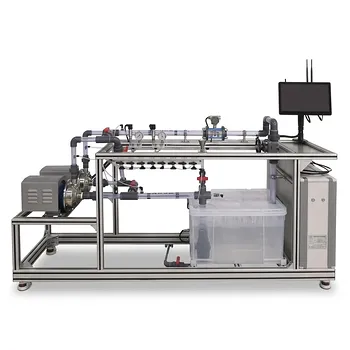
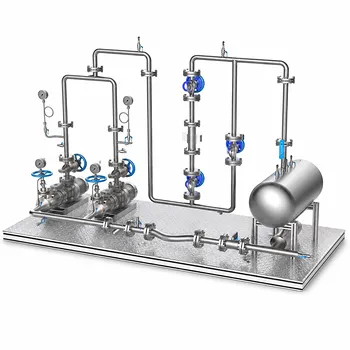
When you increase a centrifugal pump’s rotation speed, its flow rate increases proportionally, its head increases by the square of the speed change, and its power demand increases by the cube. This exponential relationship is the core of the affinity laws. However, in an educational pilot plant, you'll immediately discover these laws are a geometric idealization that is practically acceptable only within a narrow window of roughly $\pm 20%$ speed change, where the underlying assumption of constant efficiency holds true.
The affinity laws predict that a small speed increase dramatically spikes power consumption—doubling the speed theoretically requires eight times the power. For educational training, their true lesson is not just a mathematical formula but a stark warning about the practical limits of scaling. Beyond a 20% change, the prediction error grows unacceptable because the pump's internal efficiency can no longer be considered constant.
Deconstructing the Affinity Laws in a Pilot Plant
The affinity laws are derived from the fundamental velocity vectors of fluid leaving the pump’s impeller. In a fluid transport training module, you can trace each performance shift back to a change in impeller tip speed.
The Impact on Flow Rate (Linear Relationship)
The volumetric flow rate ($Q$) has a direct, proportional relationship with rotational speed ($n$). If you double the speed, the impeller sweeps out twice the volume per unit time.
This is calculated as $Q_2 = Q_1 \times (n_2 / n_1)$. In a pilot plant, you’ll see the flow meter reading move linearly, making this the most intuitive law to observe.
The Impact on Head (Square Relationship)
The head ($H$), representing the energy per unit weight of fluid, scales with the square of the speed. This occurs because the impeller tip velocity increases linearly, and it’s the conversion of this kinetic energy into pressure that follows a squared function.
The calculation $H_2 = H_1 \times (n_2 / n_1)^2$ demonstrates that a small speed bump generates a much larger increase in discharge pressure. Your pilot plant’s pressure gauge will reflect a non-linear jump that reinforces the kinetic energy principle.
The Impact on Power (Cubic Relationship)
Shaft power ($N$) cubes with the speed change because it’s the product of flow (linear increase) and head (squared increase). The relationship $N_2 = N_1 \times (n_2 / n_1)^3$ is the most critical factor in equipment protection.
The motor’s current draw will skyrocket with a modest speed increase. An educational power analyzer in the module clearly illustrates why motor thermal protection is non-negotiable during these experiments.
The Critical Limitation: The Myth of Constant Efficiency
The educational value of a unit operations pilot plant lies in highlighting when theory breaks down. The affinity laws are valid mathematical derivations based on the principle of dynamic similarity, which explicitly assumes no change in pump efficiency.
The $\pm 20%$ Validity Window
The primary reference specifies that calculation errors remain "acceptable" only when the speed change is within $\pm 20%$. Outside this range, the velocity triangles at the impeller outlet deform.
The geometric angles of the fluid flow no longer align with the impeller vanes as they should. This mismatch causes increasing shock losses and recirculation, meaning the pump deviates into a mechanically different operating regime where the "constant efficiency" assumption is destroyed.
How the Operating Point Masks the Error
A centrifugal pump always operates at the intersection of its pump curve and the system’s resistance curve. A speed change shifts the entire pump curve.
At a large speed reduction, the pump’s discharge head might not overcome the system's static head, causing flow to cease entirely—a scenario the basic affinity formula cannot predict on its own. The laws scale the curve, but the actual operating point is a negotiation with your specific pipeline’s friction.
Understanding the Trade-offs
Experimental data in a pilot plant quickly reveals that affinity laws are a scaling tool, not a precise digital twin.
Speed Control vs. Energy Reality
Variable speed control is celebrated because power follows the cube of the speed, promising enormous energy savings compared to throttling a valve. However, this theoretical saving is only fully realized when the system’s head is mostly dynamic friction, not static elevation.
If your pilot plant is pumping fluid against a high static lift, reducing speed sharply drops the flow rate while still requiring significant power, diminishing the cubic efficiency advantage.
The Motor Overload Trap
The cubic power increase punishes inattention. A common training mistake is overspeeding a pump to reach a target flow without checking the motor's nameplate.
If the original operating point already uses 60% of the motor’s rated power, a seemingly small 20% speed increase demands $(1.2)^3 = 172.8%$ of the base power, which instantly trips the motor’s overload protection or causes a burnout. The pilot plant’s safety lessons are rooted in this draconian mathematical consequence.
Viscosity’s Double Penalty
Although not a speed change, introducing a viscous fluid during training highlights why the efficiency assumption is so fragile. High viscosity increases disc friction inside the pump, immediately invalidating the water-based performance curves.
Just as the affinity laws fail beyond 20% speed due to efficiency shifts, they also fail immediately when a fluid variable fundamentally alters the energy losses inside the volute.
Making the Right Choice for Your Educational Goal
In a pilot plant operation, your approach to speed change experiments must match the learning objective. Use the following strategies to maximize insight while protecting the equipment.
- If your primary focus is observing basic affinity theory: Restrict all speed variation experiments strictly to within $\pm 20%$ of the pump’s rated speed and record flow, head, and power to verify the squared and cubed relationships against ideal calculations.
- If your primary focus is understanding practical system control: Combine speed changes with a VFD and a system resistance curve constructed from your piping. Plot how the operating point slips along the system curve, explicitly identifying the point where static head limits further flow.
- If your primary focus is operational safety and design margins: Calculate the theoretical third-power shaft load before every speed increase and confirm the pilot plant motor’s service factor can absorb the surge, demonstrating why density or speed changes require rigorous power calculations.
By treating the affinity laws as a foundation to be tested rather than a fact to be memorized, the pilot plant transforms from a simple pump into a profound lesson on the limits of idealization in chemical engineering.
Summary Table:
| Parameter | Relationship with Speed ($n$) | Mathematical Formula | Practical Limitation & Reality |
|---|---|---|---|
| Flow Rate ($Q$) | Linear | $Q_2 = Q_1 \times (n_2 / n_1)$ | Most accurate relationship; easy to observe linearly on meters. |
| Head ($H$) | Quadratic (Square) | $H_2 = H_1 \times (n_2 / n_1)^2$ | Affected by system static head; flow stops if head drops below static lift. |
| Power ($N$) | Cubic | $N_2 = N_1 \times (n_2 / n_1)^3$ | High risk of motor overload; minor speed increases drastically spike power. |
| Efficiency ($\eta$) | Assumed Constant | $\eta_2 \approx \eta_1$ | Only valid within a $\pm 20%$ window; flow misalignment causes losses beyond this. |
Bring Hands-On Engineering to Life with LABPARK
Are you looking to bridge the gap between textbook theory and real-world industrial practice? LABPARK provides state-of-the-art Educational and Vocational Unit Operations Pilot Plants designed specifically for universities, research institutes, and enterprises.
We offer specialized training systems across key domains:
- Chemical Engineering & Fluid Transport (including centrifugal pump and fluid dynamics modules)
- Bioprocess & Biotechnology
- Environmental & Water Treatment
Our pilot plants empower students and researchers to visualize complex fluid mechanics, test the boundaries of thermodynamic laws, and master operational safety in a controlled lab setting.
Ready to upgrade your laboratory capabilities? Contact LABPARK today to request a catalog or discuss a custom pilot plant solution for your institution!
Related Products
- Centrifugal Pump Performance Determination Educational Unit Operations Pilot Plant
- Centrifugal Pump Performance and Orifice Flowmeter Calibration Educational Pilot Plant
- Chemical Pipeline Assembly and Fluid Transport Practical Training Unit Operations Pilot Plant
People Also Ask
- Why start a centrifugal pump with a closed outlet valve? Protect your pilot plant motors.
- How can cavitation and slurry erosion be studied and mitigated using fluid transport and centrifugal pump pilot plants?
- How does fluid density affect pump head and pressure? Avoid Pilot Plant Motor Overload
- How does fluid viscosity affect centrifugal pump performance? Key pilot plant correction methods.
- How does fluid density affect centrifugal pump performance & motor safety in pilot plants?