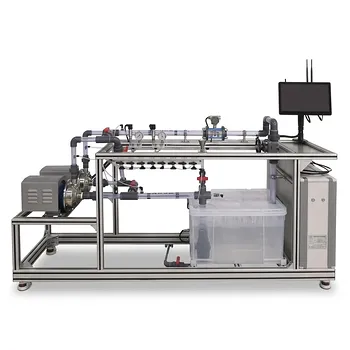
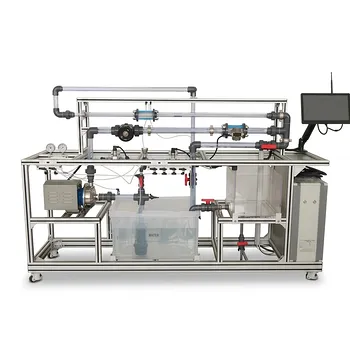
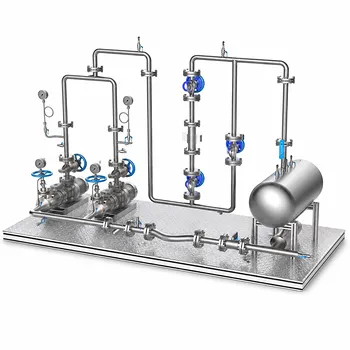
Changing the working fluid to a higher density in a centrifugal pump circuit – while keeping pump speed and pipework identical – leaves the volumetric flow rate and head completely unchanged. However, because pressure and power are directly proportional to density, both the outlet pressure and the shaft power increase precisely in line with the density ratio. For a salt solution 1.2 times denser than water, you will see a 20% rise in both the discharge gauge reading and the motor’s power draw.
The takeaway for any unit operations lab: A centrifugal pump’s flow and head curves are independent of fluid density, but every extra kilogram per cubic meter translates straight into higher pressure and a heavier load on the motor. Teaching this relationship gives students an unforgettably practical lesson in motor sizing and overload risk.
Why Volumetric Flow Rate and Head Stay the Same
Head Is Energy per Unit Weight
A centrifugal pump imparts mechanical energy to the fluid. The key to understanding why head doesn’t change is that the theoretical head ($H_{T\infty}$) is defined as the energy added per unit weight of fluid.
Because this energy transfer depends on impeller geometry and rotational speed – and because the fluid’s weight cancels out of the velocity triangles – the pump will lift a denser brine to exactly the same height as it would lift water.
The Impeller’s Velocity Triangles Don’t Care About Density
Volumetric flow rate ($Q$) is the product of the flow area and the radial velocity exiting the impeller. Those velocities are dictated by the blade angles and rotational speed, not by how heavy the fluid is.
As a result, the pump’s $H$-$Q$ curve remains unchanged when you swap water for a denser fluid. Students can confirm this by watching the flow meter and differential pressure transmitter stay constant during a switch.
Where Viscosity Might Intervene
Strictly speaking, this independence holds only if the viscosity of the new fluid is very close to that of water. Many pilot plant salt solutions have negligible viscosity differences, so the demonstration is clean and predictable. If a fluid were both denser and noticeably more viscous, the pump curve would shift, but that is a separate effect.
How Outlet Pressure Rises with Higher Density
The Direct Proportionality
Discharge pressure is not the same as head. The hydrostatic pressure rise across the pump is given by:
$$\Delta P = \rho , g , H$$
Since $H$ remains constant, pressure scales linearly with density. A 20% increase in density produces a 20% higher reading on the pump discharge pressure gauge.
In a pilot plant, this becomes immediately visible when students switch from water to a denser solution – the gauge needle climbs even though the flow appears unchanged.
What This Means for the Piping System
Most educational rigs are designed with generous pressure margins, but the lesson is crucial: in real industrial pipework, a significant density increase could push the maximum allowable working pressure (MAWP). Checking the pressure rating of flanges, gaskets, and instruments is a vital habit to instill.
The Shaft Power Requirement
Power Scales in Lockstep with Density
The shaft power ($N$) that the motor must supply follows the fundamental pump power equation:
$$N = \frac{\rho , g , Q , H}{\eta}$$
Since $Q$, $H$, and efficiency ($\eta$) are unchanged, shaft power increases by exactly the same percentage as density.
With a 1.2× denser fluid, the motor will deliver 20% more mechanical power. In a teaching lab, the current drawn by the motor will rise noticeably, offering a vivid real-time demonstration of the physics.
The Practical Danger: Motor Overload
The most critical takeaway for students is that motors are sized for a specific fluid. If the installed motor’s rated power was only just large enough for water, running a denser fluid at full flow can push the motor beyond its thermal limit.
This leads to overheating, insulation damage, or outright burnout. The primary reference explicitly states that students must learn to size motors with an adequate safety margin for fluids heavier than water.
How to Check Before You Switch
Good practice in a pilot plant includes:
- Calculating the new shaft power using the density ratio.
- Comparing it against the motor’s nameplate power rating.
- Ensuring the service factor provides enough headroom.
- Monitoring motor current or using an overload relay as a safeguard.
Understanding the Trade-offs and Pitfalls
When Density Hides a Viscosity Problem
While the density effect is the star of this demonstration, avoid over‑generalising. If a denser fluid also brings a substantial viscosity increase, the pump’s $H$-$Q$ curve will move, and efficiency can drop.
In a carefully designed teaching lab, you can deliberately choose a fluid (like a simple salt solution) where only density changes, isolating the variable and keeping the lesson clean.
The Limits of Simple Assumptions
The principle that head and flow are independent of density holds for single-phase Newtonian fluids under turbulent conditions. If the denser fluid were a slurry or an emulsion, other factors would enter the picture. Make this a talking point to encourage critical thinking.
Pressure vs. Power: Two Faces of the Same Density Coin
Students sometimes confuse pressure with head. Emphasise that a pressure gauge tells you about density more than about pump capability. A clear lab exercise is to ask: “Why did the pressure rise, but the flow stay the same?” The answer cements the distinction between head (energy per unit weight) and pressure (force per unit area).
Making the Right Choice for Your Teaching Goals
How you frame this experiment depends on what you most want your students to learn. Use the bullet points below to focus the session.
- If your primary focus is demonstrating fundamental pump theory: Let the density switch serve as proof that the $H$-$Q$ curve is fluid‑independent. Have students calculate the expected pressure and power changes before the experiment, then verify with gauges and a power meter.
- If your primary focus is safe plant operation: Turn the lab into a motor‑sizing case study. Provide a motor nameplate rated for water, ask students to recalculate the required power for a denser fluid, and decide whether the motor can run safely – or whether it will trip the overload.
- If your primary focus is data interpretation and troubleshooting: Introduce an unannounced pump trip after a fluid change. Give students the pressure and flow readings and challenge them to diagnose that the density increase caused a motor overload, reinforcing real‑world troubleshooting skills.
By weaving this simple fluid swap into your unit operations curriculum, you give students a tactile, immediate understanding of how a centrifugal pump really behaves – an understanding that sticks long after the equations are written down.
Summary Table:
| Parameter | Effect of Higher Density | Physical Reason |
|---|---|---|
| Volumetric Flow ($Q$) | Unchanged | Dictated by impeller geometry and rotational speed. |
| Pump Head ($H$) | Unchanged | Head represents energy per unit weight; density cancels out. |
| Outlet Pressure ($P$) | Increases proportionally | Hydrostatic pressure rise ($\Delta P = \rho g H$) scales linearly with density. |
| Shaft Power ($N$) | Increases proportionally | Required mechanical power ($N = \rho g Q H / \eta$) scales linearly with density. |
Elevate Your Engineering Lab with LABPARK
Looking to provide your students and researchers with hands-on, real-world training in fluid mechanics and pump operations? LABPARK offers premium Educational and Vocational Unit Operations Pilot Plants in chemical engineering, bioprocess & biotech, and environmental & water treatment.
Designed specifically for universities, research institutes, and enterprises, our state-of-the-art pilot plants enable safe, precise, and practical learning.
Contact LABPARK today to discuss your lab requirements and request a customized quote!
Related Products
- Centrifugal Pump Performance Determination Educational Unit Operations Pilot Plant
- Centrifugal Pump Performance and Orifice Flowmeter Calibration Educational Pilot Plant
- Chemical Pipeline Assembly and Fluid Transport Practical Training Unit Operations Pilot Plant
People Also Ask
- Why start a centrifugal pump with a closed outlet valve? Protect your pilot plant motors.
- How can cavitation and slurry erosion be studied and mitigated using fluid transport and centrifugal pump pilot plants?
- How does fluid density affect pump head and pressure? Avoid Pilot Plant Motor Overload
- How does fluid viscosity affect centrifugal pump performance? Key pilot plant correction methods.
- How does fluid density affect centrifugal pump performance & motor safety in pilot plants?