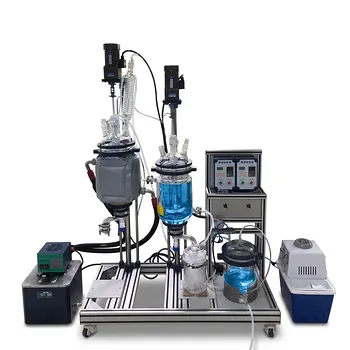
Here’s the hard truth about aluminum electrolysis at a pilot scale: It’s not just a smaller version of an industrial cell. The governing thermodynamic principles demand a solvent system to make the reaction feasible, while the hardware challenges are brutally amplified by the square-cube law—heat loss accelerates and material stability becomes the single point of failure.
The Hall-Héroult process relies on dissolving alumina in molten cryolite to lower the temperature requirement by over 1100 °C, trading a pure thermodynamic challenge for an electrochemical one. Scaling this down means you’re fighting an even more aggressive battle against fluoridation, thermal gradients, and heat balance, where every material choice and design parameter is magnified.
The Thermodynamic Foundation: Dissolving the Impossible
Alumina’s melting point of 2050 °C is an economic and engineering dead end. Transporting ions and sustaining containment at that temperature is impractical. The core thermodynamic solution is to radically alter the physical state of the reactant before applying an electric potential.
The Cryolite Solvent Strategy
Cryolite ($Na_3AlF_6$) acts as a high-temperature solvent. When alumina dissolves in molten cryolite, it forms a homogenous ionic mixture containing $AlF_6^{3-}$, $AlF_4^-$, and oxyfluoride complexes. This dissolution lowers the operating temperature to around 950 °C, reducing thermal energy input by over 50% compared to melting pure alumina.
The thermodynamics are not about simple mixture diagrams; they’re about creating a liquid ionic conductor where the aluminum oxide activity is drastically reduced. This shifts the decomposition voltage and, critically, enables the denser liquid aluminum product to separate by gravity and collect as a stable pool at the cathode, preventing re-oxidation.
The Electrochemical Reaction and Energy Balance
The overall desired reaction at 950 °C is the reduction of aluminum ions and the consumption of the carbon anode: $Al_2O_3 (dissolved) + \frac{3}{2} C (s) \rightarrow 2 Al (l) + \frac{3}{2} CO_2 (g)$
The theoretical decomposition potential for alumina is about -1.2 V at this temperature, but actual cell voltages run between 4.0 and 5.0 V. The excess voltage manifests as resistive heating from the electrolyte’s ohmic drop, which is deliberately harnessed to maintain the cell’s thermal balance. In a pilot plant, this energy balance is delicate—the cell must generate enough internal heat through the current to offset its outsized thermal losses, a problem industrial cells solve with their large, self-insulating mass.
The Hardware Hurdles of Pilot-Scale Electrolysis
Replicating this unit operation in a pilot plant introduces disproportionate challenges. The smaller dimensions mean the containment wall is always a proportionally larger part of the system, making material integrity the dominating constraint.
The Relentless Assault of Fluorination
At 950 °C, molten cryolite is an aggressive flux that dissolves many oxide-based refractories. The electrolyte and the generated $CO_2$ (and trace $HF$ from hydrogen impurities) create a combined fluorination and oxidation environment. Pilot-scale cells require containment materials with virtually zero open porosity and high chemical inertness, typically high-purity carbon-lined refractories. Even minor cracks or grain-boundary attack in a pilot cell lead to rapid failure because the corrosion path is a huge fraction of the wall thickness.
Thermal Management and Thermal Shock
A pilot cell has a high surface-to-volume ratio, causing it to lose heat much faster than an industrial cell. This forces operators to run at higher current densities to stay above the liquidus, which in turn stresses the frozen side ledge of electrolyte that protects the side wall. During startup and shutdown, the refractory lining and carbon cathodes experience severe thermal shock from gradients exceeding hundreds of degrees across a few centimeters. A mere flush with a lower-melting-point secondary salt, as used in other molten salt systems, is not an option here because the entire electrolyte chemistry is fixed by the alumina–cryolite equilibrium.
Power Supply and Process Control
Industrial cells use massive DC currents in the hundreds of kiloamperes. A pilot cell may scale down to 1–5 kA, but the challenge is not just lower amperage. At this scale, the electromagnetic fields that drive metal pad circulation become highly unpredictable. Poor magnetic compensation causes turbulence, drawing the aluminum into the electrolyte and reducing current efficiency catastrophically. Additionally, safely managing a high-current, low-voltage DC power supply in a laboratory or pilot environment requires custom rectifier design and fault protection, far beyond a standard furnace controller.
Understanding the Trade-offs When Scaling Down
The decision to build a pilot cell is not simply about proving a reaction; it’s about proving a material system will survive. There are several non-negotiable trade-offs that become obvious only at a smaller scale.
- Heat loss vs. superheat: To keep the bath molten, you often operate with a very high superheat (temperature above the liquidus), which accelerates fluoridation attack on all containment materials, creating a cycle where solving one problem worsens another.
- Side ledge stability: A thin, fragile frozen electrolyte ledge is the only barrier preventing direct contact between the highly corrosive bath and the sidewall. In a small cell, any power fluctuation that shrinks this ledge for a few minutes can cause a wall breach, a risk industrial cells buffer with their massive thermal inertia.
- Anode-to-cathode distance control: The anode gap must be precisely maintained. In a pilot cell, slight mechanical misalignments or uneven anode consumption due to thermal gradients cause local hot spots and arcing, which can instantly destroy an anode assembly.
How to Apply This to Your Pilot Plant Design
Your approach to pilot-scale aluminum electrolysis should be focused on the specific knowledge you need to extract, not on mimicking production.
- If your primary focus is material qualification: Over-specify the chemical purity and grain structure of your carbon cathode and sidewall lining. Run extended static immersion tests in parallel to decouple thermal shock from chemical attack in your data interpretation.
- If your primary focus is process validation: Design the cell with an excessively thick, sacrificial sidewall and operate with a very conservative current density. This will deliberately hurt current efficiency but gives you the thermal stability to gather meaningful, repeatable electrochemical data without constant wall failures.
- If your primary focus is energy efficiency research: Use advanced cathodes like TiB2-coated materials immediately, but instrument the cell with high-density thermocouples to map the heat loss pathways. The battle will be lost or won in the insulation layers, not just in the electrolyte chemistry.
Ultimately, success in a pilot cell for molten salt electrolysis of aluminum is defined by mastering the art of thermal containment under chemical duress, where the true unit operation is not the electrolysis itself, but the survival of the vessel.
Summary Table:
| Aspect | Thermodynamic Principle / Solution | Pilot-Scale Hardware Challenge |
|---|---|---|
| Operating Temp | Cryolite solvent lowers alumina melting point to ~950°C | High surface-to-volume ratio causes rapid, severe heat loss |
| Containment | Ionic mixture requires precise chemical equilibrium | Molten cryolite causes aggressive fluorination & thermal shock |
| Process Control | Electrolyte ohmic drop maintains thermal balance | Unpredictable magnetic fields at low kA reduce current efficiency |
Scaling up complex chemical processes requires robust, corrosion-resistant engineering. LABPARK provides advanced Educational and Vocational Unit Operations Pilot Plants in chemical engineering, bioprocess & biotech, and environmental & water treatment. Specifically designed for universities, research institutes, and enterprises, our pilot systems deliver the material durability and thermal control needed for extreme conditions.
Ready to bring reliable unit operations to your facility? Contact LABPARK today to request a quote!
Related Products
- Water Electrolysis Hydrogen Production and Storage Educational Pilot Plant
- Alkaline Membrane Water Electrolysis Educational Pilot Plant Unit Operations Training System
- Electrolytic Hydrogen Production Educational Unit Operations Pilot Plant
- Electrolyte Distillation Purification and Formulation Educational Pilot Plant
- Potassium Salt Thermal Dissolution and Crystallization Separation Educational Unit Operations Pilot Plant
People Also Ask
- How do chemical engineering pilot plants demonstrate electrolysis? Bridge Theory & Industrial Scale
- In educational chemical engineering pilot plants, why use absorption and adsorption before reforming?
- How do chemical engineering unit operations pilot plants demonstrate catalytic high-purity hydrogen production from methane?
- SMR, POX, or ATR? Trade-offs in Hydrogen Production Educational Pilot Plants
- Gap-Electrode vs. Zero-Gap Membrane: Key Design Choices for Water Electrolysis Pilot Plants