RSM is your most powerful ally here. For optimizing syngas conversion and product selectivity, the methodology you need is Response Surface Methodology (RSM) built on a central composite design. The key process variables you must manipulate are the total flow rate (residence time), the H₂:CO feed ratio, and the reaction temperature. This approach maps the response landscape of both conversion and selectivity, revealing that while conversion often changes in a linear fashion, selectivity—especially for a valuable product like propane—is governed by quadratic, non-linear relationships that demand precision control.
The core insight: Syngas conversion follows a planar, intuitive trend with your operating variables, but selectivity is a curved surface where small changes can trigger massive shifts. The H₂:CO ratio exerts a dominant, non-linear influence on what products you make. To truly optimize, you must then manage the fundamental trade-off that high conversion kills selectivity, often solved by running the reactor at a lower per-pass conversion and recycling unreacted syngas.
How RSM Models Syngas Reactor Performance
RSM is the systematic way to map cause and effect when multiple variables interact in a non-linear fashion. For syngas in a pilot or production unit, a central composite design lets you build an empirical model that predicts both CO conversion and product selectivity from a manageable set of experiments.
The Variables That Govern Conversion and Selectivity
Three independent variables sit at the heart of your optimization problem. First, the total flow rate determines the residence time of the gas inside the reactor—how long the molecules have to react. Second, the H₂:CO feed ratio controls the stoichiometric balance and the chemical potential of the reacting mixture. Third, the reaction temperature governs the kinetics and thermodynamic equilibrium of each competing pathway.
Why Selectivity Demands a Non-Linear Lens
Here is the trap: you might assume both conversion and selectivity respond similarly when you turn these knobs. They do not. CO conversion typically exhibits a planar, linear relationship with these variables—turn up temperature or residence time, and conversion rises in a predictable straight line. But target product selectivity—such as propane selectivity in Fischer-Tropsch—exhibits quadratic behavior. The response surface bends. Among the three variables, the H₂:CO ratio has the most dominant effect on selectivity, meaning your ability to tune the feed composition with high precision will make or break your product distribution.
Navigating the Conversion-Selectivity Trade-off
Understanding the non-linear model is only half the battle. The deep need is to achieve high yield of the wanted product without drowning in by-products. This forces you to confront a harsh reality: pushing for maximum single-pass conversion directly undermines selectivity.
The Limits of Pushing for Maximum Conversion
When you drive conversion very high, the reactor outlet becomes rich in products and lean in reactants. This creates an environment where side reactions—oligomerization, hydrogenolysis, coke formation—proliferate. High conversion rates often lead to lower selectivity because the high product concentration promotes these secondary reactions, generating more by-products. The linear gain in conversion is paid for by a non-linear collapse in the purity of your desired stream.
Using Recycle to Decouple Conversion from Yield
The pragmatic fix, proven in unit operations pilot plants and full-scale facilities alike, is to run the reactor at a lower per-pass conversion rate. You then place a separation unit downstream to isolate the high-purity product and recycle the unreacted syngas back to the reactor inlet. This approach teaches a critical lesson: you are not optimizing conversion alone, but the balance between reactor conversion limits, recycling costs, and the energy burden of separation. Your RSM model must therefore include selectivity as the primary response, with conversion serving as a constraint you manage through the recycle loop.
Applying These Principles in a Pilot Plant Setting
Whether you are working with a Fischer-Tropsch micro-reactor or an educational photochemical unit, the same logic holds. While some reactor dimensions—like lamp radius in a photochemical setup—are often fixed by hardware availability, the adjustable variables remain your lever: reactant inlet composition (your H₂:CO equivalent), the volumetric flow rate, and, where physically modifiable, a geometrical parameter like outer reactor radius that controls radiation path length. In all cases, the methodology stays the same: use RSM to map the non-linear selectivity landscape, identify the sweet spot of conversion that maximizes selectivity, and then close the loop with separation and recycle.
Understanding the Trade-offs
- Data vs. intuition: RSM requires a disciplined experimental campaign. A simple one-factor-at-a-time approach will miss the critical interactions and the curvature that dictates selectivity.
- Model boundaries: The empirical model is only valid within the range of variables you tested. Extrapolating beyond your central composite runs risks steering you into unsafe or unproductive conditions.
- Time and resource cost: Running enough points for a central composite design can be significant in a pilot plant. You must balance the depth of your model against the operating cost.
- Selectivity metrics: You must choose the right selectivity metric—carbon-based, yield-based, or product fraction—that aligns with your downstream economics, or your RSM optimization will lead you to a technically perfect but commercially useless solution.
Making the Right Choice for Your Goal
Your optimization strategy must follow your definition of success. Use the RSM framework, but weight your responses accordingly.
- If your primary focus is maximum single-pass CO conversion: Model the linear response and push temperature and residence time to their limits, but accept a severe selectivity penalty and plan for extensive downstream purification.
- If your primary focus is maximizing a high-value product like propane: Build the quadratic RSM model for selectivity, anchor your operating point at the sweet spot of the curved surface, and run the reactor at a lower conversion integrated with a recycle loop.
- If your primary focus is developing a robust student or pilot-plant protocol: Teach the central composite design methodology and the conversion-selectivity trade-off, using variable inlet composition and flow rate as hands-on knobs while explicitly including separation and recycle in the unit operation sequence.
Ultimately, a reactor that maximizes conversion is not a reactor that maximizes value. Use RSM to see the whole response surface, respect the non-linear nature of selectivity, and let the recycle flow carry the unreacted opportunity back to the beginning—the hallmark of a truly optimized syngas unit operation.
Summary Table:
| Key Process Variable | Effect on Conversion | Effect on Selectivity | Optimization Strategy |
|---|---|---|---|
| Total Flow Rate | Linear (residence time) | Non-linear / Quadratic | Adjust to balance throughput and contact time |
| H₂:CO Feed Ratio | Linear | Quadratic (Dominant) | Control composition with high precision |
| Reaction Temperature | Linear | Quadratic | Map via RSM to locate thermodynamic sweet spots |
| Recycle Loop | N/A | High (Decouples trade-off) | Run lower per-pass conversion; recycle unreacted gas |
Bring Advanced Reactor Optimization to Your Lab
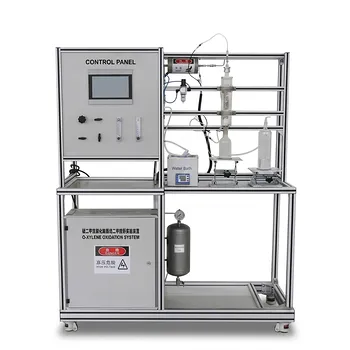
Are you looking to bridge the gap between process theory and industrial reality? LABPARK provides state-of-the-art Educational and Vocational Unit Operations Pilot Plants in chemical engineering, bioprocess & biotech, and environmental & water treatment.
Designed specifically for universities, research institutes, and enterprises, our pilot plants enable students and researchers to master Response Surface Methodology (RSM), reaction kinetics, and recycle loop dynamics in a safe, controlled environment.
Ready to elevate your department's training or research capabilities? Contact us today to discuss your pilot plant needs!
Related Products
- O-Xylene Oxidation to Phthalic Anhydride Educational Unit Operations Pilot Plant
- Fixed-Bed Chemical Reaction and Gas Dust Tar Removal Unit Operations Pilot Plant
- Fixed Bed Gas Solid Catalytic Reaction Educational Pilot Plant
People Also Ask
- What materials fit high-temp oxidation pilot plants? Key Hastelloy & Titanium Requirements
- Under what conditions can axial diffusion be neglected? Reactor Simulation Guide
- What limitations exist in high-temp pilot reactor design? Key Material & Safety Rules
- What pressure parameters ensure pilot plant safety? Analyze reactor profiles & gas evolution.
- How are sensitivity functions applied to parameter estimation in chemical reactor pilot plants? Guide