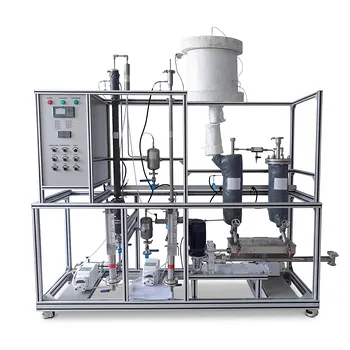
The safest way to process heavy hydrocarbons starts long before they ever reach your primary reformer. The pre-reformer acts as a chemical gatekeeper, an adiabatic fixed-bed reactor that intercepts your feed stream and converts higher hydrocarbons (C2+ compounds) into a benign mixture of methane, hydrogen, carbon monoxide, and carbon dioxide. By eliminating these problematic carbon precursors at around 770 K, the pre-reformer directly protects the main reformer catalyst from coking, enabling the entire downstream process to run harder, cleaner, and more efficiently.
Processing a feed that contains even small amounts of heavy hydrocarbons without a pre-reformer forces you into a punishing trade-off: either operate with an excessively high steam-to-carbon ratio that wastes energy, or risk rapid catalyst deactivation through carbon deposition. A pre-reformer unravels that dilemma entirely, decoupling the conversion of tough molecules from the main steam reforming reaction and giving you back full control over both.
How a Pre-Reformer Transforms Your Feed
The pre-reformer’s mission is singular and uncompromising: it dismantles every carbon-carbon bond in your heavier feed molecules before they can enter the primary reformer. Understanding exactly how it achieves that is the first step to appreciating its value.
The Adiabatic Fixed-Bed Design and Its Chemical Logic
A pre-reformer is a catalytic fixed-bed reactor that operates adiabatically—it does not receive an external heat supply. Instead, the temperature profile inside the reactor is shaped entirely by the balance between the endothermic steam reforming reactions and the exothermic methanation and water-gas shift reactions.
At the typical inlet temperature of around 770 K, the catalyst triggers a rapid sequence of reactions. Higher hydrocarbons (everything from ethane up to naphtha-range compounds) are adsorbed, cracked, and steam-reformed almost to extinction, leaving a stream dominated by methane, carbon monoxide, carbon dioxide, and hydrogen. The solution is elegant: you are not adding energy to destroy the complex molecules; you are using the molecular re-arrangement itself to generate a safer gas mixture.
Eliminating the Worst Carbon Precursors Before They Attack
Coking is the primary failure mode of a steam reforming catalyst, and heavy hydrocarbons are the most aggressive initiators of that coking. Long-chain molecules, olefins, and aromatics can thermally crack on hot metal surfaces or directly decompose on the nickel catalyst sites, laying down a carbon film that physically blocks the active surface.
The pre-reformer converts these compounds into methane and hydrogen, which are inherently stable against carbon formation under typical reforming conditions. By removing the worst carbon precursors, the pre-reformer effectively inoculates the downstream process against one of the most common and expensive causes of catalyst deactivation.
The Chain Reaction of Benefits for the Downstream Process
Once you have a pre-reformer scrubbing the feed clean, your primary reformer is no longer constrained by the fear of carbon formation. This single change triggers a cascade of operational and economic advantages that multiply the value of the entire plant.
Drastically Lower Steam-to-Carbon Ratio
Without a pre-reformer, operators must flood the process with excess steam—often well above a molar steam-to-carbon ratio of 3.0—to gasify carbon deposits and keep the main reformer’s catalyst alive. That extra steam translates directly into higher fuel consumption and larger equipment sizes for steam generation.
With the pre-reformer’s clean-up step complete, you can safely operate at a significantly lower steam-to-carbon ratio. The immediate impact is lower energy demand for steam production, reduced pressure drop through the system, and an overall more efficient process. You are simply not vaporizing and superheating water that was never needed in the first place.
Higher Heat Fluxes and Process Intensification
A primary reformer that is constantly fighting carbon formation must be run conservatively, with mild heat fluxes to avoid hot spots where coking can initiate. These thermal bottlenecks limit the plant’s throughput and increase its physical footprint.
When the coking risk is negated by the pre-reformer, the main reformer can tolerate much higher tube wall heat fluxes. This allows the same number of reformer tubes to process a larger feed load, or enables a more compact furnace design for a given capacity. The result is a steam reformer that operates at a higher intensity without sacrificing reliability.
Standardized, Lower-Cost Catalyst Selection
Heavy hydrocarbons demand specialized, often more expensive, main reformer catalysts that can resist carbon deposition and promote gasification. In a plant without a pre-reformer, you are locked into that premium catalyst chemistry.
Once the pre-reformer homogenizes the feed to a clean methane-rich gas, you can confidently switch to a standard natural gas reforming catalyst in the primary reformer. This standardization reduces both the initial catalyst cost and the complexity of managing multiple catalyst types, while allowing you to leverage catalysts with well-optimized activity and mechanical strength.
Understanding the Trade-offs and Limitations
A pre-reformer is not a universally free lunch. Its inclusion adds its own set of constraints that must be weighed against the downstream gains.
Additional Fixed Capital and Reactor Complexity
The pre-reformer is a standalone reactor vessel complete with its own catalyst bed, internal distributers, and controls. This adds a measurable capital cost to the front end of the plant. You are now managing an extra piece of equipment that requires its own temperature monitoring, pressure drop tracking, and periodic catalyst changeouts.
For feeds that already consist of nearly pure methane with negligible heavy components, this additional investment may offer little return. The decision to install a pre-reformer must be grounded in a thorough feed analysis and a realistic lifetime cost assessment.
Inlet Temperature and Preheating Requirements
To achieve the necessary conversion at the low inlet temperatures of an adiabatic reactor, the feed must be carefully preheated to the 770 K region before entering the pre-reformer. This places a demand on the upstream heat recovery network and may require a dedicated preheat coil or heat exchanger.
Over-preheating can also trigger premature cracking in the transfer lines if not managed properly. The system design must balance the need for sufficient preheat to drive the pre-reforming reactions against the thermal stability of the feed in the piping.
Making the Right Choice for Your Reforming System
The pre-reformer’s final value hangs entirely on what you are trying to achieve with your plant. Use this goal-based decision guide to map the technology to your specific priorities.
- If your primary focus is processing heavy or variable hydrocarbon feeds: A pre-reformer is non-negotiable. It is the only reliable way to prevent coking and maintain catalyst integrity when your feedstock departs from pure methane.
- If your primary focus is maximizing energy efficiency and minimizing operating cost: The pre-reformer allows you to slash your steam-to-carbon ratio, directly cutting fuel consumption and steam generation costs across the entire facility.
- If your primary focus is debottlenecking an existing primary reformer: Adding a pre-reformer upstream can permit higher heat fluxes and throughput in the main furnace without increasing the reformer’s tube count, effectively re-rating the plant.
- If your primary focus is simplifying catalyst management and reducing inventory costs: The shift to a standard natural gas reforming catalyst in the main reformer pays off in both reduced capital expense and operational simplicity.
Every pre-reformer installation places a deliberate shield between your harsh feed and your high-value reformer. When the chemistry of your hydrocarbons demands more than a simple steam reformer alone can handle, that shield is what transforms a fragile operation into a robust and profitable process.
Summary Table:
| Feature / Aspect | Pre-Reformer Unit Details | Key Downstream Benefits |
|---|---|---|
| Core Function | Converts C2+ heavy hydrocarbons into CH4, H2, CO, and CO2 | Prevents catalyst coking and deactivation |
| Operation Mode | Adiabatic catalytic fixed-bed reactor (~770 K inlet) | Allows lower steam-to-carbon ratios |
| Process Impact | Homogenizes feed stream before primary reforming | Enables higher heat fluxes and standard catalyst use |
| Key Limitations | Requires precise feed preheating; adds equipment CAPEX | N/A |
Enhance Your Chemical Engineering Training with LABPARK
Bring industrial-grade steam reforming and catalytic reaction concepts into your laboratory. LABPARK provides state-of-the-art Educational and Vocational Unit Operations Pilot Plants in chemical engineering, bioprocess & biotech, and environmental & water treatment for universities, research institutes, and enterprises. Our systems are engineered to help students and researchers safely explore pre-reforming, heat integration, and process optimization.
Ready to upgrade your lab's hands-on capabilities? Contact LABPARK today to discuss your custom pilot plant requirements!
Related Products
People Also Ask
- What thermodynamic principles govern methane reforming in pilot plants? Master equilibrium and coke control.
- How to prevent carbon & hot spots in steam reforming pilot plants? Essential Safe Operation Guide
- How to Minimize Hazardous Inventory in Pilot Plants? Master Inherently Safer Design
- Why is the steam reforming of methane hindered at elevated pressures in a chemical engineering unit operations pilot plant?
- How is carbon deposition controlled in steam reforming? The Critical Role of S/C Ratio