The selection of a flowmeter for a chemical engineering pilot plant is not a trivial choice of hardware—it is a foundational decision that dictates the validity of your experimental data. To answer this directly, you must critically evaluate the fluid state and its properties, the flow conditions and Reynolds number, the device's rangeability (turndown ratio), and its mechanical installation constraints. Furthermore, you must plan for dynamic process compensation by supplying real-time fluid pressure and temperature data to the transmitter, and potentially integrating a density analyzer if the stream composition fluctuates during your unit operation experiments.
Selecting a pilot plant flowmeter is an optimization problem, not a simple specification match. The core challenge is that no single meter excels universally; the "critical" parameter is understanding how the fluid's physical properties and your specific flow regime interact with a meter's operating principle. Your ultimate goal is to choose the technology that minimizes uncertainty for your exact experimental conditions, not the one with the highest theoretical accuracy.
Decoding the Fluid: The Starting Point
The physical and chemical nature of your process stream immediately eliminates many options. You must define your fluid's state, conductivity, and cleanliness before anything else.
The State and Conductivity
Is your fluid a clean liquid, a gas, steam, or a slurry? A Coriolis meter can handle all these states, but its cost may be prohibitive. If your fluid is a conductive liquid, an electromagnetic flowmeter becomes a top contender because it is completely agnostic to density and viscosity changes.
However, if you are running a gas-phase reaction or steam-in-place (SIP) sterilization, the electromagnetic meter is non-functional. Here, a vortex shedding meter provides a reliable digital output for steam and clean gases, while a differential pressure (DP) meter, like an orifice plate, remains a rugged, versatile option for high-temperature vapors.
Handling Corrosive Chemicals and Slurries
Pilot plants often test aggressive chemistries. For corrosive, abrasive, or slurry-type fluids, you must avoid meters with moving parts or small pressure taps that can clog or degrade. Electromagnetic flowmeters with inert liners (like PTFE) are a primary choice here, as they present an unobstructed flow path with zero moving parts. Similarly, a Coriolis meter, while more expensive, provides a straight-tube design that can handle slurries while simultaneously giving you mass flow rate and density data.
The Fluidodynamic Context: Reynolds Number, Density, and Flow Profile
The flow regime inside your pilot plant’s small-bore piping is often turbulent, variable, and developing. Your meter choice must align with this hydraulic reality.
Matching the Flow Regime
The Reynolds number ($N_R = LV\rho/\mu$) , which you likely calculate as part of your fluid mechanics module, is your primary guide. A turbine meter requires a stable, turbulent profile for accuracy, while positive displacement meters are unaffected by profile distortions but are sensitive to dirt. Vortex meters have a strict minimum Reynolds number below which they simply cease to function. Always check the manufacturer’s cut-off point against your minimum experimental flow rates.
The Viscosity-Density Trap
A volumetric meter like a vortex or turbine infers flow from a velocity measurement. If your pilot reaction changes the fluid’s density, the volumetric reading becomes a moving target, requiring separate density compensation. This is a core argument for Coriolis mass flowmeters in reaction monitoring or precise dosing, as they directly measure mass flow independently of fluid temperature, pressure, or viscosity variations.
The Installation Imperative: Mechanical Constraints
A brilliant meter choice is worthless if it requires a straight-run pipe length your pilot plant skid cannot provide.
Achieving a Stable Velocity Profile
This is the most common source of measurement error in pilot plants. An orifice flowmeter needs a calm, fully developed flow profile. The standard requirement is a straight run of at least 10 pipe diameters (10d1) upstream and 5 pipe diameters (5d1) downstream. In a cramped pilot plant, elbows, tees, or control valves are often too close, creating swirl and a distorted velocity profile that invalidates the orifice’s theoretical coefficient.
If your mechanical layout is tight, a Coriolis or positive displacement meter, which forces the fluid into a predefined path, becomes a superior choice because they are insensitive to upstream flow disturbances.
Pressure Drop and Energy Balance
A pilot plant is a model for a scaled industrial process, and your energy balance matters. A DP meter like an orifice plate creates a significant permanent pressure loss due to the vena contracta and downstream turbulence. If your available pump head is limited, this energy sink could choke your system. For low-pressure gas lines or systems with minimal driving force, use a Pitot tube for large ducts or select a meter with little to no obstruction, such as an electromagnetic or ultrasonic device.
Performance Envelope: Rangeability and Accuracy
Pilot plants run batch and continuous processes with high variability. Your meter’s effective range must cover the entire experimental plan.
The Turndown Reality
Rangeability, or turndown ratio, is the ratio of maximum to minimum measurable flow within the stated accuracy. Your primary reference correctly flags this. If your experiment involves a 50:1 flow variation, a standard orifice plate (typically a 3:1 or 4:1 turndown) is a poor choice; you would need multiple plates on a switching manifold. A vortex meter offers a wider turndown (up to 20:1), while a Coriolis meter can accurately handle a massive turndown, capturing high process flows and tiny dosing streams in the same experiment.
Understanding the Trade-offs
No single parameter exists in a vacuum. Optimizing for one metric inevitably compromises another, and being aware of these trade-offs prevents costly experimental failure.
- High Accuracy vs. Hardware Cost: Coriolis meters offer the highest direct mass accuracy and density logging but represent a significant capital investment. A DP meter with a transmitter is far cheaper but introduces a permanent pressure drop and requires external compensation devices.
- Robustness vs. Sensitivity: A positive displacement gear pump/meter is highly robust for viscous fluids but will be destroyed by solids. A non-invasive ultrasonic meter avoids contamination but fails on fluids with entrained gases or low acoustic transmission.
- Clean Fluids vs. Dirty Services: An orifice plate requires a clean stream to avoid tap hole plugging. Electromagnetic meters are ideal for dirty, conductive slurries but are blind to hydrocarbon flows.
To close the loop on data integrity, you must feed the transmitter with real-time pressure and temperature data to compensate for gas density fluctuations. If the stream composition changes dynamically during the reaction, a dedicated online density analyzer or a Coriolis meter’s built-in density output is no longer optional—it is a necessity.
Making the Right Choice for Your Experiment
Your selection hinges on the primary objective of your pilot plant study and the nature of your process fluid.
- If your primary focus is high-precision mass balance for a chemical reaction: Prioritize the Coriolis mass flowmeter's direct mass measurement, which sidesteps the errors caused by changing fluid density, temperature, or viscosity.
- If your primary focus is demonstrating hydraulic principles and the impact of pipe fittings: Select an orifice plate or venturi tube, as the associated straight-run requirements and pressure drop calculations are central to the learning objective of calculating friction factors ($f$) and head loss ($h_f$).
- If your primary focus is handling conductive, corrosive, or slurry-based process streams: An electromagnetic flowmeter is the logical choice, offering an unobstructed flow path, zero permanent pressure loss, and immunity to changes in fluid density.
- If your primary focus is operating within a tight budget and a constrained physical footprint: Consider a variable area meter (rotameter) for simple monitoring, or a vortex meter if the fluid is clean, keeping in mind their specific minimum Reynolds number limits.
Treat the flowmeter not as an isolated sensor, but as an integrated subsystem whose performance depends entirely on how well its physical principle matches your fluid's specific, dynamic state and the pilot plant's rigid spatial constraints.
Summary Table:
| Flowmeter Type | Best Suited Fluids | Turndown Ratio | Pressure Drop | Pipe Straight Run Requirement | Key Advantage |
|---|---|---|---|---|---|
| Coriolis | Liquids, gases, slurries | Very High | Low to Medium | Minimal to None | Direct mass flow & density measurement |
| Electromagnetic | Conductive liquids, corrosive slurries | High | Zero | Low | Unobstructed path, high chemical resistance |
| Vortex | Clean gases, steam | High (~20:1) | Low | Medium | High turndown for steam and vapor lines |
| DP (Orifice Plate) | Clean liquids/gases | Low (3:1 to 4:1) | High | High (e.g., 10d upstream / 5d downstream) | Industry standard, rugged & cost-effective |
Optimize Your Unit Operations Lab with LABPARK
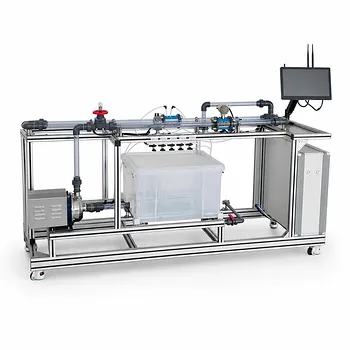
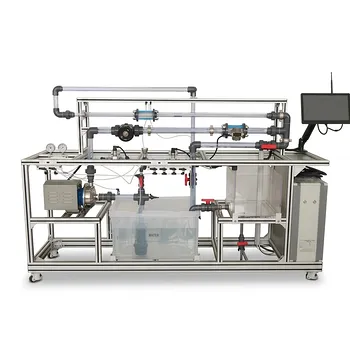
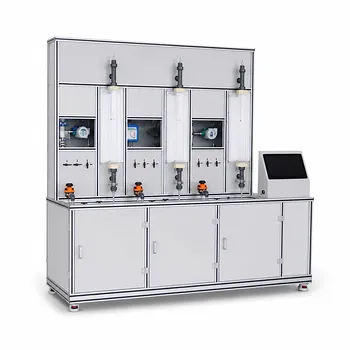
Are you looking to equip your laboratory with high-precision experimental setups? LABPARK design and supply premium Educational and Vocational Unit Operations Pilot Plants in chemical engineering, bioprocess & biotech, and environmental & water treatment.
Specifically engineered for universities, research institutes, and enterprises, our pilot plants feature industry-grade instrumentation—such as precisely matched flowmeters—to ensure accurate data collection and robust performance.
Need help configuring the perfect pilot plant for your curriculum or research? Contact the LABPARK team today to request a quote or consultation!
Related Products
- Orifice and Venturi Flowmeter Calibration Educational Pilot Plant for Fluid Mechanics Laboratory
- Centrifugal Pump Performance and Orifice Flowmeter Calibration Educational Pilot Plant
- Quantitative Dosing and Liquid Flow Control Educational Unit Operations Pilot Plant
- Two Phase Flow Pattern Velocity Resistance Measurement Educational Pilot Plant
- Fluid Reynolds Number Demonstration Educational Unit Operations Pilot Plant
People Also Ask
- What is the difference between static and stagnation pressure? Master Pilot Plant Flow Measurement
- How do pilot plants demonstrate siphon pressure variations? Visualizing Bernoulli's Energy Balance
- How do fluid mechanics training pilot plants facilitate the visualization and calculation of laminar and turbulent flows?
- How to update chemometric calibration models in pilot plants? Best practices for process engineers.
- Why are the laws of similitude critical in fluid flow pilot plants? Scale Up Safely