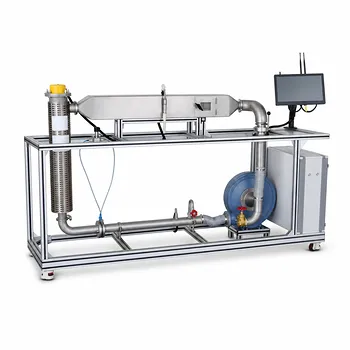
The fundamental distinction in dryers used for unit operations training—between heating by direct contact with hot gas and heating through a solid wall—is not just textbook theory. It dictates the entire learning experience, from the safety protocols students must follow to the core engineering principles you can reliably demonstrate. The primary difference is convective (direct) heat transfer versus conductive (indirect) heat transfer. This single design choice cascades into every practical decision about energy efficiency, gas handling, product containment, and what your pilot plant can safely and visibly teach.
While convective dryers (like spray and fluid bed units) offer rapid, visible evaporation ideal for teaching mass transfer fundamentals, conductive dryers (such as vacuum tray or paddle dryers) prioritize energy containment, solvent recovery, and handling hazardous materials. In vocational training, this distinction forces a deliberate trade-off between demonstration clarity, operational safety, and the breadth of unit operations you can cover in a single lab.
The Two Heat Transfer Modes in Drying
Understanding the surface-level difference is simple; the deeper value lies in recognizing how each mode shapes the machinery, the data you collect, and the skills students develop.
Convective (Direct) Heating: The Dominant Force
Hot gas—usually air, nitrogen, or combustion products—flows directly over or through the wet material. The gas simultaneously supplies the heat of vaporization and carries away the moisture.
This is the “open” drying paradigm. Spray dryers, fluid bed dryers, and simple tray dryers all operate on this principle. Because the drying medium is in direct contact with the solid, evaporation rates are high and the process closely mirrors classic psychrometric charts.
However, this efficiency demands large gas throughput. The entire gas stream must be heated, filtered, and then treated—often with cyclones, baghouses, or scrubbers—to manage dust or solvent-laden air. In a training environment, that auxiliary equipment becomes a central teaching point about environmental control and product recovery.
Conductive (Indirect) Heating: The Contained Alternative
Heat arrives by conduction through a metal wall, not by a gas stream. A jacket containing steam, hot oil, or pressurized water warms the dryer’s walls, shelves, or hollow paddles, and the heat then migrates into the material.
This creates a closed or nearly closed system. Since the vaporizing liquid doesn’t mix with a massive volume of sweep gas, the dryer operates under vacuum easily, and the evaporated solvent can be condensed and recovered in nearly pure form. Vacuum tray dryers, paddle dryers, and rotating conical dryers are classic examples used in pilot-scale education.
For a training facility, this containment translates directly into reduced air pollution risk and the opportunity to teach process safety and solvent recovery in a single, manageable unit.
How This Distinction Shapes Process Selection in Training
Vocational and educational labs choose a dryer not just for what it dries, but for what it illuminates. The heat transfer method fundamentally alters the learning outcomes.
Demonstrating Mass and Heat Transfer Fundamentals
A convective dryer is a living psychrometric chart. Students can measure inlet and outlet air temperature and humidity, calculate evaporation rates, and visualize how changing air velocity or temperature shifts the drying rate curve. Spray dryers make particle formation visible, while fluid bed units allow hands-on observation of fluidization behavior.
A conductive dryer shifts the focus. The driving force is a temperature difference across a conductive surface, often under vacuum. Students learn about boiling point reduction, heat transfer coefficients through stagnant beds, and the dominance of conductive resistance in the material layer. The demonstration is less visually dramatic but more exacting for heat transfer calculations.
Safety and Environmental Considerations as a Learning Objective
Direct heating with air means any fines or volatile solvents are entrained and must be captured. This forces the inclusion of dust collection and emission control—perfect for teaching environmental engineering but adding complexity and hazards.
Conductive dryers, especially vacuum units, inherently contain the process. A training unit processing a solvent-wet solid can recover the solvent without a massive exhaust treatment system. This makes hazardous material drying a safe, teachable module, directly relevant to pharmaceutical and fine chemical industries.
Operational Complexity and Equipment Footprint
Convective units demand proportionally large support infrastructure: blowers, heaters, ductwork, and separation equipment. In a vocational lab, this consumes space and budget both for installation and for routine filter replacement.
By contrast, a jacketed conductive dryer is comparatively compact and self-contained. A vacuum tray dryer can sit on a bench, connected only to a vacuum pump and a steam or hot-oil circuit. This simplifies maintenance and allows students to focus on the core drying mechanism without wrestling an entire gas-loop system.
Understanding the Trade-offs
No heat transfer method is universally superior. The optimal training dryer is the one that best matches your pedagogical and safety goals, with clear-eyed acceptance of its limitations.
Energy Efficiency vs. Throughput
Conductive dryers frequently use energy more efficiently because the heat is delivered directly where it’s needed, without heating a massive air volume and then exhausting it. Yet they are generally slower for granular materials that demand large surface areas, making them lower in throughput compared to a fluid bed dryer.
A vapor-compression heat pump integrated with a convective dryer can recapture exhaust heat, but that adds another layer of system complexity you must then explain to students.
Product Quality and Process Visibility
In a spray dryer or fluid bed, the product’s particle size and morphology are on display and can be tuned by adjusting atomization pressure or gas velocity. This yields rich, visual data for student reports.
In a conductive vacuum dryer, the product forms a static cake. While ideal for heat-sensitive pharmaceuticals, the process is opaque—literally. Students cannot watch moisture leaving the solid in real time, which can obscure the connection between theory and observation.
Capital and Operating Costs in an Educational Setting
A simple hot-air tray dryer is the lowest-cost entry point, but it teaches little about modern continuous processing or solvent recovery. A pilot-scale conductive vacuum unit has a higher initial price tag yet avoids expensive air-handling retrofits and can operate with minimal consumables. The budget must be weighed against the curriculum’s breadth: a single versatile conductive dryer can cover safety, thermodynamics, and separations, while a convective line-up might require multiple pieces of support equipment.
Making the Right Choice for Your Unit Operations Lab
Selection hinges on what you intend to demonstrate and the environment you can safely manage. Below are goal-oriented recommendations based on the dominant heat transfer modes discussed.
- If your primary focus is teaching classic psychrometry and visual particle formation: Choose a convective spray or fluid bed dryer. The direct gas contact makes evaporation rates obvious and allows students to practice mass and energy balances on a dynamic, open system.
- If your primary focus is aligning with modern process safety and solvent recovery standards: Select a conductive vacuum tray or paddle dryer. The closed operation inherently teaches containment philosophy, boiling point control under vacuum, and the economics of solvent recycling.
- If your primary focus is maximizing hands-on student interaction with minimal ancillary equipment: Opt for a conductive bench-top dryer. Its simplicity reduces troubleshooting time and lets students concentrate on heat transfer coefficients and drying curve analysis without the distraction of extensive air handling.
- If your primary focus is demonstrating both modes with limited space and budget: Use a modular conductive unit with a gas-sweep option, or run a convective tray dryer alongside a small jacketed batch dryer. This comparative approach directly reinforces the differences in heat transfer mechanisms and their consequences.
Ultimately, the dryer in your unit operations lab is not just a piece of hardware—it’s a dedicated teaching instrument. Match the heat transfer mode to the lesson, and you transform an ordinary drying experiment into a powerful, lasting engineering insight.
Summary Table:
| Feature | Convective (Direct) Dryers | Conductive (Indirect) Dryers |
|---|---|---|
| Heat Transfer Mode | Direct contact with hot gas/air | Conduction through a heated metal wall |
| Common Equipment | Spray, fluid bed, tray dryers | Vacuum tray, paddle, rotating conical dryers |
| Core Learning Focus | Mass transfer, psychrometry, fluidization | Heat transfer coefficients, vacuum boiling, safety |
| Solvent Recovery | Difficult (requires high gas separation) | Easy (inherently contained, vacuum condensation) |
| Footprint/Complexity | High (large ductwork, filters, blowers) | Low (compact, self-contained units) |
Enhance Your Engineering Curriculum with LABPARK
Selecting the right drying technology is essential for delivering impactful thermodynamic and mass transfer training. LABPARK provides state-of-the-art Educational and Vocational Unit Operations Pilot Plants across chemical engineering, bioprocess & biotech, and environmental & water treatment. Designed to meet the rigorous demands of universities, research institutes, and enterprises, our solutions prioritize student safety, process visibility, and real-world alignment.
Let us help you build a safer, more effective learning environment. Contact LABPARK today to discuss your pilot plant requirements!
Related Products
- Multi-Functional Drying Educational Unit Operations Pilot Plant
- General Purpose Cosmetics Production Unit Operations Training Pilot Plant
- Circulating Wind Tunnel Drying and Convective Heat Transfer Coefficient Determination Educational Pilot Plant
People Also Ask
- Vacuum vs. Atmospheric Drying: How to Choose the Right Pilot Plant Configuration for Your Lab
- Why is dry-basis moisture content preferred over wet-basis? Simplify your drying pilot plant balances.
- How do seasonal changes affect drying pilot plant blower requirements? Key sizing tips.
- How do deviations in estimating latent heat impact pilot plant thermal systems? Avoid hardware mis-sizing.
- Why Does a Pilot Plant Solver Return a Singular Matrix Error, and How Can You Resolve It?