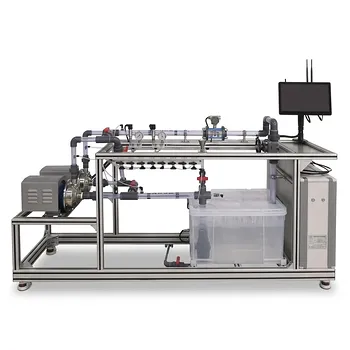
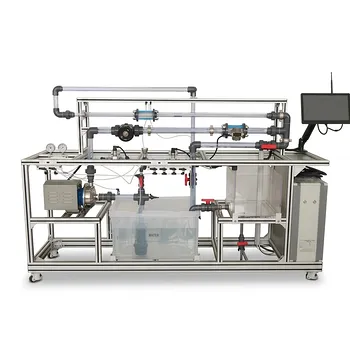
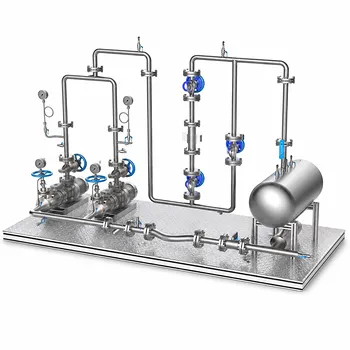
When you step into a fluid transport pilot plant, the centrifugal pump hums with potential—but the real lesson lies in how you tame its output. The three standard methods for regulating flow rate are discharge valve throttling, variable speed control (using a VFD), and bypass regulation. Among these, variable speed control is by far the most efficient, because it adjusts the pump’s own performance rather than wasting energy against artificial resistance or through recirculation. Throttling and bypass schemes are simple and instructive, but they consume significantly more power for the same net flow.
The core trade-off: discharge throttling and bypass regulation both bleed energy into useless pressure drops or recirculated fluid, while a VFD follows affinity laws to cut power consumption with the cube of speed. In pilot-plant teaching, this makes VFD demonstration essential for modern energy-conscious design, even though all three methods remain valuable for understanding control dynamics and system curves.
The Three Regulation Methods in Detail
Discharge Valve Throttling: Simple but Wasteful
Throttling uses a control valve on the pump’s outlet to impose extra resistance.
You are shifting the system curve upward, forcing the pump to work against a higher head.
The pump’s own characteristic curve stays fixed. Flow reduces, but the pump still spins at full speed and draws nearly full power—most of the extra head is consumed as friction across the valve.
This method is easy to implement and dominates legacy installations, yet the energy bill is punishing.
Variable Speed Control (VFD): Energy-Efficient Precision
A Variable Frequency Drive alters the motor’s rotational speed, directly moving the pump curve itself.
With lower speed, both head and flow drop in a way that matches the system demand without adding artificial resistance.
The affinity laws take over: power scales with the cube of the speed ratio. Cutting speed by 20% can save roughly 50% of the energy, because flow, head, and power all shift in harmony.
In pilot plants, seeing the real-time power readout drop on a VFD demo cements the message: this is how modern processes shrink their carbon footprint and operating costs.
Bypass Regulation: The Inefficient Safety Net
Here, a portion of the discharge is routed back to the suction tank through a bypass valve.
The pump continues to work at full capacity, pressurizing fluid that never reaches the process. Net flow downstream is reduced, but total pump work stays high.
Bypass loops are useful for protecting a pump against dead-head conditions (zero flow) and for studying control loop dynamics, but they are the least efficient way to regulate continuous process flow.
Understanding the Trade-offs
How Efficiency Truly Differs
Efficiency isn’t just a label—it’s the ratio of useful hydraulic power delivered to the fluid versus the electrical power consumed.
With throttling, the pump delivers a high head but much of it is dissipated in the valve without doing useful work. Power input drops only slightly while net flow falls sharply, causing overall system efficiency to plummet.
With bypass, the pump’s operating point remains near full flow; the bypassed liquid wastes energy and can heat the suction tank. The net effect is a drastic drop in overall efficiency, often worse than throttling for the same effective flow.
With VFD, the pump itself delivers only the head and flow the system truly requires. The shaft power shrinks dramatically, so system efficiency stays close to the pump’s peak. That’s the foundational lesson these pilot plants are designed to teach.
Why Affinity Laws Make VFD the Clear Winner
The pump’s head-capacity curve and power curve are linked to speed by fundamental physical laws.
Flow varies linearly with speed (Q ∝ N), head varies with the square (H ∝ N²), and power varies with the cube (P ∝ N³).
Because throttling doesn’t alter speed, power reduction is marginal. Bypass doesn’t alter the pump’s operating speed either—it just recycles volume, wasting power proportionally.
VFD seizes the cube-law advantage, making it the only strategy that can deliver 50–80% energy reductions in variable flow scenarios.
Common Pitfalls Demonstrated in Pilot Plants
Educational setups often illustrate that throttling beyond the pump’s recommended range can push the operating point into unstable low-flow zones, risking cavitation or vibration.
Bypass lines, if left open carelessly, can overheat the suction fluid and mask real process demand, making process control sluggish.
VFDs, while efficient, require careful attention to motor cooling and harmonics at low speeds—lessons students absorb when they see motor temperature rise or torque drop.
How Pilot Plants Bring the Comparison to Life
Visualizing Power Curves and System Curves
In modern pilot plants, integrated flow meters, pressure transducers, and power analyzers let students plot the head-flow curve and power-flow curve for each regulation method.
By overlaying the system curve with the pump curve, they see how throttling shifts the system line while VFD shifts the pump line. The Best Efficiency Point (BEP) shifts, and efficiency islands become visible.
Comparing the power curves side by side for identical net flows reveals the electricity wasted by throttling or bypass—a data-driven “aha” moment.
Control Dynamics and Real-World Implications
Throttling responds quickly and is easy to automate.
VFDs introduce the nuance of ramp times and PID tuning but deliver soft starts and reduced mechanical stress.
Bypass loops are sluggish in overall process control because the recirculated volume dampens response; manufacturers demonstrate this to teach why bypass isn’t a primary flow regulator.
These comparative demonstrations equip engineers with the intuition to choose wisely in the field, rather than blindly defaulting to a valve.
Making the Right Choice for Your Goal
Your choice depends on what you’re optimizing: initial simplicity, energy cost, or process protection. Here’s how to align method with priority.
- If your primary focus is lowest upfront cost and simple operator training: Discharge throttling is the quickest to implement and still widely understood. Just know you’ll pay for it in long-term energy.
- If your primary focus is maximizing energy efficiency and life-cycle savings: Variable speed control is the only option that aligns with modern sustainability targets and slashes power bills.
- If your primary focus is protecting the pump from dead-head damage during startup or testing: A small bypass loop is a valid safety feature. Use it only for occasional recirculation, not for continuous trim control.
- If your primary focus is teaching control fundamentals and system curve analysis: A pilot plant that includes all three methods gives your students the full picture of cause and effect, making abstract principles concrete.
Choose the method that matches your true priority, and let the pilot-plant data—the humming pump, the glowing VFD display, the warm bypass line—be the proof.
Summary Table:
| Regulation Method | Operating Principle | Energy Efficiency | Primary Application |
|---|---|---|---|
| Discharge Throttling | Increases system resistance via valve | Low (wastes energy as friction) | Legacy systems, low upfront cost |
| Variable Speed (VFD) | Alters pump curve by changing motor speed | High (follows affinity laws) | Modern processes, energy savings |
| Bypass Regulation | Recirculates excess flow to suction tank | Very Low (wastes hydraulic power) | Pump protection, control testing |
Bring Fluid Dynamics to Life with LABPARK
Looking to provide hands-on training for the next generation of engineers? LABPARK provides premium Educational and Vocational Unit Operations Pilot Plants in chemical engineering, bioprocess & biotech, and environmental & water treatment.
Our systems help universities, research institutes, and enterprises demonstrate complex fluid transport phenomena—like VFD vs. throttling efficiency—with real-time data visualization and industry-grade controls.
Contact our experts today to upgrade your engineering lab with customized educational solutions!
Related Products
- Centrifugal Pump Performance Determination Educational Unit Operations Pilot Plant
- Centrifugal Pump Performance and Orifice Flowmeter Calibration Educational Pilot Plant
- Chemical Pipeline Assembly and Fluid Transport Practical Training Unit Operations Pilot Plant
People Also Ask
- Why start a centrifugal pump with a closed outlet valve? Protect your pilot plant motors.
- How can cavitation and slurry erosion be studied and mitigated using fluid transport and centrifugal pump pilot plants?
- How does fluid density affect pump head and pressure? Avoid Pilot Plant Motor Overload
- How does fluid viscosity affect centrifugal pump performance? Key pilot plant correction methods.
- How does fluid density affect centrifugal pump performance & motor safety in pilot plants?