The urea hydrolysis method isn't just a demonstration—it's a masterclass in precipitate engineering. It is preferred over direct ammonium hydroxide precipitation for separating aluminum because it produces a dense, crystalline basic succinate precipitate that filters rapidly, washes cleanly, and sharply separates aluminum from other metals like nickel and zinc. This outcome is the direct result of the method's slow, homogeneous pH rise, which avoids the gelatinous hydrous oxide formed by fast base addition.
Pilot plant curricula focus on solid-liquid separation efficiency. The core lesson is that a precipitate's physical structure dictates filtration performance—gelatinous flocs blind filters and trap impurities, while dense, well-formed particles enable clean, industrial-grade separations. Urea hydrolysis teaches this principle by delivering a compact, easy-to-handle solid at a controlled pH window.
Why Precipitate Structure Overrides Chemistry in Pilot Plants
In a pilot plant, the most perfectly designed filter press or centrifuge becomes useless if the solids behave like glue. The separation method must be chosen not just for its chemical selectivity, but for the physical handleability of the product.
The Gel Problem with Direct Ammonium Hydroxide
Adding concentrated ammonium hydroxide to an aluminum solution instantly spikes the local pH. This creates an enormous supersaturation that forces aluminum to precipitate as a gelatinous, amorphous hydrous oxide.
This gel is hydrophilic, retains up to 90% water, and collapses into a slimy film on filtration media. The result is rapid blinding of filter cloths, excruciatingly slow flow rates, and a cake that resists washing.
Co-precipitation Kills Purity
The open, sponge-like structure of the hydrous oxide physically traps large quantities of other metal ions present in solution. Divalent ions like nickel, zinc, and cobalt become hopelessly entrained, requiring repeated re-slurrying and re-precipitation to reach even moderate purity.
This is not selective chemistry; it’s mechanical occlusion. The pilot plant student learns that a bad precipitate texture defeats the purpose of the separation.
How Urea Hydrolysis Engineers a Superior Separation
The urea hydrolysis method avoids every one of these problems by shifting control from the operator’s pouring speed to the chemistry of a boiling solution.
Homogeneous pH Rise in the Critical Window
Urea decomposes slowly in a boiling, slightly acidic solution (pH ~2-3), releasing ammonia uniformly throughout the entire volume. This prevents any local pH hotspots. The system drifts smoothly upward and is then held at a final pH of 4.2–4.6, a range low enough to keep many divalent metals safely in solution while still precipitating aluminum cleanly.
The Formation of a Basic Succinate Precipitate
The key is the presence of a succinate buffer complex, which transforms the precipitation product from a hydrous oxide into a dense, microcrystalline basic succinate. This solid has a low surface area, minimal water of hydration, and a well-defined particle morphology that packs into a compact filter cake.
Filtration times drop from hours to minutes. The cake cracks and dewaters easily, and washing displaces mother liquor rather than simply diluting a trapped gel.
Understanding the Trade-offs
No method is universally perfect. While urea hydrolysis demonstrates ideal industrial principles, it comes with constraints that the pilot plant exercise is designed to highlight.
Time and Thermal Input
The homogeneous decomposition of urea requires a boiling solution and typically 60–90 minutes of reaction time. Direct ammonium hydroxide precipitation is nearly instantaneous. The lesson for students: faster precipitation often leads to dramatically slower filtration, so total process time must be evaluated end-to-end, not just at the reaction vessel.
Chromium State Control and Acid Dissolution
In analyses involving scale or fouling deposits containing chromium, the basic succinate precipitate offers another critical advantage. Succinate acts as a reducing environment in boiling solution, preventing any chromium from oxidizing to its problematic hexavalent state. Furthermore, basic succinate precipitates dissolve very slowly in dilute acids, which can be a benefit if acid-washing subsequent steps need a robust solid—or a drawback if rapid dissolution is required for downstream analysis.
Buffering Against Alkaline Earths
When the feed contains calcium or magnesium, the pilot plant protocol must incorporate a step to pre-remove copper and rely on the buffering action of ammonium chloride. This keeps alkaline earth metals in solution so they don’t co-precipitate as carbonates or hydroxides during the boil. It’s a deliberate design choice that reinforces how a series of unit operations must be sequenced for an overall clean separation.
Making the Right Choice for Your Demonstration Goal
The selection between direct ammonium hydroxide and urea hydrolysis in a teaching pilot plant should be guided by the core educational objective.
- If your primary focus is demonstrating fast, stoichiometric precipitation chemistry with minimal equipment: Direct ammonium hydroxide shows immediate results but will inevitably lead to a filtration bottleneck, making it a powerful cautionary tale.
- If your primary focus is showcasing industrially optimized solid-liquid separation and the principles of crystal engineering: Urea hydrolysis is the superior method, yielding a filter-friendly solid that clearly demonstrates the link between precipitation conditions and downstream process efficiency.
- If your sample contains chromium or requires a precipitate that resists acid dissolution during transfer: The urea-succinate system provides the necessary chemical stability and safe handling of chromium’s oxidation state.
Engineer the particles, and the filtration takes care of itself. The urea hydrolysis method doesn’t just separate aluminum—it teaches the foundational truth that in real-world chemical processing, a precipitate’s physical form is its most valuable property.
Summary Table:
| Feature | Urea Hydrolysis Method | Direct Ammonium Hydroxide |
|---|---|---|
| Precipitate Form | Dense, microcrystalline basic succinate | Gelatinous, amorphous hydrous oxide |
| Filtration Speed | Fast (minutes); easy to dewater | Slow (hours); blinds filter media |
| Purity Level | High; minimal co-precipitation | Low; traps divalent metals (Ni, Zn) |
| Reaction Time | 60–90 minutes (requires boiling) | Near-instantaneous |
Optimize Your Unit Operations Training with LABPARK
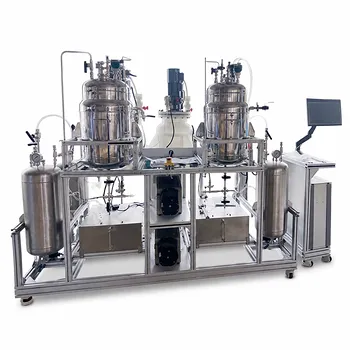
Ready to elevate your lab's hands-on learning experience? LABPARK provides state-of-the-art Educational and Vocational Unit Operations Pilot Plants in chemical engineering, bioprocess & biotech, and environmental & water treatment. Designed specifically for universities, research institutes, and enterprises, our systems help students and researchers master critical processes like solid-liquid separation and precipitation engineering.
Contact our experts today to customize your pilot plant setup!
Related Products
People Also Ask
- How do chemical engineering pilot plants demonstrate electrolysis? Bridge Theory & Industrial Scale
- Bipolar vs Monopolar Electrolysis: Key Configuration Details to Analyze in Pilot Plants
- Which Electrolysis Pilot Plant Parameters Ensure Safety & Efficiency? Key Controls Explained
- Why is the selection of electrode materials critical when configuring or operating educational electrolysis pilot plants?
- How to update chemometric calibration models in pilot plants? Best practices for process engineers.