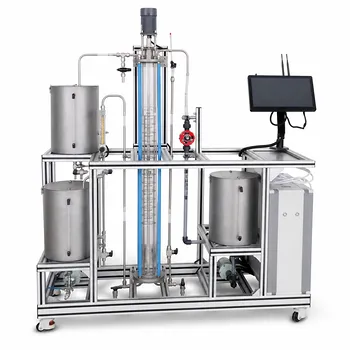
The decision isn’t about which filter is “better”—it’s about which fundamental separation principles you need your students to master. A plate-and-frame filter press is the go-to choice when your primary learning objective is batch operation and pressure-driven filtration. A rotary drum vacuum filter is the right pick when you need to demonstrate continuous, automated processing and the realities of vacuum-driven systems. For a comprehensive unit operations lab, having both allows side-by-side comparison of these paradigms.
Every filtration equipment choice in a teaching pilot plant is a pedagogical decision. You’re not just selecting a machine—you’re selecting which core chemical engineering concepts (batch vs. continuous, pressure vs. vacuum, manual vs. automated) your students will experience firsthand. Let learning outcomes dictate the hardware, not the other way around.
Aligning Equipment with Core Learning Objectives
Your pilot plant’s value comes from the concepts it makes tangible. Two filters can serve completely different educational missions.
The Batch vs. Continuous Paradigm
A plate-and-frame filter press is the classic batch demonstration. Students load slurry, apply pressure, collect filtrate, then disassemble the unit to discharge cake—seeing the cyclical nature firsthand.
A rotary drum vacuum filter is the quintessential continuous unit operation. As the drum rotates through the slurry trough, students observe cake formation, washing, drying, and discharge happening simultaneously without halting flow. This contrast is foundational to understanding plant design.
Pressure-Driven vs. Vacuum-Driven Filtration
The plate-and-frame press operates under high pressure (typically 3 × 10⁵ to 8 × 10⁵ Pa). This directly shows how increasing the driving force can handle viscous or highly resistant slurries.
The rotary drum filter relies on vacuum. Its driving force is limited to atmospheric pressure minus the system’s absolute pressure. This makes it an ideal tool for teaching how low differential pressure impacts throughput and why it’s often unsuitable for volatile or hot slurries.
Linking Theory to Measurable Outcomes
With a plate-and-frame setup, students can plot filtrate volume vs. time, calculate cake resistance, and explore compressibility. With a rotary drum, they can analyze cycle time, drum speed influence, and continuous mass balances. Together, they turn textbook equations into physical intuition.
Operational and Practical Factors in a University Setting
Beyond theory, the day-to-day realities of a teaching lab will shape your choice.
Manual Labor and Student Engagement
A plate-and-frame filter demands manual cake discharge and cleaning. This hands-on assembly and disassembly builds practical engineering skills, but it requires dedicated lab time and careful supervision.
A rotary drum filter automates discharge (often by a scraper blade). It’s a better demonstration of labor-saving design for high-throughput processes. Less student manual interaction, but more exposure to mechanical reliability and automation principles.
Slurry and Cake Characteristics
The primary reference highlights that your slurry’s filterability matters. For slow-filtering, high-resistance cakes, pressure-driven filters like the plate-and-frame are more robust. They can apply the high driving force needed.
The supplementary notes reinforce this: you must also consider cake compressibility. A highly compressible cake may blind a cloth quickly at high pressure, a nuance students can directly observe with the plate-and-frame. Conversely, a cake that cracks during washing might be better handled in a continuous system if you can maintain a uniform cake layer.
Utility and Safety Requirements
Each unit brings different infrastructure demands. A plate-and-frame requires a compressed air or hydraulic power source for pressure, plus safe drainage and containment for potential leaks.
A rotary drum filter needs a reliable vacuum pump, cooling water (if applicable), and proper ventilation—especially because vacuum operation can pull volatile vapors into the surrounding area. Any pilot plant must verify its utilities match the equipment’s design basis before installation, as the supplementary references emphasize. Insufficient power or drainage can render an otherwise perfect educational tool unusable.
Understanding the Trade-offs
No single filter covers all teaching angles. Honest appraisal of the downsides will help you avoid a costly mismatch.
Plate-and-frame limitations: Manual labor can become a bottleneck if multiple groups need the equipment in a short lab period. Cake discharge is messy. Cycle-time downtime makes it hard to teach steady-state continuous processes. High-pressure operation demands rigorous safety protocols.
Rotary drum limitations: The lower driving force means it won’t handle all slurries. Volatile solvents or hot liquids can flash evaporate under vacuum, creating safety hazards or incomplete filtration. The machine’s moving parts and seals introduce maintenance complexity that a simple plate-and-frame avoids. And because it operates continuously, diagnosing a filtration problem requires understanding dynamic equilibrium rather than a simple batch curve.
The hidden cost of choosing one: Selecting only one filter type may leave your students with a blind spot. Employers expect graduates to understand both batch pressure systems and continuous vacuum systems. The supplementary reference explicitly states that providing both allows students to “compare the productivity of continuous vacuum systems against the pressure-driven batch efficiency of plate and frame systems.”
How to Make the Right Choice for Your Lab
Start by mapping your curriculum’s required experiments, then match the equipment accordingly. Use these goal-oriented guidelines as your final decision heuristic.
- If your primary focus is demonstrating pressure-driven, batch filtration: Choose the plate-and-frame filter press. It excels at teaching cake compressibility, filtration flux over time, and manual process steps.
- If your primary focus is demonstrating continuous, automated unit operations: Select the rotary drum vacuum filter. It clearly shows steady-state mass balances, production rate optimization, and hands-free cake removal.
- If your goal is a comprehensive unit operations lab that contrasts these principles: Invest in both units. The ability to run side-by-side experiments transforms abstract theory into decisive engineering judgment.
Design your lab infrastructure around the chosen unit’s utility needs first. Then let every experiment plan reinforce why that filter was the ideal teaching tool for that concept. When your equipment selection directly serves your learning outcomes, students leave not just with data points, but with a mental model they’ll carry into every future plant design conversation.
Summary Table:
| Feature | Plate-and-Frame Filter Press | Rotary Drum Vacuum Filter |
|---|---|---|
| Operation Mode | Batch | Continuous |
| Driving Force | Pressure ($3 \times 10^5$ to $8 \times 10^5$ Pa) | Vacuum ($< 1$ atm differential) |
| Automation | Manual cake discharge & cleaning | Automated continuous discharge |
| Ideal Learning Key | Cake compressibility & batch curves | Continuous mass balance & cycle time |
Equip Your Unit Operations Lab for Success
Choosing the right filtration system is key to delivering impactful, hands-on engineering education. LABPARK provides premium Educational and Vocational Unit Operations Pilot Plants in chemical engineering, bioprocess & biotech, and environmental & water treatment for universities, research institutes, and enterprises.
Whether you need to demonstrate batch pressure filtration or continuous vacuum systems, we can help you configure the perfect setup. Contact LABPARK today to consult with our experts and receive a custom solution for your lab!
Related Products
People Also Ask
- How do density and IFT affect liquid-liquid extraction pilot plants? Optimize Column Performance
- In a liquid-liquid extraction pilot plant, how is a ternary-phase diagram utilized to determine solvent feed requirements?
- How are ternary phase diagrams and LLE data applied in extraction experiments? Optimize Pilot Plant Scale-up
- How Do Selectivity & Distribution Coefficients Influence LLE Pilot Plant Solvent Choice?
- How to Validate BIPs for LLE Pilot Plants? Steps to Align Simulations with Reality