A smaller D2/D1 ratio generates a more sensitive measurement signal, but this improvement in readability comes at the price of increased permanent pressure loss and a higher risk of cavitation. In unit operations pilot plants, the throat-to-pipe diameter ratio (D2/D1) is therefore a design lever that allows engineers to shift the balance between signal strength and operational reliability.
The D2/D1 ratio directly controls the trade-off between measurement sensitivity and overall system performance. While a smaller throat produces a larger, easier-to-read differential pressure, it amplifies frictional head loss in the diverging diffuser and can drop the throat pressure below the liquid’s vapor pressure, leading to cavitation or gas release that corrupts experimental data.
How the Diameter Ratio Shapes Venturi Meter Behavior
The key lies in fluid mechanics. A Venturi meter forces fluid through a contraction and then a gradual expansion, creating a pressure difference proportional to the square of the flow velocity. The D2/D1 ratio—the throat diameter divided by the inlet pipe diameter—determines how aggressively the flow is constricted and expanded.
The Physics: Continuity, Bernoulli, and Signal Generation
Mass conservation demands that as the cross-sectional area shrinks (lower D2/D1), velocity increases. Bernoulli’s principle then forces the static pressure to drop at the throat. This pressure drop is the differential pressure (ΔP) measured by the manometer or transmitter. The larger the velocity change, the larger the ΔP.
Measurement Sensitivity: A Larger Differential Pressure Signal
A smaller diameter ratio amplifies the ΔP for a given flow rate. For example, reducing D2/D1 from 0.50 to 0.40 can more than double the measured pressure signal. This is particularly valuable in pilot plants where flow rates may be low or where the process fluid generates only a small pressure differential. A stronger signal improves accuracy, reduces the relative impact of instrument noise, and makes the meter usable over a wider flow range.
Hydrodynamic Performance: Permanent Pressure Loss
The same constriction that creates the measurement signal also wastes energy. Most of the permanent frictional head loss occurs in the diverging section, where kinetic energy is recovered as pressure. With a smaller D2/D1, the diffuser must redirect a higher-velocity jet over a longer or steeper recovery path, leading to higher losses. Typical Venturi meters see a permanent pressure loss of 10% to 20% of the measured ΔP. A very small D2/D1 pushes this loss toward the upper end of that range, raising pumping costs and potentially upsetting downstream unit operations in the pilot plant.
The Cavitation Risk: When Sensitivity Goes Too Far
An excessively small throat diameter can drop the local static pressure below the liquid’s vapor pressure. This initiates cavitation—the formation and violent collapse of vapor bubbles—or causes the release of dissolved gases. Not only does this damage the meter’s throat surface over time, but it also introduces erratic pressure fluctuations that completely undermine measurement reliability. In a pilot plant, where data integrity is paramount, cavitation is a hard stop.
Understanding the Trade-offs in a Pilot Plant Context
Choosing a diameter ratio is never about picking the “best” number—it’s about matching the meter to the experimental priorities and constraints of the unit operation.
Prioritizing Signal Strength vs. Minimizing Energy Waste
A high-sensitivity setup (low D2/D1, say 0.30-0.40) makes sense when flows are tiny, the fluid is viscous, or the pump capacity is ample. The larger ΔP gives a clearer reading, even if 15-20% of that pressure head is lost permanently. In contrast, a typical 0.50 ratio is the workhorse choice: it provides a sufficient signal for most pilot-scale experiments while keeping energy losses moderate. Ratios above 0.60 are rarely used because the ΔP shrinks to the point where the meter loses resolution.
Avoiding the Data Black Hole of Cavitation
The real performance cliff is cavitation. No measurement is worth the chaos of bubble formation. Pilot plant operators must ensure the throat pressure stays well above the vapor pressure at all operating conditions, including during transient start-ups or when handling warm, volatile solvents. A larger D2/D1 raises throat pressure and creates a safer margin. When cavitation cannot be avoided with a large throat, meters are often relocated to a high-pressure section of the plant or a different flow measurement technology is considered.
The Diffuser’s Dominant Role
Most of the permanent loss and the cavitation initiation happen in the diverging section. An optimized diffuser angle can partially mitigate the penalty of a small D2/D1. However, the primary control remains the diameter ratio itself. A well-designed Venturi with a 0.50 ratio can achieve over 80% pressure recovery, but aggressive ratios (0.25-0.30) may struggle to recover 70%, even with ideal diffuser geometry.
Making the Right Choice for Your Pilot Plant Goal
The optimal D2/D1 depends entirely on which performance metric matters most for your specific unit operation and experimental objectives.
- If your primary focus is maximizing measurement sensitivity with small or low-velocity flows: Select a diameter ratio in the 0.30–0.40 range. Accept the higher permanent pressure loss, but install pressure relief or a back-pressure valve to keep throat pressure above liquid vapor pressure.
- If your primary focus is balancing good signal quality with minimal impact on plant energy efficiency: Use the classic 0.50 ratio. It offers a reliable, standardized signal with manageable permanent loss that will not interfere with most downstream equipment.
- If your primary focus is avoiding cavitation and ensuring rock-solid data integrity, especially with volatile fluids: Favor a larger ratio, such as 0.60–0.65, and supplement with a high-resolution differential pressure transmitter to compensate for the smaller ΔP.
The throat-to-pipe diameter ratio is not a performance detail; it is the master knob that dials in the entire measurement chain—sensitivity, pressure loss, and operational safety. Turn it with care, and your pilot plant data will reflect only the physics you intend to study.
Summary Table:
| D2/D1 Ratio | Measurement Sensitivity | Permanent Pressure Loss | Cavitation Risk | Ideal Application |
|---|---|---|---|---|
| Low (0.30 - 0.40) | High (Strong signal) | High (15–20% of ΔP) | High | Low flow rates or high-viscosity fluids |
| Standard (0.50) | Moderate | Moderate (10–15% of ΔP) | Low | General-purpose pilot-scale experiments |
| High (0.60 - 0.65) | Low (Requires high-res sensor) | Minimal | Very Low | Volatile fluids & cavitation-prone systems |
Enhance Your Engineering Lab with LABPARK
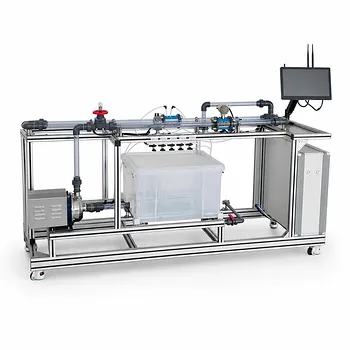
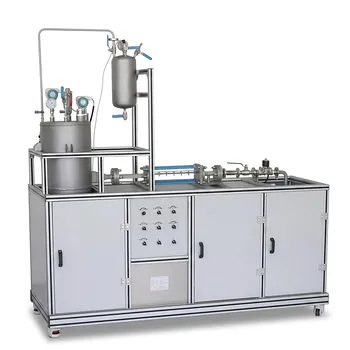
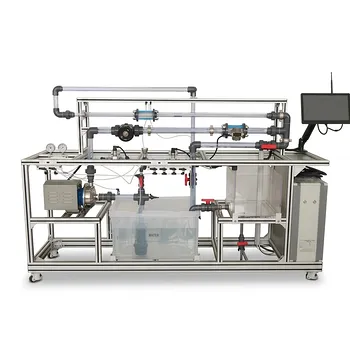
At LABPARK, we design and supply premium Educational and Vocational Unit Operations Pilot Plants in chemical engineering, bioprocess & biotech, and environmental & water treatment. Tailored for universities, research institutes, and enterprises, our systems ensure precise flow measurement, data integrity, and robust performance.
Need help optimizing your pilot plant's fluid dynamics and instrumentation? Contact our experts today to find the ideal custom solution for your curriculum or research goals!
Related Products
- Orifice and Venturi Flowmeter Calibration Educational Pilot Plant for Fluid Mechanics Laboratory
- Cavitation Phenomenon Demonstration and Analysis Educational Unit Operations Pilot Plant
- Centrifugal Pump Performance and Orifice Flowmeter Calibration Educational Pilot Plant
People Also Ask
- What is the difference between static and stagnation pressure? Master Pilot Plant Flow Measurement
- How do pilot plants demonstrate siphon pressure variations? Visualizing Bernoulli's Energy Balance
- How do fluid mechanics training pilot plants facilitate the visualization and calculation of laminar and turbulent flows?
- How to update chemometric calibration models in pilot plants? Best practices for process engineers.
- Why are the laws of similitude critical in fluid flow pilot plants? Scale Up Safely