Let’s cut straight to the chase: In an orifice meter, the fluid streamlines continue to converge after passing the plate, creating a true minimum flow area—the vena contracta—that is smaller than the physical hole. In a Venturi meter, the smooth converging-diverging throat physically confines the flow, so the minimum area is exactly the throat cross‑section with no additional contraction.
The game‑changing difference is jet contraction. An orifice meter produces a variable, contracted flow area downstream, while a Venturi meter locks in a fixed, predictable minimum area right at the throat. This single physical fact is why the orifice discharge coefficient is ruled by contraction effects, why the Venturi coefficient leans almost entirely on velocity, and why their calibration curves behave so differently in the lab.
The Physical Phenomenon – Jet Contraction Decoded
Why a Sharp‑Edged Orifice Always Pinches the Flow
When fluid approaches a sharp‑edged orifice, it cannot negotiate an instant 90‑degree turn. The streamlines detach at the edge, continue to converge for a short distance, and reach their tightest cross‑section at the vena contracta.
The actual flow area at that point is C_c × A_0, where C_c (the contraction coefficient) is always less than 1. For a standard sharp‑edged orifice, C_c typically lands around 0.62–0.64, meaning nearly 40% of the physical area is effectively blocked from a flow perspective.
How the Venturi Meter Kills Contraction
A Venturi meter guides the fluid through a gradual conical convergence. There is no sudden edge to cause separation. The flow follows the walls, and the throat area A_t is the un‑choked minimum passage.
Because streamlines hug the profile, no vena contracta forms. The minimum geometric area and the minimum flow area are one and the same.
The Direct Consequence for Flow Area Terms
When you derive the theoretical flow equation, you start with the physical restriction area:
- For an orifice:
A_0(the bore area). - For a Venturi:
A_t(the throat area).
But only for the Venturi does this physical area equal the effective flow area. For the orifice, the effective area is always smaller. The entire burden of that mismatch falls onto the discharge coefficient C_d. That is why the C_d of an orifice is fundamentally a contraction‑dominated coefficient, while the Venturi C_d is almost purely a velocity coefficient (near 0.98–0.99).
How This Plays Out in Lab Experiments
The Orifice C_d – A Story of Contraction and Sensitivity
In a calibration experiment, you measure actual flow Q, pressure drop ΔP, and plug into Q = C_d A_0 √(2ΔP/ρ). The C_d you obtain is not a pure friction‑loss number. It is a lumped parameter that absorbs:
- The contraction effect (the dominant variable).
- Small velocity‑profile distortions.
Because the contraction coefficient can shift with Reynolds number, edge sharpness, and tap location, the orifice C_d is quite sensitive. Students often see it dip or drift in the laminar‑to‑turbulent transition zone, reflecting changes in how much the jet actually contracts.
The Venturi C_d – A Velocity Story That Stays Flat
For a Venturi, C_d is calculated using the fixed throat area A_t. With no contraction to correct, the coefficient only accounts for small viscous losses through the smooth throat. It remains remarkably stable across a wide Reynolds range, typically hovering around 0.98. In lab reports, that’s why the Venturi offers a near‑perfect calibration curve with very little scatter.
Practical Implications for Flow Area Calculations
When you process data:
- You always use the physical area (
A_0orA_t) in the flow equation. - For the orifice, you must accept that the
C_dvalue you compute is functionally inseparable from the contraction coefficient. It is not a “meter efficiency” you can compare directly with a Venturi’sC_d. - This explains why the uncertainty in an orifice‑measured flow is larger unless the meter is carefully calibrated against a known standard.
Understanding the Trade‑offs
Orifice Meter – Cheap and Compact, But You Pay in Losses
- Advantages: Simple plate, low cost, easy to install between flanges, no moving parts.
- Pitfalls: The vena contracta creates a permanent pressure loss of 60–80% of the measured differential. The coefficient is sensitive to edge wear and upstream disturbances, so lab repeatability can suffer if the plate is nicked or misaligned.
Venturi Meter – Precision Comes with a Higher Price Tag
- Advantages: Exceptionally low permanent pressure loss (typically 10–20% of
ΔP), high accuracy, stable coefficient. Ideal for experiments where you need reliable, repeatable flow data without frequent recalibration. - Pitfalls: Bulky, expensive to machine, requires significant straight‑pipe length. Not a choice you’d make for a quick‑and‑dirty bench‑top setup.
The Hidden Takeaway for Calibration Curves
Students often plot C_d vs. Reynolds number for both meters and wonder why the orifice curve is lower and more erratic. The answer is not just “more friction.” It’s that the orifice curve is literally tracking contraction behavior, while the Venturi curve is tracking a near‑perfect velocity recovery. Recognizing this prevents the mistake of treating C_d as a universal loss factor.
How to Apply This Insight to Your Lab Work
- If your goal is to study the fundamentals of head‑loss meters: Use an orifice meter to illustrate the powerful role of the vena contracta. The ever‑changing
C_dis a perfect vehicle for explaining why device geometry dictates flow behaviour. - If your goal is a highly reliable reference flow measurement: Choose a Venturi meter. Its fixed flow area and stable coefficient give you a trustworthy baseline, making it easier to isolate other variables in your experiment.
- If you cannot escape using an orifice for a core experiment: Dedicate time to precisely measure edge condition and tap location. Those physical details directly control
C_cand will determine the quality of your calibration curve.
Once you see that a Venturi bounds the flow while an orifice lets the flow bound itself, every line on your calibration plot becomes a clear, physical story rather than a confusing set of coefficients.
Summary Table:
| Feature | Orifice Meter | Venturi Meter |
|---|---|---|
| Minimum Flow Area | Vena contracta (smaller than physical bore) | Throat area (equals physical throat) |
| Contraction Coeff. ($C_c$) | ~0.62–0.64 | 1.0 (No contraction) |
| Discharge Coeff. ($C_d$) | ~0.60–0.65 (highly sensitive to flow changes) | ~0.98 (highly stable across Reynolds range) |
| Permanent Pressure Loss | High (60–80% of measured differential pressure) | Low (10–20% of measured differential pressure) |
Bring Fluid Dynamics to Life in Your Lab
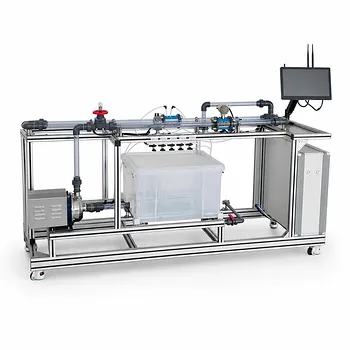
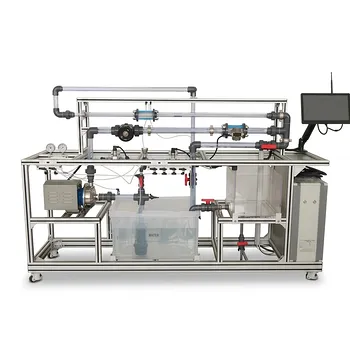
Teaching flow measurement principles requires reliable, high-precision equipment that makes physical phenomena like jet contraction and pressure drops visible and measurable. LABPARK provides state-of-the-art Educational and Vocational Unit Operations Pilot Plants in chemical engineering, bioprocess & biotech, and environmental & water treatment tailored for universities, research institutes, and enterprises.
Equip your lab with hands-on systems that deliver highly accurate, repeatable calibration curves for student experiments and advanced research. Contact LABPARK today to find the perfect pilot plant setup for your department!
Related Products
- Orifice and Venturi Flowmeter Calibration Educational Pilot Plant for Fluid Mechanics Laboratory
- Centrifugal Pump Performance and Orifice Flowmeter Calibration Educational Pilot Plant
People Also Ask
- What is the difference between static and stagnation pressure? Master Pilot Plant Flow Measurement
- How do pilot plants demonstrate siphon pressure variations? Visualizing Bernoulli's Energy Balance
- How do fluid mechanics training pilot plants facilitate the visualization and calculation of laminar and turbulent flows?
- How to update chemometric calibration models in pilot plants? Best practices for process engineers.
- Why are the laws of similitude critical in fluid flow pilot plants? Scale Up Safely