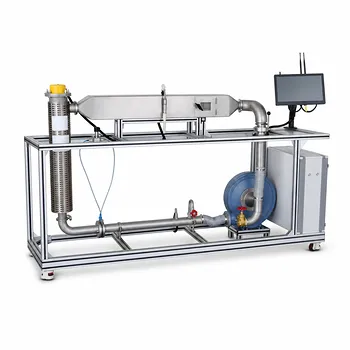
Blast drying and vacuum drying operate on fundamentally different physical principles, and that difference dictates which equipment you purchase for a chemical engineering teaching lab. Blast drying ovens use a fan-driven stream of heated air (up to 300°C) to strip surface moisture through forced convection—ideal for demonstrating rapid drying of thermally stable, non‑volatile powders. Vacuum drying ovens, by contrast, reduce chamber pressure to lower the boiling point of liquids, allowing gentle drying of volatile, flammable, or oxygen‑sensitive materials at much lower temperatures (often up to 250°C). Equipment selection therefore hinges on which material behaviors and safety lessons you want students to master.
For a unit operations lab, the real educational value lies in contrasting these two mechanisms directly. Blast drying teaches convective heat and mass transfer with simple, robust hardware, while vacuum drying introduces phase equilibrium manipulation and process safety for delicate compounds. A lab equipped with only one type leaves critical industrial drying scenarios unexplored.
Distinguishing the Mechanisms: How They Work
Blast Drying: Convective Heat and Mass Transfer
Blast drying ovens move a high‑volume stream of hot air across the sample. The fan forces the air to carry away evaporated moisture, creating a steep concentration gradient that accelerates drying.
Because the process relies on air temperature, it routinely reaches 300°C. This makes blast drying fast and energy‑efficient for samples that can handle the heat—think inorganic salts, silica, or dry granular polymers.
The mechanism is simple to visualize. Students easily connect air velocity, temperature, and drying rate, which makes blast ovens an excellent first step for teaching heat‑and‑mass‑transfer fundamentals.
Vacuum Drying: Manipulating Phase Equilibrium
Vacuum ovens remove the air—and with it, the protective atmospheric blanket. By lowering the chamber pressure, the boiling point of the liquid inside the sample drops significantly. Water, for instance, can vaporize at 40–50°C under a strong vacuum.
This mechanism is gentle. The product never encounters high temperatures, which protects heat‑sensitive, volatile, or easily oxidized materials. Pharmaceuticals, fine chemicals, and solvent‑laden samples are classic candidates.
Safety is built into the principle. Because the atmosphere is thin and often inert, the oven prevents combustion or degradation. Students learn that drying is not just about adding heat—it’s about controlling the thermodynamic environment.
Impact on Equipment Selection in a Teaching Lab
Material Compatibility and Safety Training
The first filter for equipment selection is the sample portfolio you intend to use. If your lab will only handle thermally robust, non‑flammable solids, a blast oven alone may suffice. The risks are low, and students can safely run multiple trials.
But when the curriculum touches solvents, volatile organics, or oxygen‑sensitive materials, a vacuum oven becomes non‑negotiable. It transforms drying into a process‑safety exercise—students must learn to manage vacuum levels, condensation traps, and inert gas purges.
Selecting both types of equipment lets you stage a direct comparison. One group struggles with a charred sample in a blast oven, while another gently recovers a sensitive API in a vacuum oven. The lesson sticks.
Educational Objectives and Unit Operations
Your pedagogical goals drive the choice. A blast oven isolates the core drying kinetics—moisture content versus time, drying rate curves, and the critical moisture point. It’s a clean, fast‑paced experiment.
A vacuum oven layers on phase behavior. Students confront Raoult’s law, boiling point depression, and the concept of a drying equilibrium that shifts with pressure. It’s the difference between teaching a unit operation and teaching process thermodynamics.
For a truly representative unit ops lab, having both allows you to cover the full spectrum of industrial drying: tray drying, vacuum shelf drying, and the rationale for choosing one over the other. This alignment with real‑world decision‑making is prized by accreditation boards and future employers.
Practical Constraints: Budget, Space, and Versatility
Blast ovens tend to be simpler, smaller, and less expensive. A single high‑quality blast oven can serve a large class with quick turnover. It’s the pragmatic entry point.
Vacuum ovens require pumps, seals, and more robust construction. They take up more bench space and demand a longer experimental cycle. If budget forces a choice, many labs start with a blast oven and add a vacuum oven later as a specialized workhorse.
Yet, a single vacuum oven with a programmable pressure profile can demonstrate concepts that a blast oven cannot. For labs focused on fine chemicals or bioprocessing, it might be the only dryer worth buying.
Understanding the Trade‑offs
Even the best equipment selection involves compromise. Objectively weighing these trade‑offs is essential for a defensible purchasing decision.
Speed vs. Sensitivity
Blast ovens dry fast—often in minutes—but leave behind only the materials that can survive the thermal onslaught. You trade sample range for throughput.
Vacuum ovens are slower, yet they preserve what would otherwise be lost. You trade time for product integrity. In a teaching lab, this means longer class sessions or smaller groups per session.
Operational Complexity and Cost
A blast oven is as close to plug‑and‑play as lab equipment gets. Minimal training translates to fewer student mistakes.
A vacuum oven demands an understanding of seals, pump maintenance, and pressure ramping. The learning curve is steeper, but the educational return is higher—if your curriculum can support it.
Scope of Demonstrations
With only a blast oven, your lab can never show how to dry a solvent‑wet cake without a nitrogen purge or an explosion hazard. An entire class of industrial problems becomes invisible.
With only a vacuum oven, students might never appreciate why conventional tray dryers still dominate high‑volume commodity processing. The economic and throughput argument gets lost.
The most balanced equipment selection is therefore a pairing of both, used strategically across different lab modules.
Making the Right Choice for Your Lab’s Curriculum
The mechanism dictates the mission. To align equipment with educational outcomes, consider what you’re really trying to teach.
- If your primary focus is teaching classical drying kinetics and convective transport: A blast drying oven is the workhorse. It gives clear, rapid data and lets students explore the effect of temperature and airflow without distraction.
- If your primary focus is process safety, volatile materials, or gentle pharmaceutical drying: A vacuum drying oven is mandatory. It brings phase equilibrium, pressure control, and inherent safety into the hands‑on curriculum.
- If your primary focus is a comprehensive unit operations experience that mirrors industry: Acquire both. Run blast drying experiments early in the term and vacuum drying later, explicitly comparing the mechanisms and the criteria for selecting one over the other.
- If your primary focus is a tight budget with maximum versatility: Start with a vacuum oven equipped with a good pump and a nitrogen purge option; it can dry inert solids too, albeit more slowly, and it future‑proofs the lab for advanced safety training.
Every drying experiment is a lesson in what happens when heat, mass, and thermodynamics intersect—choosing the right equipment ensures that lesson is not limited by the machine.
Summary Table:
| Feature | Blast Drying | Vacuum Drying |
|---|---|---|
| Mechanism | Forced convection (heated air stream) | Boiling point reduction (reduced pressure) |
| Max Temp | Up to 300°C | Often up to 250°C |
| Best For | Thermally stable, non-volatile powders | Heat-sensitive, volatile, or flammable materials |
| Key Teachings | Convective heat & mass transfer kinetics | Phase equilibrium & process safety |
| Cost & Complexity | Lower cost, simpler operation | Higher cost, requires vacuum pumps & seals |
Equip Your Chemical Engineering Lab with LABPARK
Enhance your student's learning and research capabilities with industry-grade pilot plants. LABPARK provides state-of-the-art Educational and Vocational Unit Operations Pilot Plants in chemical engineering, bioprocess & biotech, and environmental & water treatment. Designed specifically for universities, research institutes, and enterprises, our drying systems bridge the gap between classroom theory and industrial application.
Ready to upgrade your laboratory training facilities? Contact us today to discuss your equipment requirements and get a custom quote!
Related Products
- Multi-Functional Drying Educational Unit Operations Pilot Plant
- Circulating Wind Tunnel Drying and Convective Heat Transfer Coefficient Determination Educational Pilot Plant
People Also Ask
- Vacuum vs. Atmospheric Drying: How to Choose the Right Pilot Plant Configuration for Your Lab
- How do seasonal changes affect drying pilot plant blower requirements? Key sizing tips.
- Why is dry-basis moisture content preferred over wet-basis? Simplify your drying pilot plant balances.
- How can unit operations pilot plants demonstrate simultaneous removal of light and heavy impurities? Configure a modular setup
- Why Does a Pilot Plant Solver Return a Singular Matrix Error, and How Can You Resolve It?