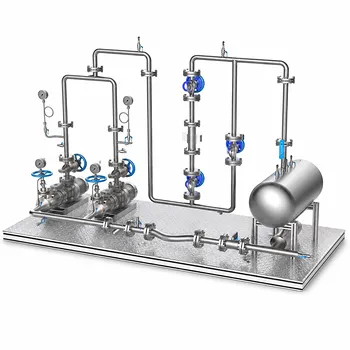
The safest way to start a centrifugal pump in a pilot plant is with its discharge valve fully closed. This is not a quirk of tradition—it’s a direct consequence of the pump’s shaft power-flow rate (N‑Q) characteristic curve. At zero flow (valve shut), the shaft power demand is at its absolute minimum, which dramatically reduces the electrical and mechanical stress placed on the motor during startup.
Starting a centrifugal pump against a closed discharge valve is standard protocol because the N‑Q curve proves that shaft power reaches its lowest point when flow is zero. This practice minimizes startup current, initial torque, and motor overload—protecting both the electrical infrastructure and the pump equipment in a pilot-scale environment.
The N‑Q Curve: The Physics Behind the Protocol
What the Shaft Power Curve Tells You
A centrifugal pump’s performance is mapped by three fundamental curves at constant speed: Head vs. Flow (H‑Q), Efficiency vs. Flow (η‑Q), and Shaft Power vs. Flow (N‑Q). The N‑Q curve always shows power rising with flow.
The critical insight is that at shutoff (Q = 0), the N‑Q curve bottoms out. The impeller is doing the least possible hydrodynamic work—only churning the trapped liquid rather than accelerating it through the system. This minimal energy demand is precisely what protects the drive motor during the instant it accelerates from standstill to rated speed.
Why Startup Current Matters
Electric motors draw a massive inrush current during acceleration—often 5–7 times their full-load current. If that inrush coincides with a high mechanical load, the total current can easily exceed protective device ratings, causing nuisance trips or winding damage.
By starting with the valve closed, you deliberately match the motor’s highest electrical stress with the pump’s lowest mechanical load. This alignment keeps the combined thermal and magnetic stress within safe limits, even in the electrically constrained environment of a pilot plant where multiple instruments share the same circuits.
A Direct Link to Equipment Protection
The pilot plant setting magnifies the importance of this practice. Motors are often small, supply panels may lack the robustness of industrial switchgear, and the cost of a failure—both in repair time and lost experimental data—is high. The zero‑flow startup directly translates the N‑Q curve’s theoretical minimum into a practical safeguard against motor burnout and electrical failures.
Beyond the Motor: What Happens to the Pump
The Head and Efficiency Curves at Shutoff
At zero flow, the H‑Q curve shows the pump developing its maximum head—sometimes called the “shutoff head.” This momentarily elevated pressure is harmless for the pump casing and seals, because centrifugal pumps are not positive displacement machines; they can safely operate against a closed valve for a short period without building destructive pressure spikes. The efficiency, however, is zero (no useful work is done), which is why the closed-valve condition must be brief.
Avoiding the Confusion with Dead‑Heading
A common mistake is to confuse startup with prolonged dead‑head operation. While starting against a closed valve is protective, running the pump indefinitely at shutoff will overheat the liquid inside the casing, as all the input motor power converts to heat rather than flow. In a pilot plant, the protocol is always: close valve → start pump → verify speed is stable → immediately begin opening the valve to establish flow. This sequence uses the N‑Q curve’s low-power starting window without drifting into the danger zone.
Understanding the Trade‑offs and Common Pitfalls
The Time Window Matters
The protective advantage of the closed‑valve startup exists only for seconds. If the operator forgets to open the valve or if an automated sequence fails, the pump will quickly enter a high‑heat, low‑efficiency state. Pilot plant instructors must emphasize that the valve should be opened as soon as the motor reaches full speed—typically within 5 to 10 seconds.
Not All Centrifugal Pumps Behave Identically
While the standard N‑Q curve rises with flow, very high specific‑speed axial‑flow pumps can exhibit a power curve that drops or stays flat at shutoff. However, the vast majority of centrifugal pumps used in unit operations pilot plants (radial and mixed‑flow designs) follow the rising N‑Q trend, making the closed‑valve start universally applicable in that context.
Electrical Settings Still Require Verification
Even with the closed valve, a mis‑set overload relay or an undersized breaker can trip unnecessarily. The N‑Q curve reduces the probability of overload, but does not eliminate the need to properly size motor protection for the specific pump and application. Always cross‑check the motor nameplate current against the startup curve.
Making the Right Choice for Your Pilot Plant Operation
- If your primary focus is teaching safe startup protocols: Use the N‑Q curve as the central visual proof. Show students the numerical minimum at Q=0 and explain how it directly protects the motor during the inrush phase.
- If your primary focus is protecting expensive pilot plant equipment: Integrate the closed‑valve sequence into your standard operating procedure and incorporate a brief timer or check‑valve bypass to guarantee the valve is opened shortly after reaching speed.
- If your primary focus is understanding pump theory: Study the N‑Q, H‑Q, and system curves together. Recognize that the operating point is the intersection of pump and system curves, but that the startup condition is a deliberate detour to the far‑left of the N‑Q curve to ensure a gentle electrical start.
By respecting the simple lesson of the N‑Q curve—that minimum flow means minimum load—you transform a pump’s vulnerability during startup into one of the strongest layers of protection for your pilot plant.
Summary Table:
| Parameter | State at Shutoff (Q = 0) | Impact on Pilot Plant System |
|---|---|---|
| Flow Rate (Q) | Zero | Safest starting point; prevents immediate fluid surging |
| Shaft Power (N) | Minimum | Minimizes inrush current, torque, and motor overload stress |
| Pump Head (H) | Maximum (Shutoff Head) | Creates peak pressure; harmless if kept to a brief duration |
| Efficiency (η) | Zero | Directs input energy into heat; requires quick valve opening |
Optimize Your Engineering Lab with LABPARK
Are you looking to teach hands-on fluid dynamics and process safety effectively? LABPARK provides premium Educational and Vocational Unit Operations Pilot Plants in chemical engineering, bioprocess & biotech, and environmental & water treatment. Engineered specifically for universities, research institutes, and enterprises, our systems help students and operators safely master critical procedures like pump startup protocols.
Ready to elevate your training and research capabilities? Contact LABPARK today to discover the ideal pilot plant solution for your facility!
Related Products
- Centrifugal Pump Performance Determination Educational Unit Operations Pilot Plant
- Centrifugal Pump Performance and Orifice Flowmeter Calibration Educational Pilot Plant
- Chemical Pipeline Assembly and Fluid Transport Practical Training Unit Operations Pilot Plant
People Also Ask
- Why start a centrifugal pump with a closed outlet valve? Protect your pilot plant motors.
- How can cavitation and slurry erosion be studied and mitigated using fluid transport and centrifugal pump pilot plants?
- How does fluid density affect pump head and pressure? Avoid Pilot Plant Motor Overload
- How does fluid viscosity affect centrifugal pump performance? Key pilot plant correction methods.
- How does fluid density affect centrifugal pump performance & motor safety in pilot plants?