The definitive difference lies not in if choking happens, but in what happens after. Under choked flow conditions, both an orifice plate and a Venturi nozzle will limit the mass flow rate to a maximum value once the gas velocity at the minimum cross-section reaches the local speed of sound. However, their downstream discharge behaviors diverge completely. For an orifice plate, this sonic velocity is the absolute physical limit, and the jet remains subsonic or sonic as it dissipates energy violently. A converging-diverging Venturi nozzle, on the other hand, exploits its specific geometry to further expand the gas, accelerating the discharge jet from sonic at the throat to well-defined supersonic speeds.
The core insight for any pilot plant operator or engineer is this: choked flow is a state dictated by the upstream-to-downstream pressure ratio, but the character of the discharge is dictated by geometry. An orifice plate chokes into a turbulent, energy-wasting plume capped at Mach 1, while a Venturi nozzle can efficiently convert thermal energy into directed kinetic energy, achieving a supersonic jet with higher momentum.
The Physics of Choked Flow in Different Geometries
The primary reference correctly identifies the fundamental, non-negotiable distinction: the ultimate velocity achievable. This isn't just a minor academic detail; it changes how the fluid's energy is transformed and dictates the mechanical limits of the experiment.
The Orifice Plate: Sonic Limit and Energy Dissipation
When an orifice plate chokes, the flow at the vena contracta—the point of minimum jet area just downstream—reaches acoustic velocity (Mach 1). This is the absolute speed limit for this geometry. The kinetic energy simply cannot increase any further, regardless of how low the downstream pressure drops.
Any additional energy derived from a lower downstream pressure is not converted into velocity. Instead, it is violently dissipated through intense turbulence, shockwaves, and vortex formation immediately past the restriction. The permanent pressure loss is catastrophic, as kinetic energy is converted into heat, not recoverable static pressure.
The Venturi Nozzle: Controlled Supersonic Expansion
A converging-diverging Venturi nozzle is a thermodynamic machine designed to organize expansion. The minimum area (throat) chokes at Mach 1, just like the orifice. However, this is where the similarity ends. In the diverging section that follows, the increasing cross-sectional area allows the sonic flow to expand and accelerate to supersonic velocities. The gas's thermal energy is efficiently converted into directed kinetic energy, producing a controlled high-momentum jet. This is the same principle that enables rocket nozzles to achieve hypersonic exhaust.
Beyond Choking: Pressure Recovery and Energy Loss
Understanding the choked jet is only half the picture. In a chemical engineering pilot plant, the systemic impact—particularly energy efficiency—is often the deeper, unspoken need behind this question.
Permanent Pressure Loss as a System-Wide Cost
The discharge behavior directly dictates the permanent pressure loss. An orifice meter’s turbulent, dissipative discharge creates a massive loss, often 60-80% of the measured differential pressure. This translates to higher pump or compressor power consumption for the entire pilot plant. A Venturi's streamlined design and controlled supersonic expansion allow for an excellent pressure recovery, with permanent losses often below 15%. If your deep need is demonstrating an energy-efficient process, the Venturi’s discharge is inherently superior, as the supplementary references confirm.
Visualizing the Difference for Student Clarity
For educational setups, the distinction is best learned through direct comparison. In an orifice plate, you'll observe high-frequency pressure fluctuations downstream, indicative of chaotic vortices. In a Venturi nozzle, you can observe a more stable, directed jet, and, if you have a transparent section, potentially even visualize shock diamonds (Mach disks) in the supersonic exhaust plume, making the concept tangible.
Measurement Accuracy and Discharge Coefficients
The question about discharge behavior is intertwined with measurement quality. The very concept of a discharge coefficient ((C_d)) captures how real-world behavior deviates from the ideal.
The Contraction Coefficient ((C_c)) Dominance
For an orifice meter, the discharge coefficient is a complex function of the jet contraction. The physical orifice area ((A_o)) is not the actual flow area; the jet necks down to a smaller, variable vena contracta. The orifice (C_d) is heavily dependent on the contraction coefficient ((C_c)). Any change in flow properties that alters this contraction—like fluid viscosity—will significantly impact the meter's accuracy and, by extension, your understanding of the choked condition's onset.
The Venturi's Inherent Stability
A Venturi nozzle’s geometry forces the flow to fill the entire cross-section. There is no separate jet contraction; the flow area is the known, fixed throat area ((A_2)). Consequently, its discharge coefficient is essentially just a velocity coefficient ((C_v)), making it far more predictable and closer to 1.0. Under choked flow, this provides a direct, reliable link between the throat area, stagnation conditions, and the critical mass flux, simplifying pilot plant calculations and control.
The Influence of Fluid Properties on Choked Behavior
The transition to choked flow, and the meter's behavior near it, is not immune to the gas's properties.
Reynolds Number Sensitivity
The supplementary references highlight a critical educational point: the performance at high flow rates is still linked to the viscous behavior at lower ones. For an orifice meter, an increasing viscosity (decreasing Reynolds number) initially makes the discharge coefficient non-monotonic, rising as the vena contracta swells before falling as viscous losses dominate. A Venturi meter exhibits a simpler, monotonic decline in (C_d) with decreasing Reynolds number. This predictability near the choked flow transition is a significant analytical advantage. You are isolating compressible effects without the confounding, non-linear influence of jet contraction changes.
Understanding the Practical Trade-offs
No technology is perfect. Trust is built on an honest, objective assessment of the downsides.
The Cost of Precision and the Price of Simplicity
- Orifice Plates: The acquisition cost is so low it's negligible, and they are trivially installed between flanges. The downsides are brutal: profound permanent energy loss, a sharp edge that erodes and alters the choked flow behavior over time, and a discharge behavior that violently dissipates energy rather than doing useful work.
- Venturi Nozzles: The discharge behavior is elegant and efficient, minimizing energy loss and enabling supersonic jets. The cost is brutally practical: they are physically long, heavy, and require expensive precision machining to exact dimensional tolerances. A slight deviation in the diverging angle destroys the idealized supersonic expansion.
Installation and System Integration
An orifice plate's simple, compact nature allows for easy installation and replacement. A Venturi nozzle demands a significant straight-run length and a much larger physical footprint in a pilot plant skid. The "best" choice for a pilot plant doesn't exist in a vacuum; it is a negotiation between the purity of the fluid dynamics you wish to demonstrate and the constraints of your budget and physical space.
Making the Right Choice for Your Pilot Plant
Your objective governs which device serves your deep need. Choose based on what failure mode you can tolerate.
- If your primary focus is studying energy efficiency and pressure recovery: Install a Venturi nozzle. Its supersonic, organized discharge exemplifies the efficient conversion of thermal energy to kinetic energy with minimal permanent loss.
- If your primary focus is analyzing the physics of jet contraction and compressible dissipation: Use an orifice plate. Its chaotic, Mach-1-capped discharge makes the concepts of vena contracta and turbulent energy loss a tangible, measurable reality.
- If your primary focus is cost-sensitive metering and mechanical simplicity: An orifice is the pragmatic choice. Accept the high energy loss and sonic velocity cap as the price of a simple, well-characterized device that fits your budget.
Ultimately, the question isn't which discharge is "better," but which specific physical behavior you need to illuminate or utilize in your chemical engineering pilot plant.
Summary Table:
| Feature | Orifice Plate | Venturi Nozzle |
|---|---|---|
| Maximum Velocity | Mach 1 (Sonic limit at vena contracta) | Supersonic (in the diverging section) |
| Downstream Jet | Chaotic, turbulent, energy-wasting plume | Controlled, high-momentum directed jet |
| Permanent Pressure Loss | High (60% to 80% loss) | Low (typically under 15% loss) |
| Discharge Coefficient ($C_d$) | Variable; heavily dependent on contraction ($C_c$) | Stable and predictable; close to 1.0 |
| Best Academic Focus | Analyzing turbulent dissipation & shockwaves | Demonstrating energy efficiency & expansion |
Optimize Your Lab with LABPARK Pilot Plants
Are you looking to deliver hands-on understanding of advanced fluid dynamics and unit operations? LABPARK designs and manufactures premium Educational and Vocational Unit Operations Pilot Plants tailored for chemical engineering, bioprocess & biotech, and environmental & water treatment.
We empower universities, research institutes, and enterprises with high-fidelity, industry-grade systems that make complex thermodynamic principles like choked flow visible, measurable, and safe to study.
Ready to upgrade your laboratory capabilities? Contact LABPARK today to discuss your custom pilot plant configuration!
Related Products
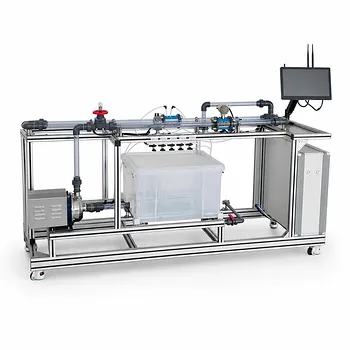
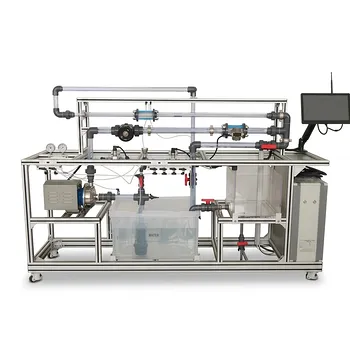
- Orifice and Venturi Flowmeter Calibration Educational Pilot Plant for Fluid Mechanics Laboratory
- Centrifugal Pump Performance and Orifice Flowmeter Calibration Educational Pilot Plant
People Also Ask
- What is the difference between static and stagnation pressure? Master Pilot Plant Flow Measurement
- How do pilot plants demonstrate siphon pressure variations? Visualizing Bernoulli's Energy Balance
- How do fluid mechanics training pilot plants facilitate the visualization and calculation of laminar and turbulent flows?
- How to update chemometric calibration models in pilot plants? Best practices for process engineers.
- Why are the laws of similitude critical in fluid flow pilot plants? Scale Up Safely