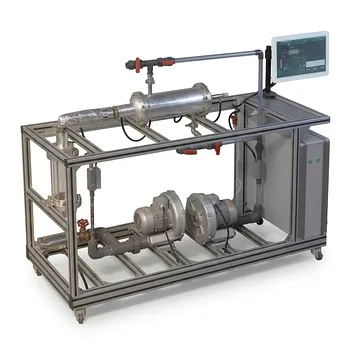
For high-temperature process heating, closed-loop thermal oil systems typically deliver more heat with less pressure, complexity, and distribution loss than steam systems. They can exceed 500°F (260°C) at comparatively low operating pressures, while providing precise, uniform temperature control close to the process equipment. This reduces high-pressure hazards, regulatory burden, heat loss, and the infrastructure required for steam distribution.
The central advantage is decoupling high temperature from high pressure: thermal oil can circulate at high temperature without requiring the extreme pressures associated with high-temperature steam. The result is a safer, more controllable, and often simpler heating system for thermal process unit operations.
Why Thermal Oil Reduces Operating Pressure
High temperature without high steam pressure
Steam temperature is directly tied to its saturation pressure. Achieving high temperatures with steam therefore requires high-pressure boilers, piping, valves, and process equipment.
A closed-loop thermal oil system achieves the required temperature through heated fluid circulation rather than steam pressurization. This allows temperatures above 500°F (260°C) at substantially lower operating pressures than would be required with steam.
Lower pressure reduces hazard exposure
Lower operating pressure reduces the severity of potential leaks, ruptures, and equipment failures. This is particularly valuable in pilot plants, laboratories, educational facilities, and other environments where personnel may work near the process equipment.
Thermal oil also avoids the possibility of high-pressure steam entering a process stream, which can be important where contamination or personnel exposure must be prevented.
Simpler pressure-related requirements
Steam boilers and high-pressure steam networks commonly require more extensive pressure-rated equipment, controls, inspections, and regulatory compliance. Thermal oil systems can reduce these pressure-related design and operating requirements, although they still require appropriate engineering, safeguards, and fluid management.
How Thermal Oil Improves Process Control
More precise temperature regulation
A circulating thermal fluid system transfers heat continuously to the process equipment. The heater and circulation loop can be controlled to maintain a stable supply temperature and respond to changing process loads.
This supports tighter temperature control than may be practical with steam, particularly when the process requires a temperature above the range served efficiently by low-pressure steam.
More uniform equipment heating
Thermal oil circulates through jackets, coils, or heat exchangers, providing a consistent heat-transfer medium across the equipment. Uniform circulation helps reduce hot spots and cold zones in thermal unit operations.
This is useful for processes where local overheating can affect product quality, reaction behavior, viscosity, or material integrity.
Suitable for a broad high-temperature range
Thermal oils are commonly used for high-temperature duties in the approximate range of 50°C to 400°C, depending on the selected fluid and system design. This makes them suitable for many chemical processing, pilot plant, and modular unit operation applications.
The correct fluid must be selected for the required temperature, process compatibility, operating life, and safety requirements.
How Localized Heating Improves Efficiency
Reduced distribution heat loss
Thermal oil heaters can be located close to the equipment they serve. Shorter circulation paths reduce the opportunity for heat loss compared with a centralized steam plant feeding distant users through a larger distribution network.
This can improve thermal efficiency and reduce the amount of insulation, tracing, condensate handling, and distribution equipment required.
Lower piping and infrastructure complexity
A steam network generally requires supply piping, condensate return systems, traps, separators, pressure-reducing stations, and associated drainage or recovery arrangements. A closed thermal oil loop primarily requires a heater, pump, expansion provision, distribution piping, and user-side heat-transfer equipment.
The difference becomes especially significant when several small or modular process units require high-temperature heating.
One loop can serve multiple users
A single thermal oil circulation loop can supply multiple jackets, coils, or heat exchangers operating at similar temperature requirements. This can be more cost-effective than building separate steam connections and condensate arrangements for numerous small-scale users.
The system is particularly well suited to pilot plants and modular educational facilities where heating loads are distributed across several unit operations.
Where Thermal Oil Fits Best
High-temperature batch processing
Thermal oil is well suited to batch operations that require elevated temperatures and stable, controllable heating. The circulating loop can maintain the temperature required by a vessel jacket, coil, or external heat exchanger without introducing steam into the process.
Pilot plants and laboratory-scale systems
In pilot facilities, lower operating pressure can reduce the consequences of equipment failure and simplify the operating environment. This is valuable when students, operators, or researchers work near the equipment.
A thermal oil loop can also support several small-scale heating demands without the complexity of a full high-pressure steam distribution system.
Processes sensitive to contamination
Because the thermal fluid remains in a closed heating circuit, it does not normally contact the process material. This avoids the risk of steam leaking directly into the process stream and changing its composition, moisture content, or operating conditions.
The closed circuit also allows the process side and heating side to be isolated through jackets or heat exchangers.
Understanding the Trade-offs
Thermal oil is not risk-free
Lower pressure does not eliminate all hazards. Thermal oils can be combustible, and leaks at elevated temperature may create fire, smoke, or personnel-burn risks.
The system therefore requires suitable fluid selection, leak prevention, expansion capacity, temperature protection, ventilation, fire safeguards, and operating procedures.
Fluid condition affects performance
Thermal oil can degrade if it is overheated, contaminated, or operated outside its intended temperature range. Degraded fluid may reduce heat-transfer performance and increase maintenance requirements.
Fluid condition should be monitored according to the supplier’s recommendations, and the heater should be protected against excessive film and bulk temperatures.
Steam may remain preferable for some duties
Steam can be advantageous where rapid condensation provides very high heat-transfer rates, where large centralized loads already exist, or where steam is needed for sterilization, humidification, stripping, or direct process contact.
The choice should therefore be based on the complete utility and process design rather than temperature alone.
Temperature compatibility must be verified
The thermal oil must be compatible with the maximum operating temperature, pump, seals, piping, gaskets, expansion tank, and heat-transfer surfaces. A system designed around the wrong fluid or insufficient circulation can lose the control and reliability advantages expected from thermal oil.
Making the Right Choice for Your Goal
Thermal oil is most compelling when high temperature, low pressure, precise control, and distributed process heating are all important.
- If your primary focus is high-temperature operation: Choose thermal oil when the process requires temperatures above the practical range of low-pressure steam without accepting the pressure required by high-pressure steam.
- If your primary focus is personnel and equipment safety: Favor thermal oil to reduce high-pressure exposure and avoid direct high-pressure steam intrusion into process streams, while still providing appropriate thermal-fluid and fire safeguards.
- If your primary focus is temperature quality: Use a properly designed circulating loop to obtain more stable and uniform heating across jackets, coils, and heat exchangers.
- If your primary focus is facility simplicity: Consider a localized thermal oil heater and loop to reduce steam distribution, condensate-return, and pressure-management infrastructure.
- If your primary focus is multiple modular loads: Evaluate one thermal oil loop when several small or distributed process units require similar high-temperature heating.
- If your primary focus is total lifecycle performance: Compare thermal oil against steam using fluid management, fire protection, maintenance, energy distribution, and any existing facility utilities—not only the initial equipment cost.
Choosing between thermal oil and steam is ultimately a question of matching the heating utility to the required temperature, pressure, control, safety, and facility layout.
Summary Table:
| Consideration | Closed-Loop Thermal Oil | Steam System |
|---|---|---|
| High-temperature operation | Reaches above 500°F (260°C) at comparatively low pressure | Higher temperatures require higher steam pressure |
| Process control | Precise, stable, and uniform heating through jackets, coils, or heat exchangers | Effective heat transfer, but control may be more complex at high temperatures |
| Safety profile | Reduces high-pressure exposure, but requires thermal-fluid and fire safeguards | Requires high-pressure boilers, piping, valves, and controls |
| Infrastructure | Heater, pump, expansion provision, and circulation loop | Boiler, supply network, condensate return, traps, separators, and pressure stations |
| Heat distribution | Localized heating can reduce distribution losses | Longer networks may increase heat loss and maintenance needs |
| Multiple users | One loop can serve several modular process units with similar temperature needs | Multiple users may require more extensive steam and condensate systems |
| Best-fit applications | High-temperature batch processing, pilot plants, laboratories, and contamination-sensitive processes | Centralized high-load systems, sterilization, humidification, stripping, or direct steam contact |
| Key requirements | Correct fluid selection, circulation, expansion capacity, temperature protection, and fluid monitoring | Boiler operation, pressure management, condensate handling, inspections, and regulatory compliance |
Planning a pilot plant, laboratory, or production system that needs reliable high-temperature heating? Contact LABPARK to discuss your requirements. LABPARK provides Educational and Vocational Unit Operations Pilot Plants for chemical engineering, bioprocess and biotech, and environmental and water treatment applications. Our team can help universities, research institutes, and enterprises evaluate thermal oil versus steam, select suitable heating and heat-transfer equipment, and develop a practical unit operations solution with precise temperature control, safe operation, modular flexibility, and dependable performance.
Related Products
People Also Ask
- Why Apply LMTD Correction in Shell-and-Tube Pilot Plants & How to Determine It
- Why adjust baffle spacing in shell-and-tube heat exchanger pilot plants? Master heat transfer & pressure drop.
- How to Estimate Shell-Side Pressure Drop in a Shell-and-Tube Heat Exchanger Pilot Plant: Key Parameters Explained
- How is the fouling factor (Rd) evaluated? Key Pilot Plant Insights for Students
- How is fouling factor demonstrated using shell and tube pilot plants? Practical Lab Guide