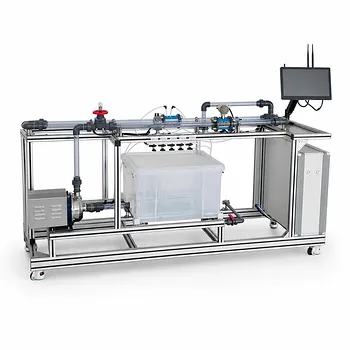
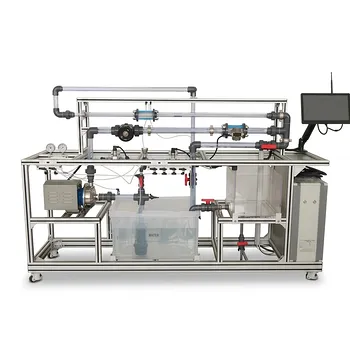
The core differentiator is the presence—or absence—of jet contraction. In a pilot plant, a Venturi meter guides the fluid smoothly, eliminating jet contraction and making its discharge coefficient highly predictable and stable (around 0.97–0.99). An orifice plate forces the fluid through a sharp-edge restriction, creating a variable vena contracta downstream. This means its discharge coefficient is far lower (0.59–0.68) and depends on complex, fluctuating variables, making it a fundamentally different measurement tool.
While both meters use a pressure drop to infer flow rate, distinguishing their behavior isn't just a theoretical exercise—it's essential for choosing between measurement precision and system energy cost. An orifice meter’s behavior is governed by jet contraction and high energy dissipation, whereas a Venturi’s behavior is governed by a smooth velocity profile and minimal energy loss.
The Physics Defining Meter Behavior
The distinction between these two meters starts with a single, critical fluid dynamic phenomenon: jet contraction. This event dictates everything else, from the coefficient's value to the meter's energy footprint.
The Venturi Meter: Precision Through Guiding
A Venturi meter is a study in flow control. Its design eliminates the most chaotic element of differential pressure measurement.
A smooth, converging cone guides the fluid into the throat. This guiding action prevents the fluid stream from separating from the walls, so the physical area of the throat is effectively the minimum flow area.
Since the actual flow area is a known, fixed geometry, there is no ambiguity introduced by a contracting jet. The discharge coefficient (Cd) is therefore not a correction for area change but becomes almost purely a velocity coefficient (Cv).
This is why a well-machined Venturi meter has a Cd very close to 1.0. The coefficient is high, predictable, and remarkably stable, making it an ideal tool for precision measurement in a pilot plant where understanding the fundamental principle is the goal.
The Orifice Meter: A Study in Contraction and Chaos
An orifice plate is a blunt obstruction. The fluid accelerates not through a funnel, but around a sharp edge, detaching from the boundary to form a jet.
This jet continues to contract, reaching its minimum cross-sectional area a short distance downstream at the vena contracta. The area at this point is variable and inherently unknown, as it's a property of the dynamic flow, not the physical meter.
The orifice's discharge coefficient has to account for this huge unknown. The Cd is heavily dependent on the contraction coefficient (Cc)—the unknown ratio of the jet area at the vena contracta to the physical orifice area.
Because the vena contracta area changes with flow rate and fluid properties, the Cd for an orifice is not a stable constant. This introduces an inherent measurement uncertainty that must be characterized, not ignored, in a pilot plant setting.
The Critical Consequences: Energy, Stability, and Application
Understanding the physics isn't the end goal. The real reason to distinguish these behaviors in a pilot plant is to witness how they directly dictate system performance and measurement strategy.
The Energy Footprint: Recoverable vs. Permanent Loss
The energy cost of a flow measurement is a key unit operations concept. The two meters behave in opposite ways.
A Venturi meter is designed for pressure recovery. Its diverging cone acts as a diffuser, decelerating the fluid and converting kinetic energy back into static pressure with high efficiency.
An orifice meter is a notorious energy waster. The vortices and intense turbulence generated downstream of the plate dissipate rotational kinetic energy directly into heat. This permanent frictional head loss is significantly higher than that of a Venturi, as summarized by the relationship h_f ≈ [1 - (D_o/D_1)^2]h.
In a pilot plant, a student can see that choosing a cheaper orifice meter means accepting a much higher operating cost over the system's lifetime. The distinction makes the connection between a device's Cd behavior and its energy consumption tangible.
Coefficient Stability and Measurement Uncertainty
This is a direct lesson in calibration reality. The high, stable Cd of a Venturi means a single calibration curve is highly reliable across a wide operating range.
The low, variable Cd of an orifice tells a different story. Surface wear on the sharp edge, a slight increase in upstream pressure head, or a change in fluid properties will measurably shift the coefficient. It can drift by 1–2% over time simply due to surface roughening.
In a pilot plant, this uncertainty is magnified for compressible fluids. The pressure drop across an orifice further accelerates a gas, causing a density change. You must introduce an expansion factor (Y) to correct the incompressible flow equation, which would otherwise overestimate the true flow rate. This additional correction is less critical for the more pressure-efficient Venturi, further highlighting their distinct operational behaviors.
Understanding the Trade-offs and Pitfalls
An objective technical assessment requires a clear-eyed view of the downsides. The benefits of one meter are the direct trade-off of the other.
- The Venturi's Drawbacks: Its elegant behavior comes at a steep price. The meter is physically large, heavy, and expensive to manufacture. Installation requires significant straight pipe runs, and it cannot be easily installed between existing flanges.
- The Orifice's Pitfall: The greatest mistake is treating its
Cdas static. Assuming a textbook value without performing a Reynolds-number-based calibration in your pilot plant will bake significant error into your mass and energy balances. - Choked Flow Behavior: The distinction persists even at sonic conditions. In an orifice, acoustic velocity is the absolute limit at any point in the flow. In a Venturi nozzle, the diverging section allows the now-supersonic jet to further expand and accelerate, demonstrating a fundamentally different downstream velocity profile that students can analyze for pressure drop recoverability.
Making the Right Choice for Your Pilot Plant Goal
The decision of which meter to use—or more importantly, why you are studying them—defines the value of a pilot plant exercise.
- If your primary focus is on maximum measurement accuracy and energy efficiency: Your study should center on the Venturi meter. Its behavior demonstrates how precision engineering minimizes variable losses and yields a stable, high-recovery measurement.
- If your primary focus is on cost sensitivity and studying the impact of design on fluid dynamics: The orifice meter is your primary subject. It provides a powerful, hands-on lesson in jet contraction, vortex dissipation, and the critical need for experimental calibration.
- If your primary focus is on high-accuracy gas flow calibration: You must compare both. The exercise of calculating the expansion factor for the orifice against the more intrinsic coefficient of the Venturi drives home the consequences of pressure profile design on a meter's suitability for compressible flow.
- If your primary focus is a lasting pedagogical installation: Select equipment that includes both types. The direct, side-by-side measurement of
Cdand permanent pressure loss across an orifice, a flow nozzle, and a Venturi provides the enduring, intuitive understanding that defines a successful unit operations experience.
The distinction isn't just about two coefficients; it's a complete framework for evaluating the true cost of any engineering measurement.
Summary Table:
| Feature | Orifice Meter | Venturi Meter |
|---|---|---|
| Jet Contraction | Significant (creates variable vena contracta) | None (fluid is guided smoothly) |
| Discharge Coefficient ($C_d$) | Low (0.59–0.68) and variable | High (0.97–0.99) and stable |
| Pressure Recovery | Poor (high permanent frictional head loss) | Excellent (efficient diffuser recovery) |
| System Footprint & Cost | Compact and inexpensive | Large, heavy, and expensive |
Elevate Your Unit Operations Training with LABPARK
Looking to demonstrate fluid dynamics principles like discharge coefficients with hands-on precision? LABPARK provides state-of-the-art Educational and Vocational Unit Operations Pilot Plants in chemical engineering, bioprocess & biotech, and environmental & water treatment.
We help universities, research institutes, and enterprises bridge the gap between theory and practical engineering application with robust, reliable, and curriculum-aligned systems.
Ready to upgrade your laboratory? Contact us today to discuss your customized pilot plant requirements!
Related Products
- Orifice and Venturi Flowmeter Calibration Educational Pilot Plant for Fluid Mechanics Laboratory
- Centrifugal Pump Performance and Orifice Flowmeter Calibration Educational Pilot Plant
People Also Ask
- How does nozzle geometry affect energy efficiency and jet performance in fluid mechanics laboratory demonstration units?
- How does jet contraction differ between orifice and Venturi meters? Flow Area Calculation Guide
- What is the difference between static and stagnation pressure? Master Pilot Plant Flow Measurement
- Why are the laws of similitude critical in fluid flow pilot plants? Scale Up Safely
- What is the physical significance of the vena contracta? Master Fluid Flow Calibration