Edge wear is the silent thief of flow measurement accuracy.
In a long-running pilot plant, the sharp inlet edge of an orifice plate gradually becomes rounded by erosion, corrosion, or particulate impingement. This rounding reduces the plate’s throttling effect, generating a smaller differential pressure for the same actual flow rate. As a direct result, the flow meter will under-report the flow, displaying a value lower than what is truly passing through the pipe.
The primary symptom of edge degradation is a systematic under-reading of flow, caused by a loss of fluid acceleration past the orifice. Simple visual inspection and periodic replacement are the most reliable corrections, but you must also verify that other common pilot-plant measurement issues—like pulsating flow, improper straight-pipe runs, or air in manometer lines—are not compounding the error.
The Physics of Degradation: Why a Sharp Edge Matters
The Role of the Sharp Inlet Edge
An orifice plate measures flow by forcing fluid through a sudden contraction. The sharp, square edge creates a controlled vena contracta and a predictable pressure differential (ΔP).
The discharge coefficient (Cd), which links ΔP to actual flow, is calibrated for this sharp-edge geometry.
How Rounding Changes the Game
When the edge wears into a rounded profile, it acts more like a smooth nozzle than a sharp restriction.
This reduces the head loss and the measured ΔP for a given flow rate. The original Cd is no longer valid, so the flow calculation—based on the now-falsely low ΔP—returns a value below the true flow.
The Inevitability of the Problem
In pilot-plant service, fluids often contain trace solids, catalysts, or corrosive agents. Even mildly abrasive conditions attack the edge over thousands of hours.
Degradation is a slow, continuous process, which makes it especially dangerous: the error drifts gradually, escaping notice until product quality, mass balance, or safety calculations are compromised.
The Real-World Impact in a Pilot Plant
Data Integrity and Scale-Up
Pilot plants generate data used for process scale-up and reactor design.
If your flow data is systematically low, kinetic models, heat transfer coefficients, and safety relief sizing may all be based on erroneous values—leading to costly design mistakes later.
Material Balance and Process Control
In continuous pilot units, an under-reported feed rate can mask yield losses, leaks, or side reactions.
Operators adjusting setpoints based on the faulty reading will unknowingly push the plant into an unsafe or suboptimal operating region.
Detecting the Silent Drift: Signs of a Worn Orifice Plate
Consistent Under-Reading vs. Independent Checks
If you notice that a coriolis meter, weigh tank, or volumetric catch test shows a higher flow than your orifice meter, suspect edge wear.
A widening gap between redundant measurements is a classic flag.
Visual Inspection Is King
A physical inspection often reveals a dulled, polished appearance on the inlet side.
Comparing the plate against a new “go/no-go” edge gauge during a shutdown provides immediate confirmation.
Unexpected Changes in Discharge Coefficient
If you are recalibrating regularly, a downward trend in the calculated Cd over several campaigns strongly indicates progressive rounding. Document this trend to predict replacement intervals.
Fixing the Problem: Replacement vs. Recalibration
When to Replace
Replacement is the definitive fix. Once the edge is visibly rounded, no amount of electronic compensation can fully restore the original uncertainty.
A swap-out during shutdown and a fresh calibration traceable to known standards eliminates the physical error source.
When a Recalibration Can Buy Time
If the wear is minor and you have accurate, correlated reference measurements, you can adjust the flow equation with a corrected Cd.
However, this approach assumes the wear geometry is stable—which rarely holds true long-term. Think of it as a temporary patch, not a permanent solution.
A Holistic Approach to Orifice Meter Accuracy in Aging Plants
Beyond the Edge: Eliminate Pulsating Flow
Pulsations are a notorious error amplifier. Because flow is proportional to the square root of ΔP, taking the square root of the mean pressure in a pulsating line always overestimates the true flow.
Edge degradation pulls the reading down; pulsations push it up. The two errors can partially cancel, hiding a serious problem. Always physically eliminate pulsations with dampeners or surge tanks—throttling the gauge line is cosmetic and does not fix the root cause.
Ensure Proper Straight-Pipe Runs
A worn edge is only one variable. Verify that your upstream straight-run is at least 10 pipe diameters, and downstream at least 5 pipe diameters.
Elbows or valves too close disrupt the velocity profile, causing errors that multiply the effect of an already-degraded plate.
Manometer Connection Integrity
If your pilot plant still uses U-tube manometers, confirm the connecting leads are completely filled with process fluid and free of air bubbles.
Trapped air mimics a lower ΔP, creating yet another under-reading that can be confused with edge wear. The physical installation height does not matter; bubble-free lines do.
Understanding the Trade-offs
Maintenance Cost vs. Accuracy Risk
Frequent orifice plate inspections require planned shutdowns and may seem expensive.
But the cost of **operating on bad data—failed batches, incorrect scale-up, undetected hazards—often dwarfs the maintenance expense within a single campaign.
Material Selection: Extending Plate Life
A standard 316 stainless steel plate may erode quickly in corrosive or slurry flows.
Upgrading to a harder alloy or a plate with a hardened inlet edge insert increases replacement intervals and reduces drift. Balance the higher upfront plate cost against improved long-term stability and fewer shutdowns.
The Sneaky Danger of Compensating Errors
Do not assume that a “stable” flow reading over months means everything is fine. A rounded edge (causing under-read) can be masked by a new pump pulsation (causing over-read) .
Only independent verification and a methodical inspection schedule can disentangle these effects and prevent a sudden, puzzling process excursion.
Making the Right Choice for Your Pilot Plant
- If your primary focus is long-term reproducibility for scale-up: Establish a fixed replacement interval based on material compatibility and visual inspection records. Document the edge condition at every shutdown; do not rely on recalibration alone to compensate for wear.
- If your primary focus is minimizing downtime: Implement a redundant flow measurement (e.g., Coriolis) that serves as a continuous health check. When the deviation exceeds a preset limit, plan a targeted replacement—avoid running to failure.
- If your primary focus is troubleshooting an existing error: First, rule out air in manometer lines and flow pulsations. Then perform a visual inspection of the plate. An edge that feels dull to the touch under a microscope or gauge is almost certainly the culprit.
Treat the orifice plate edge as a consumable, not a permanent fixture. Integrate its physical condition into your instrument maintenance plan, and you will safeguard the data quality that defines a pilot plant’s value.
Summary Table:
| Problem Source | Impact on Measurement | Recommended Resolution |
|---|---|---|
| Edge Rounding | Flow under-reading (lower ΔP) | Regular visual inspection & plate replacement |
| Pulsating Flow | Flow over-estimation (square root error) | Install pulsation dampeners or surge tanks |
| Short Pipe Runs | Disrupted velocity profile & inaccuracy | Ensure ≥10D upstream and ≥5D downstream runs |
| Air in Manometer | False low ΔP reading | Purge lines to ensure bubble-free liquid filling |
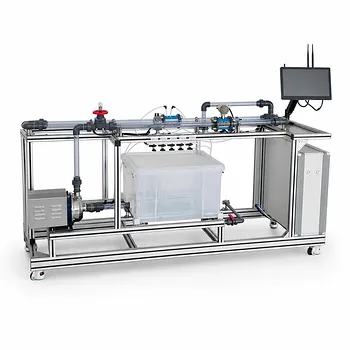
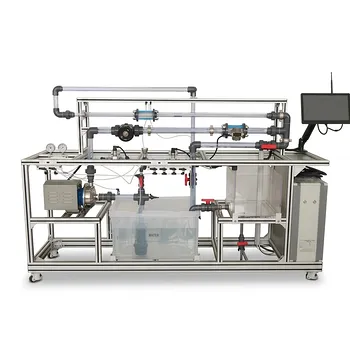
Ensure the absolute accuracy and reliability of your process data. LABPARK provides state-of-the-art Educational and Vocational Unit Operations Pilot Plants in chemical engineering, bioprocess & biotech, and environmental & water treatment for universities, research institutes, and enterprises. Built with high-precision engineering to prevent measurement drift, our systems support seamless scale-up. Contact our experts today to optimize your pilot plant performance!
Related Products
- Orifice and Venturi Flowmeter Calibration Educational Pilot Plant for Fluid Mechanics Laboratory
- Centrifugal Pump Performance and Orifice Flowmeter Calibration Educational Pilot Plant
People Also Ask
- What is the difference between static and stagnation pressure? Master Pilot Plant Flow Measurement
- How do pilot plants demonstrate siphon pressure variations? Visualizing Bernoulli's Energy Balance
- How do fluid mechanics training pilot plants facilitate the visualization and calculation of laminar and turbulent flows?
- How to update chemometric calibration models in pilot plants? Best practices for process engineers.
- Why are the laws of similitude critical in fluid flow pilot plants? Scale Up Safely