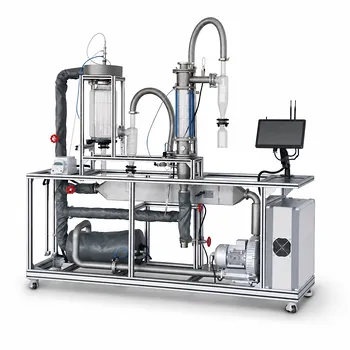
This is a fundamental engineering choice between process integration and process speed, one that pits operational flexibility against superior homogeneity. At its core, a filter dryer excels at processing toxic, potent, or sticky slurries in a single contained vessel, using conductive heating for high energy efficiency, whereas a fluid bed dryer excels at rapidly and uniformly drying free-flowing granules using convective hot air, but at the cost of higher energy consumption and complex gas handling.
The decision isn’t just about moisture removal; it’s a strategic trade-off. Filter dryers solve the deep need for contained processing of challenging slurries with minimal energy loss, but risk mechanical attrition. Fluid bed dryers solve the deep need for rapid, uniform drying of discrete particles, but demand significant energy and are defeated by sticky feeds. At pilot scale, your material’s physical form is the uncompromising dictator of this choice.
Core Principles: Conduction vs. Convection
Understanding how heat reaches your product explains the fundamental differences in performance and limitation.
The Agitated Nutsche Filter Dryer (ANFD)
A filter dryer is a closed-loop, batch system. Heat is transferred via conduction—the product rests directly on a heated jacket. This method is inherently efficient because heat energy moves straight into the solid or wet mass without first needing to heat a massive volume of air. The defining operational advantage is the ability to sequentially filter a slurry, wash the resulting wet cake, and then dry it—all within the same vessel. This makes it the gold standard for containment, isolating operators from potent or toxic compounds.
The Fluid Bed Dryer (FBD)
A fluid bed dryer is an open-loop or recirculating system. It relies on convection—a stream of heated gas passes through a distributor plate, lifting and suspending the solid particles. The resulting fluidized state ensures every particle surface is dramatically exposed to the hot gas. This creates superb heat and mass transfer uniformity and very short drying times. However, the low thermal capacity of gases means you must continuously heat large volumes, which carries an inherent energy penalty.
Material Suitability: The Uncompromising Dictator
The most brilliant process design fails instantly if the physical feed state cannot be handled. This is where the two technologies diverge completely.
When the Feed is a Challenge
The Filter Dryer's Domain (Slurries, Pastes, and Toxics) A fluid bed dryer cannot process a liquid slurry or a sticky paste. A filter dryer can. The primary reference confirms that fluid bed systems are "entirely unsuitable for pasty, sticky, or liquid-like wet feeds." For pilot-scale processes where the feed is a precipitated solid suspended in a solvent, the filter dryer is not just the best choice—it is often the only choice. Its ability to base the entire sequence inside one vessel eliminates the handling problems associated with transferring wet, sticky cakes.
The Particle Size Imperative
The Fluid Bed's Sweet Spot (Granules and Crystals) Fluid bed technology demands a specific particle architecture. The supplementary references sharply define the viable range: between 0.03 mm and 6 mm. For pilot-scale education and development, the ideal window tightens to 0.5–3 mm. Outside this range, physics breaks down. Particles smaller than 20 μm can cause gas channeling and slugging, while particles larger than 8 mm require gas velocities that become economically and practically prohibitive. Filter dryers have no such particle-size limitation for the feed state, as drying relies on contact and mechanical agitation, not aerodynamic suspension. However, this agitation introduces a different penalty.
Energy Efficiency: Beyond the Nameplate Number
Evaluating efficiency requires looking at the total system cost, not just the theoretical heat transfer model.
The Hidden Penalties of Convection
On paper, a fluid bed dryer’s high heat transfer rates suggest good efficiency. In reality, convective drying is systematically less efficient. Heat loss is substantial, both in the exhaust air stream and through the ancillary dust collection systems (cyclones, baghouses) that are mandatory to capture fines. The primary reference explicitly states that fluid bed dryers are "less energy-efficient" and consume "high volumes of inert gas," a critical cost factor at pilot scale if nitrogen purging is required for explosive or oxygen-sensitive materials.
The Confined Efficiency of Conduction
Filter dryers operate at a higher baseline thermal efficiency because they are conductive systems. The energy is targeted directly at the product mass through the heated vessel walls. Crucially, the fully contained vessel eliminates high-volume air handling requirements. There is no massive exhaust stream carrying away latent energy. The trade-off, however, is internal: the mechanical agitation required to mix the cake and renew the heated surface introduces significant mechanical energy (torque) and can generate undesirable fines through particle attrition.
Understanding the Trade-offs
No pilot plant manager ever chose a dryer solely on a spec sheet. They choose based on how the machine handles the product over time.
The Agglomeration vs. Dust Problem
This is the core physical conflict. Filter dryers, with their paddle or agitator action, are known for causing particle attrition (breaking crystals into dust) or, conversely, forcing particles together into hard agglomerates. If your pilot process must deliver a specific particle size distribution (PSD) with zero tolerance for fines, this is a high risk. Conversely, fluid bed dryers are champions of homogeneity, creating separate, uniform dried particles with minimal agglomeration risk. Their dust is often carried away, not generated by crushing.
The Scalability Trap
A filter dryer’s conductive heat transfer relies on the surface-area-to-volume ratio, which scales poorly. A small pilot unit might dry a cake in 2 hours, but a production unit with a thicker cake heel could require 12 hours. You must map the agitation intensity (RPM) and vacuum level meticulously. Fluid bed dryers scale predictably by maintaining the same gas velocity and bed height, but the pilot-scale gas handling and dust collector sizing must still accurately represent the production pressure drops to avoid scale-up failures.
Making the Right Choice for Your Pilot Process
Selection must be a ruthless function of your material's properties and your strategic goals.
- If your primary focus is contained processing of a toxic or potent slurry: Use a filter dryer. The integration of filtration, washing, and drying in one vessel solves the containment problem that no other single system can match.
- If your primary focus is rapid, uniform drying of a defined granular crystal (0.5-3 mm): Choose a fluid bed dryer. Its convective efficiency and scalability in drying time make it unbeatable for high-throughput particle processing.
- If your primary focus is versatility against sticky, pasty, or unpredictable wet feeds: The filter dryer wins by default, but you must design the agitation parameters carefully to minimize the risk of attrition, a process often requiring pilot trials to dial in.
- If your primary focus is minimizing energy costs for a non-sticky, free-flowing material: Look past the inherent convection losses and evaluate the fluid bed’s ability to recycle exhaust heat in a closed-loop system; combine this with the shorter drying time to calculate total cycle energy, which can sometimes offset the continuous gas heating load.
Ultimately, pilot-scale selection is a process of elimination based on constraints—where the sticky feed or the fragile crystal determines the final engineering compromise.
Summary Table:
| Feature | Agitated Nutsche Filter Dryer (ANFD) | Fluid Bed Dryer (FBD) |
|---|---|---|
| Heat Transfer Method | Conduction (direct contact with heated jacket) | Convection (fluidized hot gas stream) |
| Feed Material Suitability | Sticky slurries, pastes, and toxic compounds | Free-flowing granules (typically 0.5–3 mm) |
| Energy Efficiency | High (closed-loop system, minimal heat loss) | Lower (high energy demand for gas heating & exhaust) |
| Process Steps | Integrated filtration, washing, and drying | Drying only (requires prior filtration) |
| Particle Impact | Risk of mechanical attrition or agglomeration | Maintains particle size homogeneity |
Optimize Your Process Scale-Up with LABPARK
Choosing the right drying technology is critical for successful process scale-up and hands-on learning. LABPARK provides industry-grade Educational and Vocational Unit Operations Pilot Plants in chemical engineering, bioprocess & biotech, and environmental & water treatment.
Specifically engineered for universities, research institutes, and enterprises, our pilot plants enable students and researchers to master conduction and convection drying principles in a safe, controlled environment.
Ready to upgrade your lab's capabilities? Contact LABPARK today to find the ideal pilot plant solution for your needs!
Related Products
- Multi-Functional Drying Educational Unit Operations Pilot Plant
- Fluidized Bed Gas Solid Catalytic Reaction Educational Pilot Plant
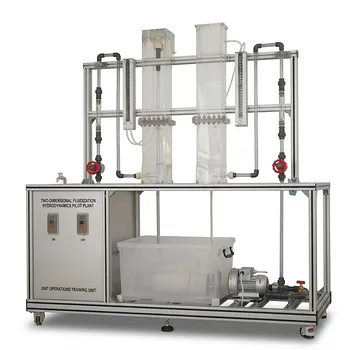
- Two-Dimensional Fluidization Hydrodynamics Educational Pilot Plant for Unit Operations Training
People Also Ask
- Why Use PTFE & Hastelloy in Chemical Pilot Plants? Prevent Corrosion & Ensure Safety
- How to study gasification in pilot plants? Compare exit gas composition & efficiency
- Why is the chemical plant startup schedule crucial? De-risk scale-up with pilot plants.
- How do deviations in estimating latent heat impact pilot plant thermal systems? Avoid hardware mis-sizing.
- When to transition from PID to adaptive control in pilot plants? Key process indicators.