The Phantom in the Beaker
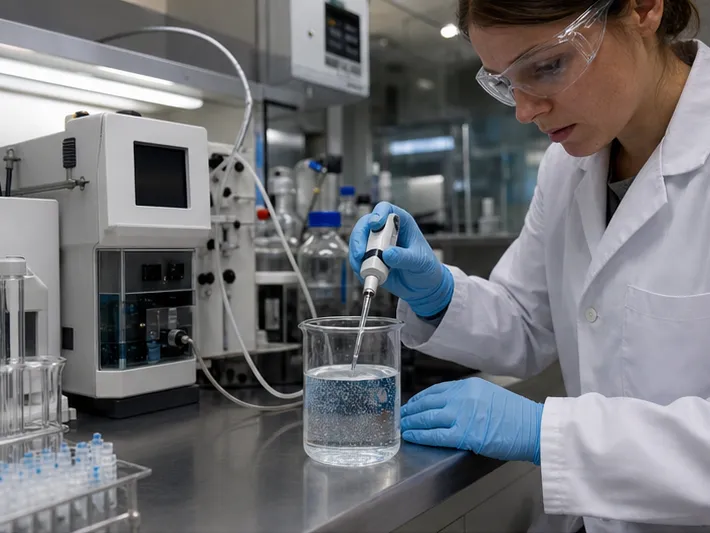
You draw a water sample from a pilot plant’s aeration basin. You bring it to the bench, add a stir bar, and start your phenolphthalein titration. Drop by drop, you wait for the faint pink that says the carbon dioxide is gone.
But the CO₂ was never going to wait for you.
Every second the beaker sits open, the gas diffuses out. Every swirl that mixes your titrant also accelerates the escape. The endpoint you finally see is not the truth. It’s a low, misleading ghost of the real concentration—a systematic error you’ve baked into your process data.
A student learning to run a water treatment pilot plant can spend weeks collecting numbers like these and never realize they are training themselves to underestimate a key variable. The problem isn’t their technique. The problem is the chemistry itself.
Two Forces Working Against You
To understand why measuring dissolved CO₂ is so unforgiving, you have to see two mechanisms happening simultaneously. Neither is complicated. But together, they create a trap that standard titration walks straight into.
A Reaction That Can’t Keep Up
The chemistry is simple on paper: CO₂ + OH⁻ → HCO₃⁻.
In reality, this neutralization is sluggish. Carbon dioxide must first hydrate to carbonic acid before it can react with hydroxide. At the low pH near the endpoint, the local concentration of OH⁻ is vanishingly small, which makes the reaction kinetics even slower. You add a drop, see no color change, add another. By the time the pink finally stabilizes, you’ve added too much titrant—and you’ve been chasing a moving target the whole time.
A Gas That Refuses to Stay
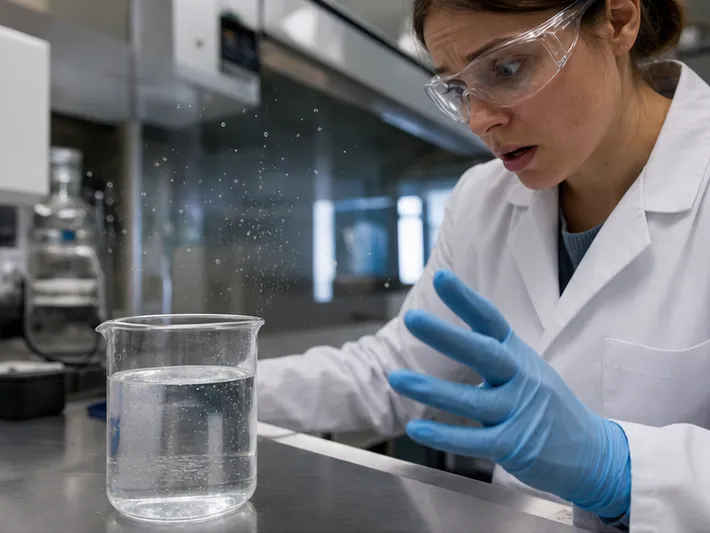
Simultaneously, dissolved CO₂ obeys only one rule: equilibrium with the atmosphere. In most pilot plant waters—whether from a chemical scrubber, a fermentation broth, or a treated wastewater stream—the partial pressure of CO₂ is higher than ambient air. The moment you open the sample to atmosphere, outgassing begins.
Stirring accelerates the loss. So does a warm room. So does the five-second pause you take to read the burette. Every action that helps the titration also helps the analyte flee. It’s a race you’re losing one bubble at a time.
The Psychology of a Bad Measurement
Morgan Housel would call this a problem of compounding ignorance. A small analytical bias—say, a 15% low CO₂ reading—doesn’t announce itself. It just quietly distorts every decision downstream.
If you’re a researcher sizing a decarbonation tower, you’ll undersize it. If you’re an operator fine-tuning lime dosing for corrosion control, you’ll underdose. If you’re a student plotting a carbon balance for a bioprocess, you’ll conclude the culture is respiring less than it really is. None of these errors scream for attention. They just degrade the quality of every conclusion you draw.
And the worst part? The more skilled you become at a slow, careful dropwise titration, the more CO₂ you lose. The technique that feels precise is actually the source of the error.
The Solution: Stop Titrating, Start Trapping
The two-step procedure doesn’t try to make the reaction faster or the gas slower. It changes the order of operations so that the CO₂ is chemically locked before it can escape.
Step 1: The Reconnaissance Pour
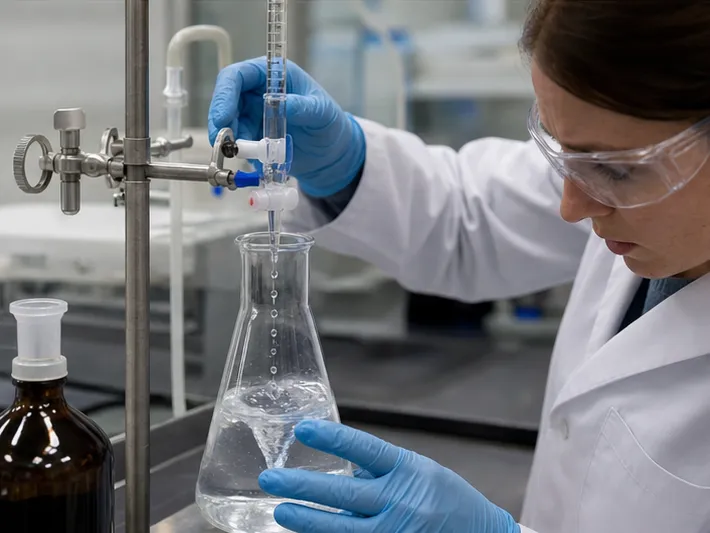
Take your first sample. Titrate it at a normal pace, using phenolphthalein, until the faint pink endpoint. Accept right now that this number is wrong—an intentional underestimation. It’s a scout, not a measurement. Its only job is to tell you roughly how much standard alkali the water needs.
This mental reframing matters. You’re not doing a bad titration; you’re gathering intelligence.
Step 2: The Instant Overwhelm
Now draw a fresh, undisturbed sample. Take the entire volume of alkali you learned from Step 1 and add it all at once. Not dropwise. A confident, single pour.
What happens next is the chemical equivalent of a flash freeze. The sudden high concentration of hydroxide overwhelms the slow kinetics. It drives a near-instantaneous conversion:
CO₂ + OH⁻ → HCO₃⁻
Before the gas molecules can reach the water’s surface, they’ve been transformed into non-volatile bicarbonate ions. You’ve taken a fugitive species and turned it into a stable, titratable one. Only then do you finish the titration to a precise endpoint, without the clock ticking against you.
What the Two-Step Procedure Actually Does
| Step | Action | Purpose | Risk |
|---|---|---|---|
| Scout Titration | Normal-speed titration to first pink | Find approximate alkali demand | Undershoots due to CO₂ loss |
| Rapid Fixation | Bulk addition of that full volume to fresh sample | Lock CO₂ as bicarbonate instantly | Overshoot if scout was badly off |
Why This Matters in a Pilot Plant
A pilot plant is a learning engine. It’s where students, operators, and process engineers build the intuition they’ll carry into full-scale facilities. When that engine runs on flawed analytical data, it generates flawed intuition.
Teaching the two-step procedure is not about adding a 30-second trick to a lab manual. It’s about embedding a systems-thinking mindset: Understand what you’re measuring, understand how it behaves outside the pipe, and engineer your method around that behavior.
The Real-World Implications of Getting It Wrong
Use the wrong method, and you’ll see “stable” CO₂ levels that are actually drifting down with every sample. You’ll calibrate online sensors to a false baseline. You’ll make process adjustments that solve imaginary problems while the real ones—scaling, corrosion, carbon imbalance—compound silently.
When the measurement error is systematic, no amount of data volume fixes it. You just get more confident in the wrong number.
The Role of the Right Pilot Plant System
None of this analytical finesse matters if the water you’re sampling doesn’t represent a real process. A glass beaker in a sterile teaching lab can’t teach the messiness of an industrial water treatment line—the varying CO₂ loads, the temperature swings, the biological activity that shifts equilibrium minute by minute.
That’s why the most effective way to teach this technique is to embed it in a working unit operations pilot plant that generates genuine process water. Students need to experience drawing a hot, turbid sample from an aeration tank or a decarbonation column, racing it to the bench, and executing the two-step fixation with the same urgency they’ll need in a plant.
A pilot plant designed for education and vocational training transforms analytical chemistry from a recipe-following exercise into a problem-solving discipline. It makes the CO₂ loss real—not because the instructor says so, but because the student can measure the difference between a slow titration and a rapid fixation and see the 20% gap with their own eyes.
That’s the moment the lesson sticks. Not as theory, but as something their own hands have proven.
Choosing the Right Platform for This Kind of Learning
Not all pilot plants are built for this. A research-only skid might be too delicate, a full-scale industrial simulator too opaque. What’s needed is a transparent, modular system where the water chemistry is accessible, the sampling points are designed for training, and the process conditions can be varied enough to make analytical choices matter.
LABPARK’s Educational and Vocational Unit Operations Pilot Plants serve exactly this function. Built for universities, research institutes, and enterprises in chemical engineering, bioprocess, biotechnology, and environmental and water treatment, these systems place real industrial processes at the scale and openness that deliberate practice requires.
- Students can sample from real aeration basins, chemical dosing loops, or membrane systems, facing the same CO₂ volatility they’ll encounter in industry.
- Instructors can design curriculum around critical analytical techniques—like the two-step CO₂ titration—that textbooks mention but only real flowing water can teach.
- Research teams gain a platform where analytical rigor translates directly into process insight, because the water they’re testing is the same water they’re treating.
A pilot plant that hides its chemistry behind sealed sensors and automated analyzers teaches students to trust numbers they never learned to question. A system that demands they get their hands wet, race a gas, and own the result builds a different kind of engineer.
The Engineer’s Romance of a Well-Timed Pour
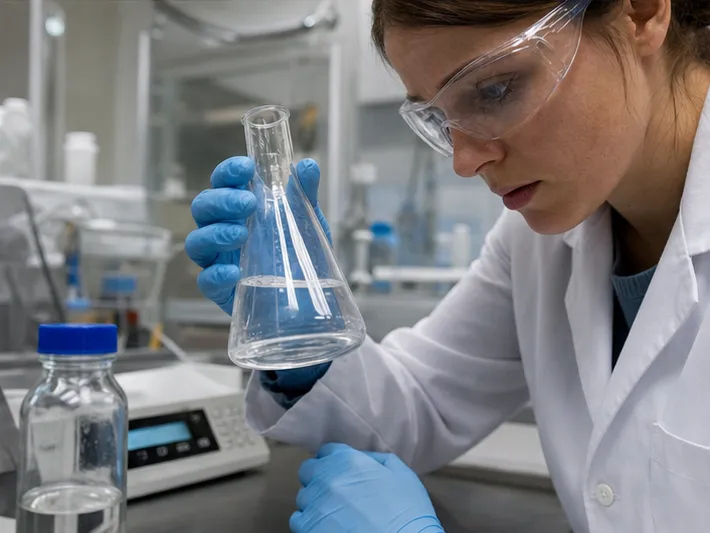
There’s something beautiful about the two-step titration when you get it right. The first step is humility—admitting your initial measurement is wrong and using it deliberately. The second step is conviction—committing an entire volume of reagent in one motion, trusting your chemistry to be faster than a dissolving gas.
That’s the kind of moment that makes an engineer fall in love with process control. It’s not about the pink color. It’s about understanding a system so thoroughly that you can outsmart its physics with a single, decisive action.
If you want to build that understanding in your students or your team, give them water that moves, that off-gasses, that defies lazy measurement. Then give them the tools and the system to conquer it.